Best T8 for Succulents and Cacti
Finding the best T8 for succulents and cacti means balancing spectrum, intensity, and coverage. This guide covers everything you need to choose the right fixture and bulbs for thriving desert plants indoors.
Growing succulents and cacti indoors can feel tricky at first. These sun-loving plants evolved in bright, open deserts. They crave intense light. Without it, they stretch, fade, and weaken. That is where a good grow light comes in. If you have been searching for the best T8 for succulents and cacti, you are in the right place. T8 fluorescent tubes are a popular choice. They are affordable, widely available, and fit standard fixtures. But not all T8 bulbs work well for desert plants. You need the right spectrum, the right output, and the right setup. This guide walks you through everything. We will cover what to look for, which products perform best, and how to avoid common mistakes. Let us dive in.
You might wonder why T8 specifically. T8 refers to the tube diameter. It is one inch, or eight-eighths of an inch. T8 bulbs are more efficient than older T12 tubes. They run cooler. They last longer. They fit in most shop lights and grow light fixtures. For a home grower, they strike a great balance. You get decent output without the heat or cost of high-intensity discharge lights. LEDs are great too, but quality T8 setups remain a solid, budget-friendly option. Especially if you already have fixtures. The key is picking the right bulbs and using them correctly. We will show you how.
Key Takeaways
- Full spectrum is essential: Look for T8 bulbs with a color temperature between 5000K and 6500K to mimic natural sunlight for succulents and cacti.
- High output matters: Choose high-output (HO) or very high-output (VHO) T8 fixtures to deliver enough light intensity for compact growth.
- Distance affects results: Keep T8 lights 6 to 12 inches above your plants for optimal photosynthesis without stretching.
- Duration counts: Run lights 12 to 14 hours daily for most succulents and cacti, adjusting seasonally for best results.
- Fixture quality varies: Invest in fixtures with good reflectors and ballasts to maximize light efficiency and bulb lifespan.
- Supplement when needed: Combine T8 lighting with natural window light for the best growth during darker months.
- Monitor plant response: Watch for signs of too much or too little light and adjust your setup accordingly.
Quick Answers to Common Questions
What color temperature T8 bulb is best for succulents and cacti?
6500K (daylight) is ideal. It provides strong blue wavelengths that keep growth compact and colorful. Avoid 3000K to 4100K bulbs.
How close should T8 lights be to succulents?
8 to 12 inches above the canopy is the sweet spot. Closer increases intensity but reduces coverage and raises heat. Use adjustable hangers.
How many hours per day should I run T8 grow lights?
12 to 14 hours daily for most succulents and cacti. Use a timer for consistency. Reduce to 10 hours in winter if mimicking seasonal changes.
Do I need high-output (HO) T8 bulbs?
HO bulbs (44-54W) deliver 50% more light per tube. They are great if you want fewer fixtures. Standard 32W tubes work fine if you use four per fixture and keep them close.
How often should I replace T8 grow bulbs?
Replace standard T8 bulbs every 12 months. HO T8 bulbs every 18 months. Output drops 20-30% in the first year even if they still look bright.
📑 Table of Contents
Understanding T8 Lighting for Succulents and Cacti
What Makes T8 Different from Other Fluorescent Tubes
T8 tubes measure one inch in diameter. The “T” stands for tubular. The number indicates eighths of an inch. So a T12 is twelve-eighths, or one and a half inches. A T5 is five-eighths of an inch. T8 sits in the middle. It became the standard for commercial lighting in the 1990s. It uses electronic ballasts. These are more efficient than the magnetic ballasts in old T12 fixtures. T8 bulbs typically range from 17 to 32 watts for four-foot lengths. High-output versions can push 44 to 54 watts. For plants, wattage matters. But spectrum matters more. A standard office T8 at 3500K or 4100K will not cut it. You need daylight spectrum. We will explain why in the next section.
Why Succulents and Cacti Need Strong Light
Desert plants grow in full sun. They receive intense, direct light for many hours daily. Their tissues are adapted to high light levels. In low light, they etiolate. That means they stretch toward the light source. Stems become weak and pale. Leaves space out. Rosettes open up and flatten. Color fades. Growth slows. The plant becomes vulnerable to pests and rot. A windowsill often fails to provide enough intensity. Even a south-facing window filters UV and reduces intensity. Glass blocks a lot of usable light. Winter days are short. Cloudy weeks happen. Supplemental lighting fixes this. The best T8 for succulents and cacti delivers the intensity and spectrum these plants expect. It keeps them compact, colorful, and healthy year-round.
How Fluorescent Light Works for Plants
Fluorescent tubes produce light by exciting mercury vapor. This creates ultraviolet light. The UV hits a phosphor coating inside the tube. The phosphor glows, producing visible light. Different phosphor blends create different color temperatures. Color temperature is measured in Kelvin (K). Lower Kelvin (2700K to 3000K) looks warm and yellow. Higher Kelvin (5000K to 6500K) looks cool and blue-white. Plants use mostly blue and red wavelengths. Blue drives compact, leafy growth. Red drives flowering and stem elongation. For vegetative succulents and cacti, you want strong blue output. A 6500K “daylight” bulb provides this. Some growers mix a 6500K with a 3000K bulb for broader spectrum. But a single high-quality 6500K T8 often works fine for foliage-focused plants.
Why Light Spectrum Matters for Desert Plants
Blue Light Keeps Growth Compact
Blue wavelengths (400 to 500 nanometers) signal to the plant that light is abundant. The plant responds by staying short and stocky. Internodes stay tight. Leaves grow thick. This is exactly what you want for succulents and cacti. Etiolation is the enemy. Blue light suppresses stem elongation. It promotes chlorophyll production. It enhances color in many species. Echeveria, Sedum, and Graptopetalum show deeper hues under strong blue light. Cacti spines grow denser. A 6500K T8 bulb peaks in the blue region. This makes it ideal. Avoid “warm white” or “soft white” bulbs. They lack blue energy. Your plants will stretch toward them.
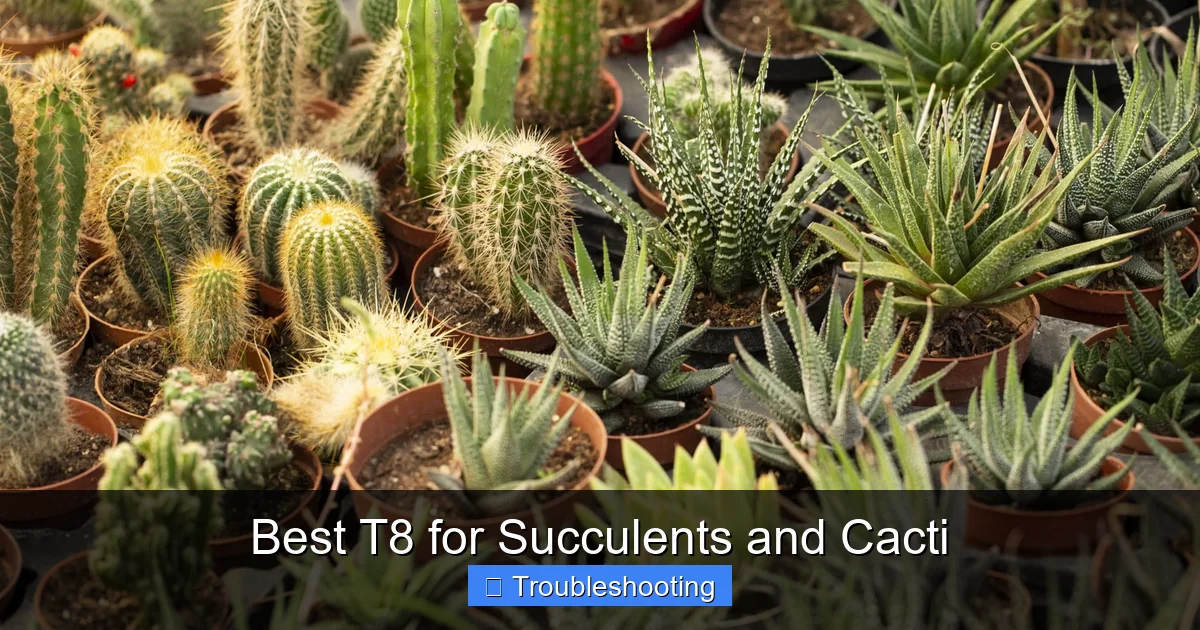
Visual guide about Best T8 for Succulents and Cacti
Image source: buchanansplants.com
Red Light Has a Role Too
Red wavelengths (600 to 700 nanometers) drive photosynthesis efficiently. They also trigger flowering. Some cacti need red light to bloom. But too much red without blue causes stretching. That is why “bloom booster” bulbs (heavy red) are risky for vegetative growth. A balanced full-spectrum bulb includes both. Many 6500K T8 bulbs have a decent red shoulder in their output. If you want flowers, you can supplement with a small red LED strip. But for general growth, a strong daylight T8 covers the bases. The best T8 for succulents and cacti usually means a high-CRI, 6500K tube. CRI stands for Color Rendering Index. Higher CRI (90+) means the spectrum is smoother and more natural. Plants benefit from this completeness.
Understanding PAR and PPFD for T8
PAR stands for Photosynthetically Active Radiation. It is the 400 to 700 nm range plants use. PPFD is Photosynthetic Photon Flux Density. It measures how many PAR photons hit a square meter per second. Units are micromoles per meter squared per second (µmol/m²/s). Succulents and cacti want 150 to 300 µmol/m²/s for good growth. Some high-light cacti want more. A single 32W T8 at 12 inches might give 80 to 120 µmol/m²/s. Two tubes double that. Four tubes can hit 300+. Distance matters hugely. At 6 inches, intensity quadruples compared to 12 inches (inverse square law). But heat and light spread change too. We will cover setup geometry later. For now, know that more tubes, closer placement, and higher-output bulbs increase PPFD.
Key Features to Look for in a T8 Grow Light
Color Temperature: Aim for 5000K to 6500K
This is the single most important spec. Check the box. It must say 5000K, 6500K, or “Daylight.” Avoid 3000K, 3500K, 4100K, or “Cool White.” Those are for offices and kitchens. They lack blue punch. Some bulbs are labeled “Plant & Aquarium” or “Grow.” These often have a purplish tint. They emphasize red and blue peaks. They can work, but they make plants look weird. A plain 6500K high-CRI tube looks natural and grows great plants. If you see “Full Spectrum” on the package, verify the Kelvin rating. Marketing terms lie. Numbers do not. The best T8 for succulents and cacti will always state 5000K to 6500K clearly.
High Output (HO) and Very High Output (VHO) Options
Standard T8 bulbs are 32 watts (four feet). High Output (HO) T8s run at 44 to 54 watts. They need special HO ballasts. Very High Output (VHO) tubes push 95 to 110 watts. They are rare now. HO T8 is the sweet spot for growers. You get 50% more light per tube. Fixtures cost a bit more. But you need fewer tubes for the same intensity. That means less clutter, less wiring, less heat. If you are building new, buy HO fixtures. If you have standard fixtures, you can still get good results with four standard tubes. Just keep them close. Check your ballast label. It must match the bulb type. Mismatched bulbs and ballasts fail fast. They can even be dangerous.
CRI (Color Rendering Index) Matters More Than You Think
CRI measures how accurately a light reveals colors compared to sunlight. Sunlight is 100. Cheap fluorescents hit 70 to 80. Good ones hit 90 to 98. High CRI means the phosphor blend is broad and smooth. There are no big gaps in the spectrum. Plants evolved under full spectrum. Gaps mean missing wavelengths. Some wavelengths regulate specific processes. UV-A (315 to 400 nm) can enhance color and stress tolerance. Far-red (700 to 750 nm) affects shade avoidance. A high-CRI 6500K bulb includes traces of both. Low-CRI bulbs spike at a few wavelengths and miss the rest. For the best T8 for succulents and cacti, choose 90+ CRI. Brands like Philips, GE, and Waveform Lighting publish CRI data. Generic hardware store brands often do not.
Fixture Reflectors Make a Huge Difference
A bare bulb wastes half its light upward. A good reflector directs that light down to your plants. Specular aluminum reflectors are best. They act like mirrors. White painted reflectors are okay. Bare metal or no reflector is poor. Some shop lights have flimsy reflectors. You can upgrade them. Adhesive Mylar or aluminum tape works. Or buy a dedicated grow light fixture with a deep, polished reflector. The difference can be 40% more light on the canopy. That is like adding a free tube. When shopping, look at the reflector design. Deep channels beat flat wings. Adjustable angles help you shape the light footprint. Do not overlook this. A great bulb in a bad fixture underperforms a good bulb in a great fixture.
Ballast Type: Electronic Beats Magnetic
Electronic ballasts run at high frequency (20,000+ Hz). No flicker. No hum. They start instantly in cold temps. They are 10 to 15% more efficient. They extend bulb life. Magnetic ballasts run at 60 Hz. They flicker (imperceptible to us, but plants notice). They hum. They struggle in cold garages. They waste energy as heat. Almost all new T8 fixtures use electronic ballasts. If you are using an old shop light, check. Magnetic ballasts are heavy. Electronic are light. The label will say “Electronic Ballast” or show a frequency rating. For the best T8 for succulents and cacti, electronic is non-negotiable. Your plants will grow steadier. Your bulbs will last longer. Your electricity bill will be lower.
Top T8 Fixtures and Bulbs for Succulents and Cacti
Best Overall Four-Foot Fixture: Hydrofarm FLT44
The Hydrofarm FLT44 is a workhorse. It holds four T8 tubes. It has a deep, specular aluminum reflector. The ballast is electronic and runs cool. It includes hanging chains and hooks. The powder-coated steel housing is sturdy. It fits standard 32W T8 bulbs. You can also run 25W or 28W energy-saver tubes. The footprint covers roughly 2 by 4 feet at 12 inches height. At 6 inches, intensity jumps but coverage narrows. For a succulent shelf, this fixture is hard to beat. Price sits around $80 to $100. Bulbs sold separately. Pair it with four 6500K high-CRI tubes. You get a professional-grade setup for under $150 total. Many commercial growers use these for propagation. They last for years.
Best Budget Two-Foot Option: Barrina T8 LED Integrated Fixtures
Wait, LED? Yes. Barrina makes T8-shaped LED fixtures. They look like fluorescent tubes but have built-in LEDs. No ballast. No bulb changes. They link together end-to-end. Each two-foot bar draws 20 watts. Output is around 2500 lumens at 5000K or 6500K. CRI is 80+. Not perfect, but good for the price. A four-pack costs about $60. You get 80 watts total over four feet. That rivals four 32W fluorescents at half the power. They run cool. They are damp-rated. Great for shelves. If you want true fluorescent, look at the Lithonia Lighting 2-light T8 shop light. About $35. Add two 6500K bulbs ($10 each). Total $55. Less intense than the Hydrofarm, but fine for a small collection.
Best High-Output Bulb: Philips 865 HO 54W T8
If you have an HO fixture, this is the bulb. Philips 865 series. 6500K. CRI 85. 54 watts. 5000 lumens initial. 36,000-hour rated life. The “865” code means 85 CRI, 6500K. These are commercial grade. They cost $12 to $15 each. You need an HO ballast. Do not put them in a standard fixture. They will overheat and fail. In the right fixture, they are beasts. Four of these deliver 20,000 lumens. That is serious light. PPFD at 12 inches can exceed 300 µmol/m²/s. Your cacti will thank you. The best T8 for succulents and cacti in high-output form is arguably this bulb. GE and Sylvania make equivalents. Look for “865” or “965” (90 CRI) on the label.
Best Standard Output Bulb: GE Sunshine 6500K 32W T8
For standard fixtures, the GE Sunshine (F32T8/865 or /965) is a top pick. 6500K. 85 or 90 CRI. 2950 to 3100 lumens. 24,000 to 30,000 hours. Widely available at Home Depot, Lowe’s, and online. About $8 to $12 per bulb. Buy a 10-pack for savings. These are not “grow” bulbs. They are premium office lighting. But the spectrum is perfect. High blue. Smooth phosphor. Plants love them. I have run these for years. They hold output well. They start reliably in cool rooms. If you want the best T8 for succulents and cacti without buying special fixtures, this is it. Four of these in a good reflector fixture will grow beautiful succulents.
Best Specialty “Grow” Bulb: Waveform Lighting 965 T8
Waveform Lighting makes bulbs specifically for plants. Their 965 T8 is 6500K, 95 CRI. 32W standard, 44W HO versions exist. The spectrum is engineered. They boost 450nm blue and 660nm red slightly. They add a touch of UV-A and far-red. The result is a very complete spectrum. CRI 95 is exceptional for fluorescent. They cost $18 to $22 each. Pricey. But you see the difference. Colors pop. Growth is tight. Flowering improves. If you have rare or show plants, these are worth it. For a large collection, the cost adds up. But for a prized shelf, they are the best T8 for succulents and cacti you can buy. Waveform publishes full spectral charts. Transparency builds trust.
Honorable Mention: Sunblaster T8 6400K with NanoTech Reflector
Sunblaster makes a T8 strip light with a built-in NanoTech reflector. The reflector uses a nano-particle coating. It claims 97% reflectivity. The fixture includes a 6400K T8 bulb. It links to other units. It has a built-in ballast. Very easy to install. Output is decent for a single tube. About 2800 lumens. Good for supplementing a window. Or for a narrow shelf. Not enough alone for high-light cacti. But the reflector tech is clever. If you want plug-and-play simplicity, this works. Price is around $30 per two-foot unit. Four feet would be two units, $60. Plus bulbs eventually. A solid mid-range choice.
Setting Up Your T8 Lighting System
Choosing the Right Location
Pick a spot with stable temperatures. Succulents and cacti like 65 to 80°F. Avoid drafty windows in winter. Avoid hot radiators. A basement shelf works great. A spare room. A garage if heated. You need access to power. A timer outlet is essential. More on that later. The area should be easy to reach for watering and inspection. Light spills. If you are in a living space, consider a grow tent or reflective walls. Mylar, panda film, or even white paint helps. It bounces stray light back to plants. This can boost effective intensity by 20 to 30%. For the best T8 for succulents and cacti results, control your environment. A dedicated grow space beats a random corner every time.
Mounting Height and Coverage Geometry
This is where many growers go wrong. They hang lights too high. T8 output drops fast with distance. At 12 inches, a four-tube fixture might give 200 µmol/m²/s. At 18 inches, it drops to 90. At 6 inches, it jumps to 400. But 6 inches is tight. Heat builds. Airflow suffers. Plants at the edges get less light. The sweet spot is 8 to 12 inches for most setups. Use adjustable hangers. Chains or ratchet hangers let you raise the fixture as plants grow. Keep the canopy flat. Rotate pots weekly. If you have tall and short plants, put tall ones at the edges. Short ones in the center. Or use risers (upside-down pots, blocks) to bring short plants closer. Even light = even growth.
Photoperiod: How Long to Run Lights
Desert plants expect long days. 12 to 14 hours is standard. 10 hours minimum. 16 hours max for vegetative growth. Some growers do 12 on, 12 off year-round. Others mimic seasons. Spring: 12 hours. Summer: 14 hours. Fall: 12 hours. Winter: 10 hours. This can trigger flowering in some cacti. A simple mechanical or digital timer handles this. Cost: $10 to $20. Plug the fixture into the timer. Plug timer into wall. Set and forget. Consistency matters. Plants track day length. Irregular schedules stress them. For the best T8 for succulents and cacti performance, use a timer. Do not rely on memory. Life gets busy. Plants notice.
Airflow and Heat Management
T8 fixtures produce heat. Not as much as HID, but enough. Electronic ballasts run warm. Bulbs get hot to the touch. In a closed shelf, heat accumulates. Stagnant air invites fungal issues. It also slows transpiration. Plants need moving air. Add a small clip fan. Point it across the canopy, not directly at plants. Oscillating is best. Run it 24/7 or on the same timer as lights. This strengthens stems. It prevents hot spots. It keeps leaf temperature close to air temperature. If your fixture has a built-in fan (some Hydrofarm models do), use it. But a separate fan is better. Aim for a gentle breeze. Leaves should flutter slightly. This one step prevents so many problems.
Watering Under Lights
Light drives photosynthesis. Photosynthesis drives water uptake. Under good T8 light, plants drink more. Soil dries faster. Check every few days. Stick a finger in the soil. Or lift the pot. Light pot = dry. Heavy pot = wet. Most succulents want to dry completely between waterings. Cacti even more so. But “completely dry” does not mean “bone dry for weeks.” It means the root zone is dry. Then water thoroughly. Let excess drain. Never let pots sit in water. Under lights, the cycle speeds up. You might water weekly instead of bi-weekly. Adjust to your conditions. The best T8 for succulents and cacti will increase your plants’ metabolism. Feed them accordingly. But always err on the side of underwatering. Rot kills faster than drought.
Fertilizing Under Artificial Light
Indoor plants lack soil microbes and rain. They need fertilizer. But lightly. Use a balanced fertilizer (10-10-10 or 20-20-20) at 1/4 strength. Or a cactus-specific formula. Apply every other watering during active growth. Stop in winter if growth slows. Flush pots monthly with plain water to prevent salt buildup. White crust on soil or pot rim means salts. Flush heavily. Under T8 lights, growth can continue year-round. If so, fertilize year-round at reduced rate. Watch for tip burn. That is fertilizer burn. Cut back. The best T8 for succulents and cacti creates ideal growing conditions. But nutrients must match light. Too much fertilizer + high light = weak, stretchy growth. Balance is key.
Common Mistakes and How to Fix Them
Mistake 1: Using “Shop Light” Bulbs (4100K Cool White)
This is the number one error. You buy a shop light fixture. It comes with bulbs. They are 4100K “Cool White.” You think, “Cool white sounds bright.” It is not. It is green-heavy. Blue-deficient. Your succulents stretch. They turn pale green. They lean hard toward the tubes. Fix: Replace bulbs immediately. Buy 6500K “Daylight” or “Sunshine” tubes. Keep the fixture if the reflector is decent. If not, add Mylar. The best T8 for succulents and cacti starts with the right bulb. Do not skip this. It costs $20 to $40 for four bulbs. It saves months of poor growth.
Mistake 2: Hanging Lights Too High
You hang the fixture 18 to 24 inches up. Maybe to cover a wider area. Maybe heat concerns. Maybe aesthetics. Result: Light intensity at canopy is 50 to 80 µmol/m²/s. That is shade levels. Plants etiolate. They grow long, weak, floppy. Fix: Lower the lights. 8 to 12 inches. Use ratchet hangers. If heat is an issue, add a fan. If coverage is narrow, add a second fixture side-by-side. Two fixtures at 10 inches beat one at 20 inches every time. Light follows inverse square law. Distance kills intensity exponentially. The best T8 for succulents and cacti setup puts light close.
Mistake 3: Running Lights Too Few Hours
You run lights 8 hours. Or you turn them on when you wake up, off when you sleep. Irregular. Plants get confused. They need consistent day length. 8 hours is too short for desert plants. They barely maintain. Fix: Set a timer. 12 hours minimum. 14 hours better. Same on/off time daily. If you want to mimic winter, gradually reduce over weeks. Do not jump from 14 to 8 overnight. The best T8 for succulents and cacti schedule is consistent and sufficient.
Mistake 4: Overcrowding Plants Under One Fixture
You have a four-foot fixture. You cram 20 pots under it. Plants shade each other. Lower leaves die. Airflow stops. Pests spread. Rot starts. Fix: Space pots. Leave air gaps. Use multiple shelves with multiple fixtures. Or fewer plants. A crowded “jungle” looks cool but grows poorly. Each rosette needs its own light cone. If leaves touch, they are too close. The best T8 for succulents and cacti environment gives every plant breathing room.
Mistake 5: Ignoring Bulb Aging
Fluorescent bulbs dim over time. They lose 20 to 30% output in the first year. Spectrum shifts too. Red phosphors degrade faster. After 12 to 18 months, your 6500K bulb acts like a 5000K bulb. Less blue. Plants slowly stretch. You do not notice day to day. Fix: Mark install date on bulb with Sharpie. Replace standard T8 annually. HO T8 every 18 months. Or use a light meter (phone apps work roughly). If PPFD drops 25%, swap bulbs. The best T8 for succulents and cacti maintenance plan includes scheduled bulb changes.
Mistake 6: No Dark Period (24/7 Light)
You think more light = more growth. You run lights 24 hours. Plants need dark. Respiration happens in dark. Hormones reset. Cell repair occurs. Continuous light causes oxidative stress. Growth slows. Plants get “tired.” Fix: Always have a dark period. 8 to 12 hours minimum. Use a timer. No exceptions. The best T8 for succulents and cacti regimen respects the night.
Advanced Tips for Maximum Results
Supplementing with Natural Light
If you have a bright window, use it. T8 fills the gaps. Winter days are short. Cloudy days are dim. Run T8 on a timer to extend day length. Morning and evening. Or run T8 all day on cloudy days. A light sensor can automate this. But a simple timer set for 14 hours (6 AM to 8 PM) works fine. The window provides a boost. The T8 provides consistency. Together they are powerful. The best T8 for succulents and cacti strategy often combines both. Just watch for overheating in direct sun + artificial light. Adjust distance or duration.
Using Light Movers for Even Coverage
Light movers slowly slide the fixture back and forth. Or rotate it. This eliminates shadows. Every leaf gets direct light at some point. It mimics the moving sun. It can increase effective coverage by 30%. Light movers cost $100 to $200. For a serious setup, they are worth it. You can use fewer fixtures. Plants grow more symmetrically. The best T8 for succulents and cacti commercial growers often use movers. For home, it is a luxury. But a cool one.
Adding UV-B for Stress Colors
Some succulents (Echeveria, Aeonium, Sedum) develop intense reds and purples under UV stress. Standard T8 blocks UV. The glass absorbs it. You can add a UV-B reptile bulb (like Zoo Med ReptiSun 5.0 T8). Run it 1 to 2 hours daily. Or use a UV-B LED strip. Be careful. Too much UV damages DNA. Humans too. Wear eye protection. Do not look at the bulb. This is advanced. Not for beginners. But it unlocks show-quality color. The best T8 for succulents and cacti color enhancement includes controlled UV.
CO2 Enrichment: Overkill for Most
Some growers add CO2. It boosts photosynthesis if light, water, and nutrients are maxed. For T8 levels, CO2 rarely helps. Light is the limiting factor. CO2 only helps when light saturates the leaf. T8 rarely saturates high-light succulents. Skip CO2. Spend money on better bulbs or more fixtures. The best T8 for succulents and cacti investment is light, not gas.
Monitoring with a PAR Meter
A PAR meter measures PPFD. Real ones cost $200+. Phone apps (Photone, PPFD Meter) use the camera. They are surprisingly decent for relative measurements. Calibrate against a known source if you can. Measure at canopy level. Map your footprint. Find hot spots and dark corners. Adjust fixture height or plant placement. Data beats guessing. The best T8 for succulents and cacti grower knows their numbers.
Conclusion
Finding the best T8 for succulents and cacti does not have to be complicated. Start with the basics. Choose 6500K high-CRI bulbs. Use a fixture with a good reflector. Hang it 8 to 12 inches above your plants. Run it 12 to 14 hours on a timer. Add a fan for airflow. Water and fertilize appropriately. Replace bulbs yearly. That formula grows amazing succulents and cacti. You do not need the most expensive gear. You need the right gear used correctly. A $100 setup with good bulbs beats a $500 setup with wrong bulbs every time.
Remember that every collection is different. Your space, your climate, your species mix. Observe your plants daily. They tell you what they need. Stretching? More light or closer fixture. Bleaching? Too close or too long. Rot? Less water, more air. Slow growth? Check bulb age, spectrum, duration. The best T8 for succulents and cacti is the one you adjust based on feedback. Gardening is a conversation. Listen.
If you are just starting, keep it simple. One good fixture. Four 6500K tubes. A timer. A fan. A shelf of plants. Watch them thrive. Then expand. Add a second shelf. Try HO bulbs. Experiment with UV. The journey is half the fun. Your succulents and cacti will reward you with compact forms, vivid colors, and maybe even flowers. Happy growing.
Frequently Asked Questions
Can I use regular shop light T8 bulbs for succulents?
No. Standard shop light bulbs are usually 4100K “cool white” which lacks the blue spectrum succulents need. They will cause stretching and pale growth. You must replace them with 6500K daylight tubes.
Will T8 lights burn my succulents?
T8 bulbs run cooler than HID or some LEDs, but they can still burn leaves if touching or extremely close (under 4 inches). Keep 8-12 inches clearance and use a fan to manage leaf temperature.
Is T8 better than T5 for succulents?
T5 is more efficient per watt and smaller, but T8 is cheaper, more widely available, and runs cooler. For most home growers, a 4-tube T8 fixture matches a 2-tube T5 at lower cost.
Can I mix different Kelvin T8 bulbs in one fixture?
Yes. Some growers pair a 6500K with a 3000K for broader spectrum. But a single high-CRI 6500K bulb already covers blue and red well. Mixing is optional, not necessary.
Do succulents need a dark period under T8 lights?
Yes. Plants require 8-12 hours of darkness for respiration and hormone regulation. Never run lights 24/7. Use a timer to ensure a consistent dark period every night.
What is the best T8 fixture for a beginner?
A 4-foot, 4-lamp shop light with electronic ballast and specular reflector (like Hydrofarm FLT44 or similar) paired with four GE Sunshine 6500K bulbs gives professional results for under $150.