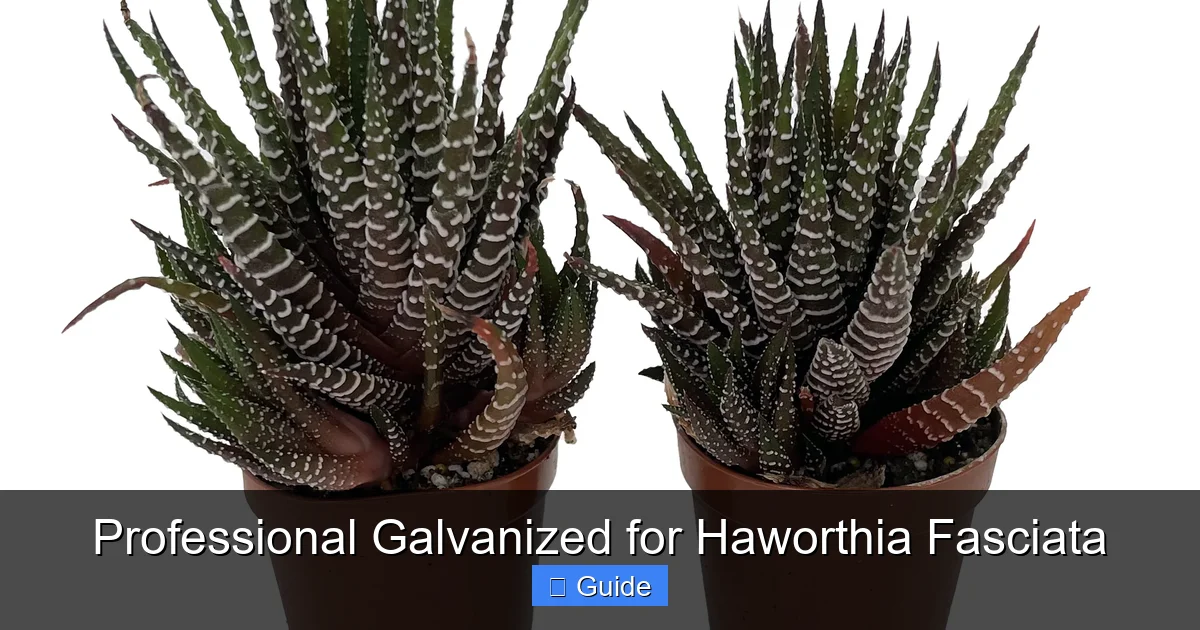
Professional Galvanized for Haworthia Fasciata
Professional galvanized containers offer excellent durability and modern aesthetics for growing Haworthia fasciata. This comprehensive guide covers everything from selecting the right galvanized planter and ensuring proper drainage to creating the ideal soil mix and mastering watering techniques. Learn how to prevent common issues like root rot and zinc toxicity while showcasing your zebra plants in style.
If you’ve been growing Haworthia fasciata for any length of time, you know these striking zebra-striped succulents deserve a container that matches their architectural beauty. Professional galvanized planters have surged in popularity among serious collectors and commercial growers alike, and for good reason. These zinc-coated steel containers bring an industrial-chic aesthetic that perfectly complements the geometric rosettes of zebra plants while offering unmatched durability.
But here’s the thing — growing Haworthia fasciata in galvanized containers isn’t as simple as drilling a few holes and filling them with soil. The unique properties of galvanized metal create specific challenges and opportunities that every grower needs to understand. From managing heat transfer and preventing zinc toxicity to mastering the perfect drainage setup, there’s a learning curve that separates thriving specimens from struggling ones. This guide walks you through everything I’ve learned from years of growing these fascinating plants in professional galvanized setups.
Key Takeaways
- Galvanized planters provide superior durability: Zinc-coated steel resists rust and lasts for decades with proper care, making them a long-term investment for serious succulent growers.
- Drainage is absolutely critical: Without adequate drainage holes and a proper drainage layer, Haworthia fasciata will quickly develop root rot in metal containers.
- Soil mix must be fast-draining: A gritty, porous mix with 50-70% inorganic material prevents water retention that leads to fungal issues in galvanized pots.
- Monitor for zinc leaching: Acidic soil conditions can cause zinc to leach from galvanized surfaces, potentially affecting sensitive Haworthia roots over time.
- Temperature regulation matters: Metal containers heat up and cool down faster than ceramic or plastic, requiring strategic placement to protect roots from extreme temperature swings.
- Elevate containers for airflow: Raising galvanized planters on feet or risers improves air circulation beneath the pot, reducing moisture buildup and heat transfer to roots.
- Regular inspection prevents problems: Check for white mineral deposits, corrosion spots, or plant stress signals monthly to catch issues before they become serious.
Quick Answers to Common Questions
Can I use a regular galvanized stock tank for Haworthia fasciata?
You can, but it requires significant modifications: drilling 10+ drainage holes, adding pot feet for elevation, epoxy-coating the interior to prevent zinc leaching, and filing all sharp edges. Purpose-made horticultural containers save time and perform better.
How often should I water Haworthia in galvanized pots?
Typically every 14-21 days during active growth (spring/fall), and every 3-4 weeks during dormancy (summer/winter). Always verify by checking moisture at root depth, not the surface, as metal containers dry unevenly.
Will the zinc coating harm my Haworthia?
In neutral to slightly alkaline soil (pH 6.5-7.0), zinc leaching is minimal and rarely problematic. Acidic conditions increase leaching risk. Epoxy-coating the interior or maintaining proper pH with dolomitic lime prevents issues.
Do galvanized containers get too hot for Haworthia roots?
Yes, in direct sun they can exceed 120°F. Mitigate by choosing light-colored finishes, elevating on pot feet for airflow, providing afternoon shade, or double-potting inside a larger cache pot with an air gap.
What’s the best soil mix for Haworthia in metal containers?
A mineral-heavy mix: 40% pumice, 20% calcined clay, 20% decomposed granite, 10% coconut coir, 10% composted pine bark. This provides 60% total pore space with excellent drainage and structural stability for years.
📑 Table of Contents
- Understanding Professional Galvanized Containers for Succulents
- Selecting the Right Galvanized Planter
- Preparing Galvanized Containers for Planting
- The Ideal Soil Mix for Galvanized Containers
- Watering Strategies for Metal Containers
- Managing Temperature in Galvanized Planters
- Fertilizing Haworthia in Galvanized Containers
- Repotting and Long-Term Maintenance
- Designing Stunning Displays with Galvanized Planters
- Troubleshooting Common Issues
- Advanced Techniques for Professional Results
- Sourcing Professional Galvanized Containers
- Conclusion
Understanding Professional Galvanized Containers for Succulents
What Makes a Planter “Professional Grade”
Not all galvanized containers are created equal. When we talk about professional galvanized for Haworthia fasciata, we’re referring to containers manufactured specifically for horticultural use — not repurposed stock tanks, water troughs, or decorative buckets from the hardware store. Professional-grade planters feature thicker gauge steel, typically 16 to 14 gauge, with a heavier zinc coating applied through hot-dip galvanization rather than electroplating.
The hot-dip process creates a metallurgical bond between the zinc and steel, resulting in a coating that’s significantly more durable and corrosion-resistant. You’ll notice professional containers have welded seams rather than riveted or bolted construction, eliminating potential leak points. Many also include pre-drilled drainage holes with reinforced edges, saving you the trouble and risk of drilling through the zinc coating yourself.
Why Galvanized Steel Works for Haworthia
Haworthia fasciata evolved in the Eastern Cape of South Africa, growing in rocky crevices with excellent drainage and air circulation around their roots. Professional galvanized containers mimic these conditions surprisingly well when properly prepared. The rigid walls prevent the soil compaction that occurs in flexible fabric pots, maintaining consistent pore space for root respiration.
Metal containers also discourage certain pests. Fungus gnats, which love the consistently moist surface of organic potting mixes, struggle to establish in galvanized planters because the metal heats up quickly in sun, drying the top layer of soil rapidly. This same property helps prevent algae and moss growth on the soil surface — a common issue with Haworthia grown in shade.
Potential Drawbacks to Consider
Before investing in professional galvanized containers, you should understand the trade-offs. Metal conducts heat efficiently, meaning root zone temperatures fluctuate more dramatically than in ceramic, plastic, or wood containers. In summer, a galvanized planter in direct sun can reach soil temperatures exceeding 100°F (38°C), potentially damaging Haworthia roots. Conversely, in winter, the metal offers minimal insulation against freezing temperatures.
There’s also the question of zinc leaching. While the zinc coating protects the steel from corrosion, acidic conditions — whether from acidic potting mixes, fertilizers, or rainwater — can cause small amounts of zinc to dissolve into the soil solution. Haworthia species vary in their sensitivity to heavy metals, but chronic exposure to elevated zinc levels can stunt growth and cause chlorosis in sensitive specimens.
Selecting the Right Galvanized Planter
Size and Proportion Guidelines
Haworthia fasciata has a relatively shallow, fibrous root system that spreads horizontally rather than diving deep. This growth habit means wide, shallow containers work better than deep, narrow ones. For a mature specimen with a 6-inch rosette diameter, look for a planter at least 8-10 inches wide but only 4-6 inches deep. This proportion provides adequate soil volume for stability while minimizing the volume of soil that stays wet after watering.
If you’re creating a mixed planting with multiple Haworthia or combining them with other small succulents, scale up accordingly. A 12-inch diameter bowl-style galvanized planter can comfortably house three to five mature Haworthia fasciata plants with room for offsets to develop. Just remember that larger containers hold more moisture, so your soil mix must be even more free-draining to compensate.
Shape Considerations for Root Health
Tapered containers — wider at the top than the bottom — make repotting significantly easier and reduce root disturbance when you eventually need to refresh the soil. Straight-sided cylinders work fine but require more careful extraction. Avoid containers with inward-curving rims or pronounced shoulders, as these trap moisture and make it impossible to remove the root ball intact.
Bowl-shaped planters with rounded bottoms promote better drainage than flat-bottomed designs because water naturally flows toward the lowest point where the drainage hole should be located. If you choose a flat-bottomed container, ensure it has multiple drainage holes distributed across the bottom, not just a single central hole.
Finish Quality and Coating Thickness
Examine the galvanization quality before purchasing. Run your hand over the interior surface — it should feel smooth with a uniform spangle pattern (the crystalline appearance of the zinc coating). Avoid containers with dull gray patches, rough spots, or visible bare steel, as these indicate thin or damaged coating that will corrode quickly once filled with moist soil.
Professional horticultural containers typically specify coating weight in ounces per square foot (oz/ft²) or grams per square meter (g/m²). Look for G90 coating (0.90 oz/ft² per side) or heavier for maximum longevity. Some premium manufacturers offer G115 or even G140 coatings for extreme environments. The additional cost pays off in decades of service life versus a few years for lighter coatings.
Preparing Galvanized Containers for Planting
Essential Drainage Modifications
Even containers with pre-drilled holes often need additional drainage for Haworthia fasciata. These plants cannot tolerate sitting in saturated soil for more than a few hours. If your planter has fewer than five drainage holes for a 10-inch diameter container, add more. Use a 1/4-inch cobalt drill bit designed for metal, drilling slowly with cutting oil to prevent overheating the zinc coating.
Space holes evenly across the bottom, with at least one hole within an inch of each corner or curve. For round containers, imagine a clock face and drill at 12, 3, 6, and 9 o’clock positions, plus the center. After drilling, deburr each hole carefully with a metal file or deburring tool. Sharp edges can damage landscape fabric and restrict water flow.
Creating a Functional Drainage Layer
Skip the traditional gravel layer — it actually impedes drainage by creating a perched water table. Instead, cut a piece of heavy-duty landscape fabric or weed barrier to fit the bottom of your container, extending slightly up the sides. This prevents soil from washing out while allowing unrestricted water movement.
On top of the fabric, add a 1-inch layer of coarse horticultural pumice or expanded shale (3/8 to 1/2 inch particle size). These materials maintain structural integrity indefinitely, unlike perlite which crushes over time. The coarse particles create large pore spaces that facilitate rapid water exit while holding minimal moisture themselves.
Protecting the Zinc Coating
Before adding soil, consider applying a food-grade epoxy coating to the interior surfaces, especially if you plan to use acidic potting mixes or fertilizers. Products like Pond Armor or similar fish-safe epoxies create an inert barrier that eliminates zinc leaching concerns entirely. Apply two thin coats according to manufacturer directions, allowing full cure time between coats.
If you prefer not to epoxy-coat, you can mitigate leaching by maintaining a slightly alkaline soil pH (6.5-7.0) and avoiding acid-forming fertilizers. Incorporate a handful of dolomitic lime or crushed oyster shell into your potting mix to buffer acidity. Test soil pH annually with a reliable meter and adjust as needed.
The Ideal Soil Mix for Galvanized Containers
Understanding Haworthia Root Requirements
Haworthia fasciata roots need three things: oxygen, rapid drainage, and minimal organic matter decomposition. In their native habitat, they grow in mineral soils with very little humus. Standard commercial cactus mixes often contain too much peat or compost, which breaks down over time into fine particles that clog pore spaces and retain excess moisture — a recipe for disaster in metal containers.
The ideal mix for galvanized planters mimics the mineral composition of their natural growing conditions while providing just enough organic matter to hold nutrients. Think of it as creating an artificial rocky crevice with perfect aeration and instant drainage.
Professional-Grade Mix Recipe
After years of experimentation, this ratio consistently produces the best results for Haworthia fasciata in galvanized containers:
- 40% coarse horticultural pumice (1/4 to 3/8 inch)
- 20% calcined clay (Turface MVP or similar)
- 20% decomposed granite or chicken grit (insoluble, #2 size)
- 10% coconut coir (buffered, low-salt grade)
- 10% composted pine bark fines (1/8 inch screened)
This mix achieves approximately 60% total pore space with 35% air-filled porosity at field capacity — ideal for Haworthia roots. The mineral components never break down, ensuring the mix maintains its structure for years. The small organic fraction provides cation exchange capacity for nutrient retention without creating anaerobic conditions.
Adjusting for Your Climate
In humid climates or if you tend to overwater, increase mineral components to 80% total and reduce organics to 20%. In arid climates or for growers who underwater, you can push organics to 30% for slightly better moisture retention. The key principle: when in doubt, go grittier. It’s far easier to water more frequently than to rescue a plant from root rot.
Always wet your mix thoroughly before potting. Bone-dry pumice and calcined clay are hydrophobic initially and will shed water, leaving dry pockets around roots. Pre-moisten until the mix holds together when squeezed but crumbles easily when poked.
Watering Strategies for Metal Containers
The Soak-and-Dry Method Adapted
Standard succulent advice says “water deeply, then let dry completely.” In galvanized containers, this approach needs refinement. Metal pots dry from the sides inward and from the top down, creating a moisture gradient that can fool you. The surface may appear bone dry while the bottom center remains saturated — exactly where Haworthia roots concentrate.
Instead, water in stages. Apply water slowly until it just begins to exit drainage holes, then stop. Wait 10 minutes. Apply a second round until steady drainage occurs. This two-stage approach ensures even moisture distribution throughout the soil column without creating a soggy bottom layer. For most indoor conditions, this thorough watering every 14-21 days works well, but always verify by checking moisture at root depth, not the surface.
Seasonal Watering Adjustments
Haworthia fasciata has two main growth periods: spring and fall. During these active growth windows, they’ll use water more quickly and benefit from slightly more frequent watering — perhaps every 10-14 days. Summer brings heat-induced dormancy for many Haworthia, and winter brings cold-induced dormancy. During both dormant periods, extend intervals to 3-4 weeks or longer.
Galvanized containers amplify seasonal effects. In summer, metal heats up dramatically, accelerating evaporation and potentially cooking roots if the soil stays wet. In winter, the same conductivity pulls heat from the root zone, increasing cold stress. Adjust not just frequency but also water temperature — use room temperature water in winter, cool water in summer to moderate root zone temperatures.
Water Quality Considerations
If your tap water is high in dissolved minerals (hard water) or has a high pH, it will gradually raise your soil pH and deposit mineral salts on the interior of your galvanized planter. These white deposits aren’t just unsightly — they indicate mineral buildup that can affect nutrient availability. Collect rainwater or use RO/distilled water for the best results.
If you must use tap water, let it sit overnight to allow chlorine to dissipate, and consider adding a few drops of vinegar per gallon to lower pH slightly. Flush the soil thoroughly every 3-4 months by watering until you see 3-4 pot volumes exit the drainage holes, carrying accumulated salts with them.
Managing Temperature in Galvanized Planters
Summer Heat Mitigation
This is the single biggest challenge with professional galvanized for Haworthia fasciata. A dark galvanized planter in afternoon sun can reach surface temperatures of 120-140°F (49-60°C), conducting heat directly into the root zone. Haworthia roots begin to suffer damage above 95°F (35°C) and can be killed by sustained temperatures above 105°F (40°C).
Several strategies work well in combination. First, choose light-colored or reflective galvanized finishes — the natural spangle pattern is already somewhat reflective, but white or silver powder-coated options stay significantly cooler. Second, elevate containers on pot feet or a wire rack to create an air gap beneath, allowing convective cooling. Third, group containers so they shade each other’s sides, or place them where they receive morning sun only.
For extreme climates, consider double-potting: place your planted galvanized container inside a slightly larger decorative cache pot with an inch of air space between walls. The outer pot absorbs and dissipates solar heat before it reaches the inner container. Light-colored ceramic or thick plastic works well for the outer pot.
Winter Cold Protection
Galvanized steel offers virtually no insulation. In freezing conditions, the soil in a metal container freezes solid within hours, while the same soil in a ceramic or wood container might remain unfrozen for days. This rapid freeze-thaw cycle ruptures Haworthia root cells and can kill the plant.
If you must overwinter Haworthia fasciata outdoors in galvanized containers in zones 9a or colder, wrap the containers in multiple layers of frost cloth or bubble wrap, extending several inches below the soil line. Better yet, move them to an unheated garage, cold frame, or covered porch where temperatures stay above 25°F (-4°C). Indoor growers should keep containers away from single-pane windows and heating vents that create extreme microclimates.
Monitoring Root Zone Temperature
Invest in a soil thermometer with a probe long enough to reach the bottom of your container. Check temperatures at different times of day and seasons to understand your specific microclimate. You’ll likely be surprised by how much hotter (or colder) the root zone gets compared to ambient air temperature. This data lets you make informed placement and watering decisions rather than guessing.
Fertilizing Haworthia in Galvanized Containers
Minimalist Feeding Philosophy
Haworthia fasciata evolved in nutrient-poor soils and has low fertilizer requirements. In galvanized containers, the stakes are higher because excess fertilizer salts have nowhere to go but into the soil solution, where they can interact with the zinc coating or burn sensitive roots. Less is genuinely more here.
Apply a balanced, low-nitrogen fertilizer at 1/4 strength twice per year — once at the start of spring growth and once at the start of fall growth. A 2-7-7 or 3-12-12 NPK ratio works well. Avoid high-nitrogen formulas that promote soft, etiolated growth prone to rot. Organic fertilizers like worm castings or fish emulsion introduce unpredictable acidity that can accelerate zinc leaching — stick to mineral fertilizers with known pH.
Micronutrient Management
The zinc coating on galvanized containers actually provides a slow-release source of zinc, an essential micronutrient. However, the form and availability are unpredictable. Rather than relying on leaching, incorporate a complete micronutrient supplement (like a succulent-specific trace element blend) into your annual spring feeding. This ensures balanced nutrition without risking zinc toxicity.
Watch for signs of nutrient deficiencies: pale new growth (nitrogen), reddish leaf tips (phosphorus), weak offsets (potassium), or distorted new leaves (calcium). In galvanized containers, calcium deficiency is common because the high pH near the zinc coating can reduce calcium availability. A monthly calcium nitrate supplement at 1/8 strength during active growth prevents this.
Repotting and Long-Term Maintenance
When and How to Repot
Haworthia fasciata in professional galvanized containers typically needs repotting every 3-4 years — less frequently than in plastic or ceramic because the rigid walls prevent soil compaction. The best time is early spring, just as new growth initiates. Signs it’s time: roots circling the drainage holes, soil level dropped more than 1 inch, water running straight through without wetting the root ball, or the plant becoming top-heavy and unstable.
To repot, withhold water for 7-10 days until the soil is completely dry. This makes the root ball easier to remove intact. Tip the container on its side and gently tap the sides to loosen the soil. If the plant resists, use a thin metal spatula or old kitchen knife to separate the soil from the container walls. Never pull on the plant itself — Haworthia leaves detach easily.
Inspecting the Container During Repotting
Each repotting is your opportunity to assess the galvanized container’s condition. Look for white powdery deposits (zinc carbonate), reddish-brown spots (iron oxide/rust), or pitting of the metal surface. Minor white deposits are normal and harmless. Rust spots indicate the zinc coating has been breached — sand the area lightly with fine steel wool, clean with vinegar, and apply a cold galvanizing compound (zinc-rich paint) to restore protection.
Check drainage holes for enlargement or tearing. Metal fatigue around holes can create sharp edges that damage roots. File smooth any rough edges. If holes have enlarged significantly, you may need to add a patch of landscape fabric over them from the inside to prevent soil loss.
Refreshing vs. Replacing Soil
With the mineral-heavy mix recommended earlier, you rarely need full soil replacement. Instead, remove the top 1-2 inches of old mix and replace with fresh. Gently work some new mix into the sides of the root ball using a chopstick. This refreshes nutrient availability and removes accumulated salts without the stress of bare-rooting.
Every second repotting (6-8 years), do a complete soil replacement. This lets you inspect the entire root system, remove any dead or rotted roots, and reset the plant at the correct depth. Haworthia fasciata should sit with the base of the lowest leaves just above the soil line — buried crowns rot quickly in any container, but especially in metal ones where moisture lingers at the soil-metal interface.
Designing Stunning Displays with Galvanized Planters
Single Specimen Showcases
A mature Haworthia fasciata in a well-chosen galvanized planter makes a striking architectural statement. Choose a container with clean lines — a low cylinder or shallow bowl in a diameter 2-3 inches wider than the plant’s spread. Top-dress with a single layer of decorative stone: crushed charcoal, black lava rock, or white quartz all work beautifully against the metallic finish.
Position the plant slightly off-center for a more natural, dynamic composition. Angle the best face toward the primary viewing angle. A single specimen display works perfectly on a windowsill, desk, or plant stand where the geometric form can be appreciated up close.
Mixed Succulent Arrangements
Galvanized troughs and rectangular planters excel at mixed plantings. Combine Haworthia fasciata with other small, slow-growing succulents that share similar cultural requirements: Haworthia cooperi, Gasteria species, small Aloe hybrids, and dwarf Crassula varieties. Avoid fast growers like Sedum or Echeveria that will quickly outcompete the Haworthia.
Plant in odd-numbered groups (3, 5, 7) for visual harmony. Vary heights and textures — the smooth, tubercled leaves of Haworthia contrast beautifully with the flat, fan-shaped leaves of Gasteria or the cylindrical leaves of certain Aloe. Leave room for offsets to develop; a well-designed mixed planting improves with age as plants fill in.
Vertical and Wall-Mounted Options
Professional galvanized containers come in wall-mountable configurations — shallow trays with integrated mounting brackets. These create living walls perfect for Haworthia collections. The shallow depth (3-4 inches) suits their root systems perfectly, and vertical orientation provides excellent drainage and air circulation.
Mount in bright indirect light, avoiding hot afternoon sun on the metal surface. Water with a squeeze bottle or syringe to control application precisely. Vertical plantings dry faster than horizontal ones, so monitor moisture closely. They’re spectacular conversation pieces and make efficient use of limited growing space.
Troubleshooting Common Issues
Root Rot Diagnosis and Recovery
Despite best efforts, root rot happens. In galvanized containers, it often starts at the bottom center where drainage is slowest. Early signs: lower leaves becoming translucent and mushy, a faint fermented smell from the soil, or the plant becoming loose in the pot. If you catch it early, unpot immediately, remove all affected tissue with sterile tools, dust cuts with cinnamon or sulfur powder, and repot into fresh, dry mix. Withhold water for 2 weeks.
Advanced rot requires more aggressive action. Remove all soil, wash roots thoroughly, and soak in a 3% hydrogen peroxide solution (1 part peroxide to 4 parts water) for 15 minutes. Trim all dark, mushy roots back to firm white tissue. If the stem is affected, you may need to behead the plant and reroot the top as a cutting. Galvanized containers that hosted rot should be thoroughly cleaned and the drainage layer replaced before reuse.
Zinc Toxicity Symptoms
Zinc toxicity in Haworthia manifests as interveinal chlorosis on new growth (yellowing between leaf veins while veins remain green), stunted growth, and reduced offset production. Older leaves may develop necrotic tips. These symptoms mimic other nutrient imbalances, so diagnosis requires soil testing or process of elimination.
If you suspect zinc toxicity, first verify your soil pH — acidity increases zinc availability. Raise pH to 6.5-7.0 with dolomitic lime. Flush the soil heavily with pH-adjusted water. Consider applying a chelated iron supplement, as zinc toxicity often induces iron deficiency. If symptoms persist, the container may be leaching excessive zinc; epoxy coating or container replacement becomes necessary.
Pest Management in Metal Containers
Galvanized containers actually reduce some pest problems. The rapid surface drying discourages fungus gnats and springtails. The smooth metal walls prevent mealybugs from hiding in crevices. However, spider mites can thrive in the hot, dry microclimate around metal pots in summer.
Inspect weekly with a 10x loupe, checking leaf axils and undersides. At first sign of mites (fine webbing, stippled leaves), spray thoroughly with insecticidal soap or neem oil, repeating weekly for three weeks. The metal container won’t be damaged by these treatments. For scale insects, dab with isopropyl alcohol on a cotton swab — the metal surface makes them easy to spot and treat.
Advanced Techniques for Professional Results
Root Pruning for Vigor
Every 2-3 years during repotting, consider strategic root pruning to rejuvenate older Haworthia fasciata specimens. Remove the plant, wash all soil from roots, and trim away the oldest, thickest roots — the ones that look woody and brown. Keep the younger, white, fibrous roots. This stimulates fresh root growth and prevents the root ball from becoming a dense, impenetrable mass that sheds water.
After root pruning, let the plant callus for 3-5 days in bright shade before repotting into fresh mix. Water sparingly for the first month. This technique is especially valuable for show plants where you want to maintain a compact, vigorous specimen in a fixed container size.
Offset Management and Propagation
Haworthia fasciata produces offsets (pups) readily in optimal conditions. In galvanized containers with excellent drainage and nutrition, you’ll see prolific offset production. Remove offsets when they’re 1/3 the size of the mother plant and have their own root initials visible. Use a clean, sharp knife to separate, including a portion of the connecting tissue.
Pot offsets into 2-inch galvanized nursery pots (available from horticultural suppliers) using the same mix. These tiny galvanized containers are perfect for starting offsets — they dry quickly, preventing rot on the small root systems. Within a year, you’ll have mature plants ready for larger containers or sharing with fellow enthusiasts.
Creating a Microclimate System
Serious growers often create a controlled microclimate for their galvanized Haworthia collection. A simple setup: wire shelving unit, full-spectrum LED grow lights on timers, small circulation fans, and a humidity tray beneath the shelves (not touching the pots). This gives you complete control over light, temperature, and air movement — the three factors that galvanized containers make challenging.
In this system, you can grow Haworthia fasciata to exhibition quality year-round, regardless of outdoor conditions. The galvanized containers become purely aesthetic choices rather than environmental compromises. Many professional collectors eventually move to this approach after struggling with outdoor or windowsill cultivation.
Sourcing Professional Galvanized Containers
Specialty Horticultural Suppliers
The best professional galvanized for Haworthia fasciata comes from suppliers who understand succulent cultivation. Companies like Bonsai Jack, Mountain Crest Gardens, and specialized container manufacturers offer planters designed specifically for succulents — with appropriate drainage, coating thickness, and proportions. These cost more than farm supply store stock tanks but save you hours of modification work.
Look for suppliers who provide coating weight specifications, drainage hole patterns, and interior dimensions. Reputable companies will also offer matching saucers or drip trays designed for their containers, preventing water damage to your furniture or floors.
Custom Fabrication Options
If you have specific dimensions in mind or need unusual shapes, local metal fabrication shops can create custom galvanized planters. Provide detailed drawings including drainage hole locations, interior dimensions, and any mounting requirements. Specify hot-dip galvanizing after fabrication (not pre-galvanized sheet metal) for maximum corrosion resistance at welds and edges.
Custom fabrication lets you create planters that fit specific spaces perfectly — a windowsill trough exactly 36 inches long, a corner-fitting triangular planter, or a tiered display unit. The cost is often reasonable compared to high-end commercial planters, especially for larger sizes.
Repurposing with Caution
You’ll see many tutorials recommending repurposed galvanized stock tanks, waterers, or buckets. While these can work, they require significant modification: drilling numerous drainage holes, adding feet for elevation, often epoxy coating the interior, and addressing sharp edges. The steel gauge is often thinner than horticultural containers, and the coating may be lighter.
If you go this route, choose only food-grade or livestock-grade containers (never chemical containers), and budget for the modifications. For a first attempt, purpose-made horticultural containers eliminate variables and let you focus on learning the plants.
Conclusion
Growing Haworthia fasciata in professional galvanized containers combines the satisfaction of mastering a technical growing method with the aesthetic reward of stunning, architectural plant displays. The learning curve is real — managing heat, drainage, and soil chemistry in metal containers demands attention to detail that plastic or ceramic pots forgive. But the results speak for themselves: vigorous, compact plants with intense coloration and prolific offset production that simply don’t achieve the same quality in less demanding containers.
Start with one quality container and a single plant. Master the watering rhythm, observe the seasonal responses, and learn to read the subtle signals your zebra plant sends. As confidence grows, expand your collection and experiment with mixed plantings, vertical displays, or custom containers. The community of galvanized-container succulent growers is generous with knowledge — join forums, attend shows, and share your successes and failures.
Remember that every expert started with a single plant and a willingness to learn. Your Haworthia fasciata deserves a container that matches its distinctive beauty, and professional galvanized planters deliver that partnership between plant and pot like nothing else. The industrial elegance of zinc-coated steel, the geometric perfection of zebra-striped rosettes — together they create living sculpture that improves with every passing season.
Frequently Asked Questions
How long do professional galvanized planters last with Haworthia?
With proper care, professional hot-dip galvanized planters (G90 coating or heavier) last 20-50 years. The key is maintaining drainage, preventing soil contact with bare metal at scratches, and avoiding prolonged exposure to acidic conditions that accelerate zinc corrosion.
Can I leave galvanized Haworthia containers outdoors year-round?
In USDA zones 9b and warmer, yes with summer heat protection. In zones 9a and colder, winter freeze-thaw cycles in metal containers will kill Haworthia roots. Move containers to a protected location (garage, cold frame, indoors) when temperatures drop below 25°F (-4°C).
Why are my Haworthia leaves turning translucent and mushy?
This indicates root rot from overwatering or poor drainage. In galvanized containers, check that drainage holes aren’t blocked, the soil mix is sufficiently gritty (70%+ mineral), and you’re allowing complete drying between waterings. Unpot immediately, trim rot, and repot into fresh dry mix.
Should I use a saucer under my galvanized planter?
Yes, but never let water sit in the saucer. Empty it within 30 minutes of watering. Standing water in a saucer defeats the purpose of drainage holes and creates a humidity chamber that encourages rot. Use risers or pot feet to keep the container bottom above any residual water.
Can I fertilize Haworthia in galvanized containers with regular houseplant fertilizer?
No. Standard houseplant fertilizers are too high in nitrogen and often acid-forming, which increases zinc leaching. Use a low-nitrogen, succulent-specific fertilizer (2-7-7 or similar) at 1/4 strength, applied only twice yearly at spring and fall growth initiation.
How do I clean mineral deposits off my galvanized planter?
White crusty deposits are calcium and mineral salts from water and fertilizer. Remove the plant, scrub the interior with a 1:1 vinegar-water solution and a nylon brush, rinse thoroughly, and let dry completely before repotting. Avoid wire brushes or steel wool that can damage the zinc coating.