How to Adjust Humidity in Summer
Master how to adjust humidity in summer with practical strategies that work. From dehumidifiers and ventilation to simple daily habits, this guide covers everything you need to maintain ideal indoor moisture levels between 30% and 50%.
Summer brings sunshine, longer days, and unfortunately, sticky air. That heavy, muggy feeling isn’t just uncomfortable. It can damage your home, trigger allergies, and make sleep nearly impossible. Learning how to adjust humidity in summer gives you control over your indoor environment. You don’t need to suffer through damp sheets and musty smells. With the right approach, you can keep your home dry, healthy, and comfortable all season long.
This guide walks you through everything you need to know. We’ll cover why humidity spikes in summer, how to measure it accurately, and the most effective ways to bring it down. Whether you’re dealing with a damp basement, a steamy bathroom, or whole-house mugginess, you’ll find practical solutions that fit your budget and lifestyle. Let’s dive in and take back your comfort.
Key Takeaways
- Ideal range: Keep indoor humidity between 30% and 50% for comfort and health
- Measure first: Use a hygrometer to track levels before taking action
- Dehumidifiers work: Portable and whole-house units remove excess moisture effectively
- Ventilation matters: Exhaust fans and open windows reduce humidity naturally
- Daily habits help: Shorter showers, covered pots, and outdoor drying cut moisture
- AC pulls double duty: Air conditioners dehumidify while cooling your home
- Prevent problems: Proper humidity control stops mold, dust mites, and structural damage
Quick Answers to Common Questions
What is the ideal indoor humidity level for summer?
The ideal indoor humidity level for summer is between 30% and 50%. This range prevents mold growth, dust mites, and discomfort while protecting your home and belongings from moisture damage.
Do air conditioners dehumidify effectively?
Air conditioners remove some moisture as they cool, but they prioritize temperature over humidity. They often cycle off before achieving optimal dehumidification, especially if oversized. A dedicated dehumidifier works better for moisture control.
How do I know if my basement is too humid?
Use a hygrometer to measure basement humidity. Readings consistently above 50% indicate a problem. Signs include musty odors, condensation on walls or pipes, damp spots, and mold growth on stored items.
Can houseplants increase indoor humidity significantly?
Yes, houseplants release moisture through transpiration. A large collection can raise room humidity noticeably. Group plants in one area with a dehumidifier or move them outdoors during humid summer months.
Should I open windows to reduce humidity in summer?
Only when outdoor dew point is lower than indoor dew point—typically early morning or evening. Check weather apps for dew point. If outdoor air is muggier, keep windows closed and use mechanical dehumidification instead.
📑 Table of Contents
- Understanding Summer Humidity
- Why High Humidity Matters
- How to Measure Indoor Humidity
- How to Adjust Humidity in Summer: Active Solutions
- How to Adjust Humidity in Summer: Passive Strategies
- Room-by-Room Humidity Management
- Maintaining Optimal Humidity Year-Round
- Advanced Strategies and Smart Home Integration
- Conclusion
Understanding Summer Humidity
Why Humidity Rises in Warm Weather
Warm air holds more moisture than cold air. It’s simple physics. As temperatures climb, the atmosphere’s capacity for water vapor increases dramatically. A summer day at 90°F can hold nearly twice as much moisture as a spring day at 70°F. This means outdoor humidity levels naturally rise. That moist air finds its way inside through open doors, windows, and tiny cracks in your home’s envelope.
Indoor activities add to the load. Cooking, showering, laundry, and even breathing release water vapor. A family of four can add two to three gallons of water to the air each day just through normal living. In winter, that moisture condenses on cold windows. In summer, it lingers in the air, raising relative humidity to uncomfortable levels.
Relative Humidity vs. Absolute Humidity
When people talk about humidity, they usually mean relative humidity. This measures how much water vapor is in the air compared to the maximum it could hold at that temperature. Absolute humidity is the actual amount of water vapor, regardless of temperature. Relative humidity is what affects comfort. At 75°F, 60% relative humidity feels sticky. At 90°F, that same 60% feels oppressive because the air holds more total moisture.
Understanding this distinction helps when you’re learning how to adjust humidity in summer. Cooling air reduces its capacity to hold moisture, which raises relative humidity unless you remove water vapor. That’s why air conditioning alone sometimes isn’t enough. You need active moisture removal.
The Comfort Zone: 30% to 50%
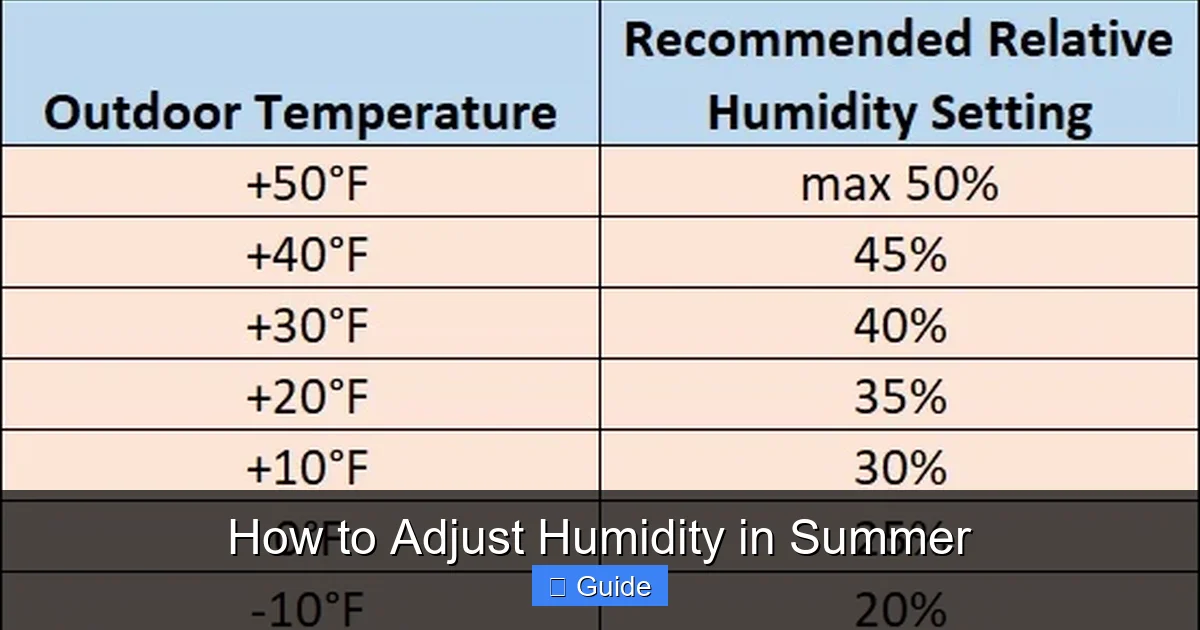
Experts agree on the sweet spot. Indoor relative humidity should stay between 30% and 50%. Below 30%, air feels dry. Skin cracks, sinuses irritate, and static electricity builds up. Above 50%, problems multiply. Dust mites thrive. Mold spores activate. Wood swells. Paint peels. The musty smell of summer takes over.
At 60% relative humidity, dust mite populations explode. At 70%, mold growth becomes likely on many surfaces. Keeping levels in the 30% to 50% range protects your health, your belongings, and your home’s structure. It also makes your air conditioner more efficient. Dry air feels cooler, so you can set the thermostat higher and save energy.
Why High Humidity Matters
Health Impacts of Excess Moisture
High humidity does more than make you sweat. It creates a breeding ground for allergens. Dust mites are microscopic creatures that feed on dead skin cells. They need humidity above 50% to survive and reproduce. Their waste particles trigger asthma and allergies in sensitive people. Mold spores are everywhere, but they only grow when moisture is available. Damp air lets them colonize walls, carpets, and furniture.
Visual guide about How to Adjust Humidity in Summer
Image source: sp-ao.shortpixel.ai
Bacteria and viruses also spread more easily in humid conditions. Some respiratory infections thrive in moist air. High humidity makes it harder for your body to cool itself through sweat evaporation. This raises heat stress risk, especially for older adults, young children, and people with chronic conditions. Learning how to adjust humidity in summer isn’t just about comfort. It’s a health investment.
Damage to Your Home and Belongings
Moisture is destructive. Wood absorbs water and swells. Doors stick. Floorboards cup. Window frames rot. Drywall softens and crumbles. Paint bubbles and peels. Wallpaper loosens. These repairs cost thousands. Prevention costs far less.
Electronics suffer too. Condensation forms inside devices when warm, humid air meets cool components. Corrosion follows. Circuit boards fail. Data gets lost. Musical instruments warp. Books develop foxing—those brown spots caused by mold and oxidation. Leather goods grow mildew. Photos stick together and fade. Your home’s contents are at risk whenever humidity climbs unchecked.
Energy Waste and Higher Bills
Humid air feels warmer than dry air at the same temperature. Your body cools by evaporating sweat. When the air is saturated, evaporation slows. You feel hotter. You lower the thermostat. Your air conditioner runs longer. Energy bills climb. A dehumidifier uses electricity too, but it lets you raise the AC setpoint by several degrees. The net savings can be significant.
An oversized air conditioner cools quickly but doesn’t run long enough to dehumidify properly. This creates a cold, clammy environment. Right-sizing your cooling system and adding dedicated dehumidification solves this. Understanding how to adjust humidity in summer helps you optimize both comfort and efficiency.
How to Measure Indoor Humidity
Choosing a Reliable Hygrometer
You can’t manage what you don’t measure. A hygrometer is essential. Digital models are affordable, accurate, and easy to read. Look for one with a ±2% to ±3% accuracy rating. Avoid cheap analog dials. They drift over time and need calibration. Place hygrometers in key areas: living room, bedroom, basement, and bathroom. Humidity varies room to room.
Smart hygrometers connect to your phone via Bluetooth or Wi-Fi. They track trends, send alerts, and integrate with smart home systems. Some trigger dehumidifiers or exhaust fans automatically. Basic digital models cost $10 to $20. Smart versions run $30 to $60. Either works. The important part is having data.
Where to Place Sensors for Accurate Readings
Placement affects accuracy. Keep sensors away from direct sunlight, heating vents, air conditioner output, and steam sources. Mount them at breathing height—about four to six feet up. Avoid exterior walls where temperature differences cause condensation. Give each room its own sensor if possible. Basements often read 10% to 20% higher than upper floors.
Check readings at different times. Morning humidity differs from evening. After a shower, bathroom humidity spikes. During cooking, kitchen levels rise. Track patterns for a week before acting. This baseline tells you where problems are worst and when they peak. It’s the first step in learning how to adjust humidity in summer effectively.
Reading and Interpreting the Data
Watch for sustained readings above 50%. Brief spikes after showers or cooking are normal. They should drop within an hour with proper ventilation. If levels stay high for hours, you have a moisture problem. Consistently low readings below 30% mean you might need a humidifier, though this is rare in summer.
Look for patterns. Does humidity spike at night? Your AC might be cycling off too soon. Does the basement stay damp regardless? You likely have foundation seepage. Does the whole house rise together? Outdoor air infiltration or an oversized AC could be the cause. Data guides your solution strategy.
How to Adjust Humidity in Summer: Active Solutions
Portable Dehumidifiers: Selection and Sizing
Portable dehumidifiers are the most direct way to remove moisture. They pull air over cold coils. Water condenses and drips into a tank or drains through a hose. The dried air reheats slightly and returns to the room. Capacity matters. Units are rated by pints removed per day at standard conditions (80°F, 60% RH).
For a damp 500-square-foot space, choose a 22-pint unit. For 1,000 square feet, go with 30 to 35 pints. For 1,500 square feet or very damp conditions, get 50 pints. Oversizing slightly is smart. The unit runs less often, lasts longer, and handles peak loads. Look for Energy Star certification. These models use 15% less energy for the same performance.
Features to consider: continuous drain option (gravity or pump), auto-restart after power loss, digital humidistat, washable filter, and low-temperature operation for basements. Place the unit centrally with at least 12 inches of clearance on all sides. Close doors and windows to the space. Empty the tank daily or run a hose to a floor drain. This is a core strategy for how to adjust humidity in summer.
Whole-House Dehumidification Systems
For comprehensive control, whole-house dehumidifiers integrate with your HVAC. They install in the return ductwork and treat all circulating air. Capacity ranges from 70 to 130+ pints per day. They drain automatically, need minimal maintenance, and operate quietly. A dedicated humidistat controls runtime independent of the thermostat.
These systems cost $1,500 to $3,000 installed. They’re ideal for humid climates, large homes, or anyone with respiratory sensitivities. They also protect the entire house—attics, crawl spaces, and wall cavities benefit from drier air circulation. Professional installation ensures proper sizing and ductwork integration. If you’re serious about how to adjust humidity in summer long-term, this is the gold standard.
Air Conditioning as a Dehumidification Tool
Your AC removes moisture as a byproduct of cooling. Warm air hits the cold evaporator coil. Water condenses and drains away. But ACs prioritize temperature, not humidity. They cycle off once the setpoint is reached, even if humidity remains high. Oversized units worsen this. They cool fast and shut down before meaningful dehumidification occurs.
To maximize AC dehumidification: set the fan to “auto,” not “on.” Continuous fan operation re-evaporates moisture off the coil. Keep the filter clean. Dirty filters reduce airflow and coil temperature, cutting moisture removal. Ensure the condensate drain flows freely. Clogged drains cause water damage and reduce efficiency. Schedule annual professional maintenance.
Consider a thermostat with humidity control. These run the AC longer at lower fan speeds to extract more moisture. Some overcool slightly (1°F to 2°F below setpoint) to dehumidify, then use reheat or wait for natural warming. This balances comfort and efficiency. It’s an important piece of how to adjust humidity in summer using equipment you already own.
Ventilation Fans and Exhaust Systems
Source control beats remediation. Bathroom fans, kitchen range hoods, and laundry room exhausts remove moisture at the source. Run bathroom fans during showers and for 20 minutes after. Use the kitchen hood whenever cooking, especially boiling or steaming. Vent dryers outdoors, never into the laundry room.
Fan capacity matters. Bathroom fans should provide 1 CFM per square foot of floor space (minimum 50 CFM). Kitchen hoods need 100 CFM per linear foot of range against a wall, 150 CFM for island mounts. Choose quiet models (1.5 sones or less) so you’ll actually use them. Timer switches or humidity-sensing controls automate operation.
Whole-house ventilation systems (ERVs and HRVs) exchange stale indoor air for fresh outdoor air while recovering energy. In summer, they can increase indoor humidity if outdoor air is muggy. Some models have humidity transfer cores that help. In very humid climates, supply-only ventilation with a dehumidifier works better than balanced systems. Ventilation strategy is key to how to adjust humidity in summer.
How to Adjust Humidity in Summer: Passive Strategies
Sealing Air Leaks and Improving Insulation
Humid outdoor air infiltrates through gaps. Seal them. Caulk around windows, doors, and utility penetrations. Weatherstrip movable joints. Foam sealant works for larger gaps around pipes and wires. Attic hatches, recessed lights, and basement rim joists are common leak points. A blower door test finds hidden leaks.
Insulation helps too. Properly insulated walls and attics keep interior surfaces warmer. Warmer surfaces resist condensation. Vapor barriers in crawl spaces stop ground moisture from rising. Encapsulated crawl spaces with dehumidifiers are ideal. Basement wall insulation (rigid foam against concrete) reduces dampness. Air sealing and insulation work 24/7 without electricity. They’re foundational to how to adjust humidity in summer.
Managing Indoor Moisture Sources
Daily habits add gallons of water to your air. Simple changes reduce this load. Cover pots when cooking. Use lids. Simmer instead of boil. Run the exhaust fan. Take shorter, cooler showers. Use a squeegee on shower walls after. Hang towels to dry in a ventilated area, not bunched on a hook. Fix leaky faucets and running toilets promptly.
Laundry is a major moisture source. Vent dryers outdoors with rigid metal ducting (not flexible vinyl). Clean the lint filter every load. Clean the duct annually. Consider a heat pump dryer—it vents no air and uses less energy. Line-dry clothes outdoors when possible. Indoor drying racks release tremendous moisture. If you must dry inside, use a dehumidifier in that room.
Houseplants transpire water. Group them in one room with a dehumidifier, or move them outdoors for summer. Aquariums evaporate constantly. Use tight-fitting covers. Firewood stored inside releases moisture as it seasons. Keep it outside. Every source you control reduces the dehumidification burden. Source management is a low-cost pillar of how to adjust humidity in summer.
Strategic Window Use and Natural Ventilation
Windows can help or hurt. Open them when outdoor humidity is lower than indoor—typically early morning or late evening in many climates. Create cross-ventilation by opening windows on opposite sides. Use window fans to pull cool, dry air in and push warm, moist air out. Close windows before outdoor humidity rises.
Monitor outdoor dew point, not just relative humidity. Dew point tells you the actual moisture content. If outdoor dew point is below 55°F, ventilation helps. Above 65°F, keep windows closed and rely on mechanical dehumidification. Between 55°F and 65°F, it depends on your indoor conditions. A smart weather station or weather app provides dew point data.
Window films and shades reduce solar heat gain. Less heat means less AC runtime, which can mean less dehumidification. But cooler surfaces also risk condensation. Balance is key. Exterior shutters or awnings block heat before it enters. Interior cellular shades insulate windows at night. Smart window use complements how to adjust humidity in summer.
Landscaping and Drainage for Foundation Protection
Ground moisture migrates through foundation walls. Proper grading directs water away. Soil should slope at least 6 inches over the first 10 feet. Gutters and downspouts must function. Extend downspouts at least 4 feet from the foundation. Consider underground drainage pipes. French drains handle severe cases.
Landscaping choices matter. Keep mulch 6 inches below siding. Don’t pile it against the foundation. Plant shrubs at least 2 feet from the house. Roots can damage waterproofing. Avoid dense ground cover that traps moisture against walls. Irrigation systems should not spray the foundation. Adjust sprinkler heads.
Interior basement waterproofing (coatings, drainage channels, sump pumps) manages water that penetrates. But exterior management stops it first. A dry foundation means a drier basement and lower whole-house humidity. This outdoor work is often overlooked in how to adjust humidity in summer but makes a massive difference.
Room-by-Room Humidity Management
Basement and Crawl Space Solutions
Basements are humidity hotspots. They’re below grade, surrounded by cool, damp earth. Concrete is porous. Water vapor migrates through. Temperature differences cause condensation. A basement dehumidifier is essential in most climates. Choose a unit rated for low-temperature operation (down to 42°F) with a pump for continuous drainage.
Seal concrete floors and walls with vapor-retarding coatings. Install a perimeter drainage channel and sump pump if water enters. Insulate rim joists with rigid foam and spray foam sealant. Encapsulate crawl spaces with heavy polyethylene vapor barrier sealed to walls and piers. Add a dedicated crawl space dehumidifier. Condition the space—supply a small amount of heated/cooled air.
Monitor basement humidity separately. It often runs 10% to 20% higher than upstairs. Don’t use basement air as your whole-house reference. Target 50% or below in basements to prevent mold on stored items and structural wood. Basement control is critical to how to adjust humidity in summer for the entire home.
Bathroom Moisture Control
Bathrooms see the most intense moisture spikes. A 10-minute shower adds 0.5 to 1 pint of water to the air. Without ventilation, humidity hits 90%+. Run the exhaust fan every time. Install a timer or humidity sensor so it runs long enough. Leave the door open after showering to disperse moisture. Use a squeegee on glass and tile.
Towel warmers or heated towel bars dry towels fast, reducing evaporation. Spread towels, don’t hang them bunched. Fix grout cracks and caulk gaps. Water behind tile creates hidden mold. Consider a small portable dehumidifier for bathrooms without windows or with inadequate fans. Bathroom discipline is a daily practice in how to adjust humidity in summer.
Kitchen and Laundry Areas
Cooking releases surprising moisture. Boiling pasta for 20 minutes adds 0.5 pints. A simmering stew adds more. Always use the range hood. Cook with lids. Use the microwave when possible—it creates less steam. Pressure cookers and slow cookers release minimal moisture. Wipe up spills immediately.
Laundry rooms need exhaust fans too. Vent dryers properly. Check the vent flap opens freely. Clean the duct annually. Front-load washers can develop door seal mold. Leave the door ajar between loads. Wipe the seal dry. Consider a dehumidifier if the laundry room stays damp. These rooms generate concentrated moisture that spreads fast.
Bedrooms and Living Spaces
Bedrooms need 30% to 50% humidity for quality sleep. High humidity disrupts sleep cycles. It increases wakefulness and reduces deep sleep. Run a bedroom dehumidifier if needed. Keep closet doors open for air circulation. Don’t overpack closets—air must move. Use moisture-absorbing products (silica gel, calcium chloride) in closed storage.
Living rooms with many occupants need more ventilation. Each person adds moisture through respiration and perspiration. A CO2 monitor helps gauge ventilation adequacy. High CO2 correlates with high humidity in occupied spaces. Open windows briefly during gatherings. Use ceiling fans to improve air mixing and evaporation from skin.
Maintaining Optimal Humidity Year-Round
Seasonal Transitions: Spring to Summer
Spring humidity creeps up gradually. Start monitoring in April. Clean and test dehumidifiers before you need them. Replace filters. Check drain hoses. Verify humidistat calibration. Switch HVAC to cooling mode. Ensure the condensate drain flows. Schedule AC maintenance early—before the first heat wave.
Adjust ventilation strategies. Spring evenings are often perfect for natural ventilation. Use them. As nights warm, shift to mechanical ventilation. Reprogram smart thermostats and humidistats for summer setpoints. If you have a whole-house dehumidifier, set it to 45% to 50%. Prepare for the first muggy spell. Proactive transitions smooth the how to adjust humidity in summer process.
Summer Maintenance Routines
Weekly: Empty portable dehumidifier tanks (unless continuous drain). Clean filters. Check drain hoses for kinks or clogs. Wipe bathroom exhaust fan covers. Verify range hood operation. Monthly: Clean dehumidifier coils (vacuum gently). Check hygrometer calibration (salt test). Inspect basement for damp spots. Test sump pump.
Seasonally: Professional AC tune-up. Clean whole-house dehumidifier per manufacturer. Inspect and clean ERV/HRV cores. Check attic ventilation. Clear gutter debris. Verify downspout extensions. Trim vegetation near foundation. These routines prevent surprises. A failed dehumidifier in July means mold by August. Maintenance is insurance.
Fall Transition: Preparing for Heating Season
As outdoor humidity drops, indoor levels follow. You may need to reduce dehumidifier runtime or turn it off. Monitor closely. Heating season brings dry air. Below 30% humidity causes its own problems. Have a humidifier ready if needed. Clean and store portable dehumidifiers properly—run them dry, clean tanks, coil, and filter. Store in a dry place.
Switch whole-house dehumidifier to “off” or winter mode. Some models have a heating season setting that maintains minimal operation for air circulation. Adjust humidistats. Seal the home for winter—this reduces infiltration of dry cold air. The annual cycle continues. Understanding how to adjust humidity in summer is part of year-round home management.
Troubleshooting Common Problems
Dehumidifier runs but doesn’t collect water: Check filter (clean it). Check coil (clean it). Check room temperature—below 65°F, standard units frost up. Check humidity setting—maybe it’s already at target. Unit ices up: Low refrigerant, dirty filter, or too-cold room. Move to warmer spot or get low-temp model.
Humidity won’t drop below 60%: Unit undersized. Air leaks bringing in moist air. Hidden moisture source (leak, wet crawl space). AC oversized and short-cycling. Windows open. Investigate systematically. Musty smell persists: Check behind furniture, in closets, under sinks. Look for mold. Fix moisture source first, then clean. Use mold-inhibiting products.
Condensation on windows: Indoor humidity too high for outdoor temperature. Lower humidistat. Increase ventilation. Improve window insulation (storm windows, films). Condensation between panes means seal failure—replace the unit. Frost in attic: Air leaks from below. Seal attic floor penetrations. Ensure proper attic ventilation. Every problem has a cause. Find it.
Advanced Strategies and Smart Home Integration
Automated Humidity Control Systems
Smart home hubs (Home Assistant, SmartThings, Hubitat) coordinate dehumidifiers, exhaust fans, ERVs, and AC based on multiple sensors. Rules like: “If bathroom humidity > 70%, run fan until < 55%." Or "If basement humidity > 55% and outdoor dew point < 55°F, open basement windows via actuators." Automation removes human error.
Smart dehumidifiers (like Frigidaire, hOmeLabs, or Santa Fe with Wi-Fi) report status and allow remote control. Smart plugs with energy monitoring turn dumb units into smart ones. Smart thermostats (Ecobee, Nest, Honeywell) integrate humidity control with cooling. Some support external humidistats for whole-house dehumidifiers. The ecosystem grows yearly.
Data logging reveals patterns invisible to daily checks. Seasonal trends. Equipment degradation. Occupancy impacts. Weather correlations. Use this to optimize setpoints and schedules. Automation is the future of how to adjust humidity in summer—set it once, refine occasionally, enjoy consistently.
Energy Recovery Ventilators in Humid Climates
ERVs transfer both heat and moisture between airstreams. In summer, they keep some outdoor humidity out while bringing fresh air in. But they’re not dehumidifiers. In very humid climates (dew point consistently > 65°F), ERVs can raise indoor humidity. Pair an ERV with a dehumidifier. Run the dehumidifier when ERV operates.
Some advanced ERVs have “humidity boost” modes that shift moisture transfer balance. Others integrate with dehumidifiers via dry contacts. Design ventilation for your climate zone. ASHRAE 62.2 sets minimum ventilation rates. Exceeding them in humid weather without dehumidification backfires. Balance fresh air and moisture control.
Desiccant Dehumidification for Special Cases
Refrigerant dehumidifiers struggle below 65°F. Desiccant units use a rotating wheel coated with silica gel or zeolite. They adsorb moisture directly, then heat a regeneration sector to release it outdoors. They work at any temperature, even freezing. They’re louder, use more energy, but excel in cold, damp spaces.
Applications: unheated garages, workshops, boat storage, cold basements, archives. Some hybrid units combine refrigerant and desiccant stages for broad-range performance. Industrial models handle huge loads. For homes, they’re niche but valuable where refrigerant units fail. Know your tools for how to adjust humidity in summer and beyond.
Conclusion
You now have a complete toolkit for managing summer humidity. From understanding why it happens to measuring, controlling, and maintaining ideal levels, every strategy serves the same goal: a comfortable, healthy, durable home. The key principles are simple. Measure first. Attack sources. Ventilate wisely. Dehumidify actively. Seal the envelope. Maintain consistently.
Start with a hygrometer. Watch the numbers. Pick one or two changes this week. Maybe it’s running the bathroom fan longer. Maybe it’s buying a basement dehumidifier. Maybe it’s sealing those drafty windows. Small steps compound. A 10% humidity drop transforms how your home feels and performs.
Remember that how to adjust humidity in summer isn’t a one-time fix. It’s a seasonal rhythm. Spring preparation. Summer vigilance. Fall transition. Winter awareness. Each season builds on the last. Your home, your health, and your wallet will thank you. Take control of your indoor air. The comfort you’ve been missing is within reach.
Frequently Asked Questions
How often should I run my dehumidifier in summer?
Run your dehumidifier as needed to maintain 30% to 50% humidity. In humid climates, this may mean continuous operation. Use the built-in humidistat to automate runtime. Empty the tank daily or use continuous drainage for convenience.
What size dehumidifier do I need for a 1,000 sq ft basement?
For a 1,000 square foot basement, choose a 30 to 35 pint dehumidifier for moderately damp conditions. For very damp or wet basements, select a 50 pint unit. Slightly oversizing improves efficiency and extends equipment life.
Why does my house feel humid even with the AC running?
Your AC may be oversized, cooling too quickly to dehumidify properly. Other causes include leaky ductwork, insufficient runtime, dirty filters, or high outdoor humidity infiltrating through air leaks. A dedicated dehumidifier often solves this.
Can high humidity damage hardwood floors?
Yes, high humidity causes hardwood to absorb moisture and expand. This leads to cupping, crowning, buckling, and gaps between boards. Maintain 35% to 55% humidity year-round to protect wood flooring. Use a hygrometer to monitor.
Is it better to use a portable or whole-house dehumidifier?
Portable units cost less upfront ($200-$400) and work well for single areas. Whole-house systems ($1,500-$3,000 installed) treat all air uniformly, drain automatically, and integrate with HVAC. Choose based on home size, budget, and severity of humidity issues.
How do I prevent condensation on windows in summer?
Summer condensation occurs when humid indoor air contacts cool window surfaces from AC. Lower indoor humidity to 40% to 45%. Improve window insulation with films or storm windows. Ensure AC isn’t oversized. Increase air circulation near windows with fans.