Essential Flood for Lettuce Health
Essential flood for lettuce health is a game-changer for growers seeking crisp, high-yield crops. This guide covers everything from irrigation timing and water depth to troubleshooting common issues like root rot and nutrient leaching. Master these techniques to grow lettuce that thrives in any season.
If you’ve ever walked a lettuce field at dawn and seen water sheeting perfectly across laser-leveled beds, you know the quiet satisfaction of a good flood. But essential flood for lettuce health isn’t just about turning on a valve and walking away. It’s a dance — timing, depth, drainage, and nutrition all moving together. Get one step wrong, and you’re fighting tip burn, root rot, or bolting by harvest.
I’ve spent fifteen years troubleshooting lettuce fields from Yuma to Salinas. The growers who sleep easy at night? They don’t guess. They measure. They schedule. They treat every flood like a prescription. This guide pulls together everything I’ve learned — and everything the best growers do — so you can skip the costly mistakes and go straight to crisp, heavy heads that pack out beautifully.
Key Takeaways
- Proper flood timing prevents disease: Water early morning so leaves dry fast, reducing fungal risks like downy mildew and bottom rot.
- Water depth matters more than duration: Aim for 2-3 inches of water across beds; deeper flooding suffocates roots and invites Pythium.
- Soil prep determines success: Laser-level fields and add organic matter to ensure even water distribution and prevent dry spots.
- Monitor EC and pH daily: Flood irrigation concentrates salts; test runoff to catch toxicity before leaf tip burn appears.
- Drainage is non-negotiable: Fields must drain within 4-6 hours; standing water longer than that kills feeder roots fast.
- Fertigate smart, not hard: Split nitrogen applications — half pre-plant, half through flood water — to maximize uptake and minimize leaching.
- Rotate crops to break pest cycles: Avoid planting lettuce after lettuce; use cover crops or grains to disrupt soilborne pathogens.
Quick Answers to Common Questions
How often should I flood irrigate lettuce in hot weather?
Every 3-4 days in hot weather. Check soil moisture at 6 inches — if a handful crumbles, it’s time. Don’t rely on calendar; use sensors or the feel method.
What’s the ideal water depth for flood irrigation on lettuce?
2-3 inches at the inlet. Less causes uneven advance; more suffocates roots and invites Pythium. Measure with staff gauges at inlet, middle, and tail.
Can I fertigate nitrogen through flood irrigation?
Yes. Use UAN 32 or calcium nitrate. Inject during middle third of set. Split applications: 50% pre-plant, 25% at thinning, 25% at early heading. Flush with clean water after.
How fast should my field drain after flood irrigation?
Completely dry — no puddles — within 4 hours. 6 hours maximum. Longer drainage kills feeder roots and invites root rot. Fix drainage if you can’t hit this.
What causes tip burn in flood-irrigated lettuce?
Rapid growth + transient calcium shortage. Triggered by uneven water, high humidity, excess ammonium nitrogen. Fix with steady irrigation, calcium nitrate at heading, and resistant varieties.
📑 Table of Contents
- Why Flood Irrigation Still Wins for Lettuce
- Field Preparation: The Foundation Everything Rests On
- Mastering the Flood: Timing, Depth, and Duration
- Water Quality and Nutrition: The Hidden Variables
- Drainage: The Half of the Equation Most Forget
- Troubleshooting Common Flood Problems
- Seasonal Adjustments: One System, Four Seasons
- Technology That Pays for Itself
- Record Keeping: Your Future Self Will Thank You
- Conclusion
Why Flood Irrigation Still Wins for Lettuce
Sprinklers have their place. Drip has its fans. But for baby leaf, romaine, and iceberg on heavy ground, flood remains king. Here’s why.
Uniformity You Can See
Flood irrigation wets the entire root zone at once. No dry edges. No emitter clogs. No pressure variation from row one to row forty. When water flows across a properly leveled field, every plant gets the same drink. That uniformity translates directly to uniform maturity — and uniform maturity means one harvest pass, not three.
Salt Management
Lettuce hates salt. Sprinklers push salts down, but they also concentrate them at the wetting front. Flood, done right, pushes salts below the root zone entirely. The key word is done right. You need enough water volume to leach, and you need drainage that actually works. We’ll cover both.
Cooling Effect
In desert growing regions, a midday flood can drop canopy temperature 8-12 degrees. That’s the difference between a marketable head and a bolted one. The evaporative cooling from wet soil surfaces creates a microclimate that keeps lettuce happy when the thermometer hits 100°F.
Labor Efficiency
One person can manage 200 acres of flood with good infrastructure. Compare that to moving hand lines or fixing drip tape. For large-scale operations, the labor math is undeniable.
Field Preparation: The Foundation Everything Rests On
You can’t fix bad prep with good water management. I’ve seen growers pour thousands into irrigation tech while ignoring a 0.2% slope error that left the low end waterlogged and the high end bone dry. Don’t be that grower.
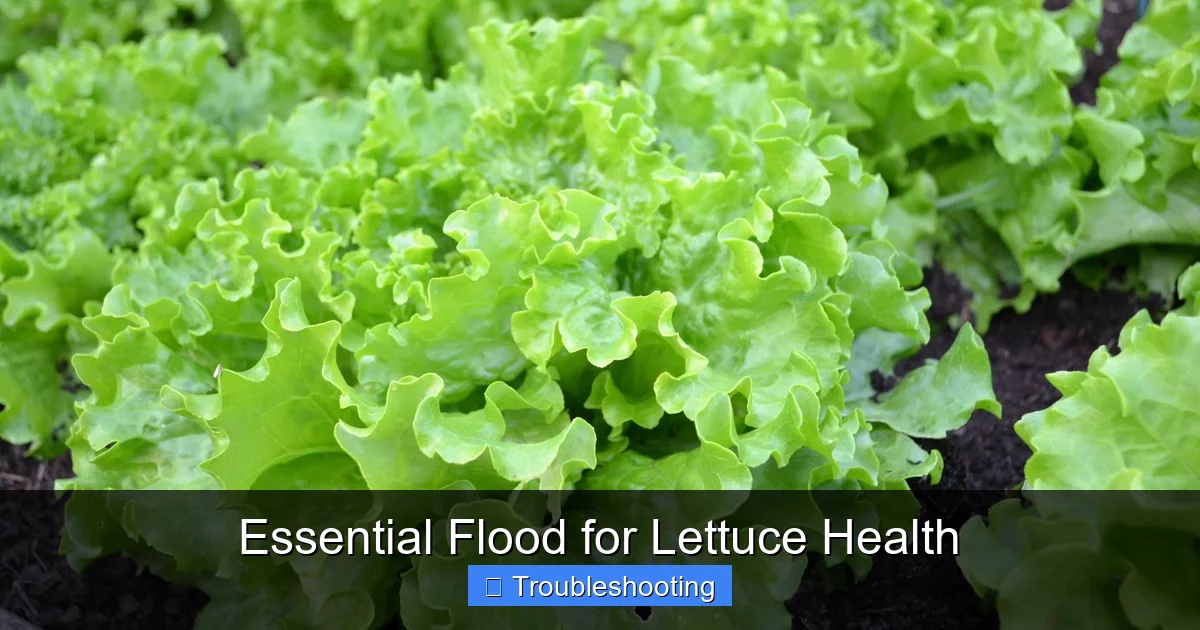
Visual guide about Essential Flood for Lettuce Health
Image source: positivebloom.com
Laser Leveling — Non-Negotiable
Modern laser leveling achieves ±0.01 foot accuracy. That’s not overkill — it’s the minimum for essential flood for lettuce health. A tenth of a foot variation across a 1,300-foot run means the low end gets 30% more water. Your heads will show it: big and soft on one end, small and tip-burned on the other.
Check your leveling annually. Settling happens. Tillage shifts soil. A quick GPS survey before planting catches problems while they’re cheap to fix.
Bed Configuration
Standard 40-inch beds with 2-4 seedlines work for most varieties. But match bed width to your variety and harvest method. Baby leaf on 80-inch beds with 12-16 lines? Different water dynamics than iceberg on 40s with two lines. Wider beds need more flow rate to advance water across the same distance in the same time.
Organic Matter and Structure
Heavy clay soils seal up after the first flood. Water ponds. Infiltration drops to near zero. The fix? Compost. Two to three tons per acre of stable compost, incorporated pre-bed, creates aggregate stability that keeps pore spaces open. You’ll see faster advance, better drainage, and less crusting.
Cover crops help too. A winter rye or mustard crop, terminated and incorporated three weeks before bedding, feeds soil biology and creates channels for water movement. Just don’t incorporate green material too close to planting — decomposition ties up nitrogen right when seedlings need it most.
Pre-Irrigation Strategy
Pre-irrigate to field capacity 7-10 days before planting. This does three things: germinates weed seeds for a stale seedbed pass, settles beds so they don’t slump after planting, and ensures uniform moisture for even germination. Skip this step at your peril — dry spots in the seed zone mean skippy stands, and skippy stands mean weeds win.
Mastering the Flood: Timing, Depth, and Duration
This is where the art lives. The science gives you parameters. Your field experience tells you where in those parameters to land today.
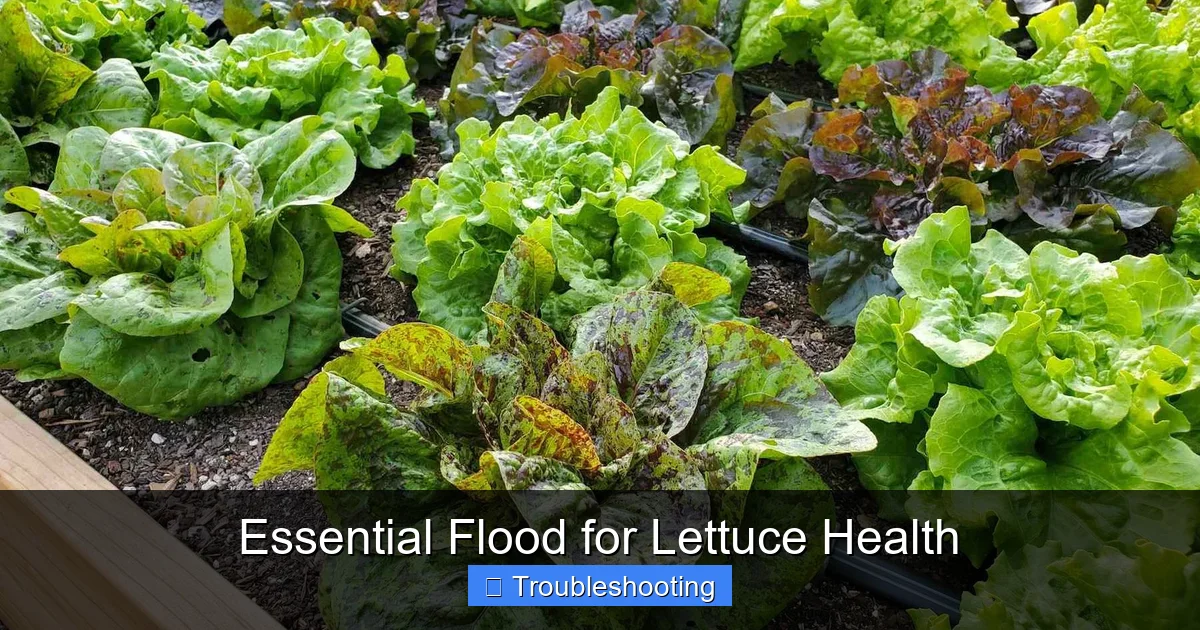
Visual guide about Essential Flood for Lettuce Health
Image source: homesteadandchill.com
When to Flood
Early morning. Always. Start at 4-5 AM. Finish by 9 AM. Why? Three reasons:
- Leaves dry before peak humidity hours, slashing downy mildew pressure
- Evaporation loss is minimal — more water goes to roots, not air
- You can see what’s happening. Managing a flood in the dark is a recipe for disaster.
Never flood late afternoon in humid regions. Wet leaves overnight are a fungal invitation you don’t want to accept.
How Deep
Target 2-3 inches of water depth at the inlet. Less than 2 inches and you get uneven advance — the water fingers out, leaving dry strips. More than 4 inches and you’re pushing oxygen out of the root zone, inviting Pythium and Phytophthora.
Measure depth with a staff gauge at the inlet, midpoint, and tail. Adjust gate openings until you hit your targets. This isn’t set-and-forget. Check every flood.
How Long
Advance time — the time for water to reach the tail — should be 30-50% of total set time. If water hits the end in 30 minutes, run 60-90 minutes total. This ensures the tail gets adequate infiltration without the head drowning.
Typical sets run 2-4 hours depending on soil texture, slope, and flow rate. Sandy loam? Two hours. Heavy clay? Four. But the real test is infiltration. Dig a hole 30 minutes after water recedes. Wet to 12-18 inches? Perfect. Wet to 6 inches? Run longer next time. Saturated to surface with standing water? You went too long.
Frequency
Lettuce roots are shallow — 80% in the top 12 inches. They need frequent drinks. In warm weather, that’s every 3-5 days. Cool weather stretches to 7-10. But don’t calendar it. Use soil moisture sensors or the feel method. Squeeze a handful from 6 inches deep. Forms a ball that holds? Wait. Crumbles? Flood.
Critical periods: germination (keep surface moist), thinning (roots establishing), and heading (maximum water demand). Cutting water during heading to “harden off” is old advice that costs yield. Modern varieties need steady supply right to harvest.
Water Quality and Nutrition: The Hidden Variables
Your water carries more than H2O. It carries salts, bicarbonates, and sometimes pathogens. What’s in your water determines what you add — and what you avoid.
Test Before You Trust
Full irrigation water analysis: EC, pH, SAR, individual ions (Ca, Mg, Na, Cl, B, NO3), and carbonates. Test quarterly. Wells change. Canal water changes with reservoir levels. A $150 test saves thousands in crop loss.
Salinity Thresholds
Lettuce is moderately sensitive. Yield decline starts at ECw 1.3 dS/m. At 2.5 dS/m, expect 25% loss. At 4.0, 50%. If your water runs high, you have three levers:
- Leaching fraction — apply 15-20% extra water to push salts down
- Calcium amendments — gypsum at 500-1000 lbs/acre displaces sodium
- Variety selection — some romaine and butterhead lines tolerate more salt than crisphead
pH and Bicarbonates
High bicarbonate water (>150 ppm) raises soil pH over time, locking up phosphorus and micronutrients. Inject sulfuric or phosphoric acid to neutralize 80% of bicarbonates. Target irrigation water pH 6.0-6.5. Don’t over-acidify — you’ll strip calcium and create new problems.
Fertigation Through Flood
Yes, you can fertigate flood. But it’s not like drip. Water moves fast. Nutrients must be soluble and mobile. Best practices:
- Nitrogen: Urea-ammonium nitrate (UAN 32) or calcium nitrate. Split — 50% pre-plant, 25% at thinning, 25% at early heading. Inject during middle third of set for best distribution.
- Phosphorus: Don’t fertigate P through flood. It binds to soil instantly. Band at planting.
- Potassium: Potassium thiosulfate or nitrate. Apply at heading for quality.
- Micros: Zinc, iron, manganese as chelates. Foliar is better — flood distribution is too uneven for micros.
Always run clean water for 15 minutes after injection to flush lines and push nutrients into root zone.
Drainage: The Half of the Equation Most Forget
Getting water on is easy. Getting it off? That’s where profits live or die.
Surface Drainage
Tail ditches must carry peak flow without backing up. Size them for 1.5x your maximum inflow rate. Grade at minimum 0.1% — flatter and they silt in. Clean them every year. A clogged tail ditch turns a 4-hour drain into a 12-hour disaster.
Subsurface Drainage
Tile drains at 4-6 foot depth, 50-100 foot spacing, transform heavy ground. They lower the water table between floods, keeping the root zone aerobic. If you don’t have tile, consider it. Payback is 2-3 years on problem fields.
The 4-Hour Rule
Water should be off the field — completely off, no puddles — within 4 hours of cutoff. 6 hours max. Longer than that, and you’re measuring root death in hours, not days. If you can’t hit this, fix drainage before next season. No exception.
Post-Flood Field Access
How soon can you drive? The thumb test: press your thumb into the bed shoulder. If it leaves a clean print without smearing, you’re good. If it smears or water wells up, wait. Compaction from early traffic creates hardpans that ruin infiltration for the rest of the season.
Troubleshooting Common Flood Problems
Even perfect systems have bad days. Here’s how to diagnose and fix the most common issues fast.
Uneven Advance — Water Fingers Instead of Sheets
Symptoms: Dry strips between wet fingers. Uneven germination. Variable head size.
Causes: Micro-topography (furrows from previous crop), crusting, insufficient flow rate, or slope variation.
Fixes: Increase flow rate to 25-30 gpm per acre for faster advance. Lightly harrow beds pre-flood to break crust. Check laser level data — re-level problem spans. For persistent issues, consider surge flooding (cycling gates on/off) to improve uniformity.
Standing Water at Tail End
Symptoms: Ponding at low end. Yellow, stunted plants. Algae on soil surface.
Causes: Tail ditch too high, insufficient grade, heavy soil, or over-running the set.
Fixes: Lower tail ditch. Cut drain cuts through headlands. Reduce set time. If soil is the issue, gypsum + compost + deep ripping post-harvest. Consider raised beds for chronic problem areas.
Crusting and Poor Emergence
Symptoms: Seedlings trapped under hard crust. Skippy stands. Cotyledons sheared off.
Causes: Low organic matter, high sodium water, excessive tillage destroying aggregates, or flooding before seedlings establish.
Fixes: Apply 500 lbs/acre gypsum pre-plant if SAR > 6. Use anti-crustant polymers at planting. Delay first flood until 2-true-leaf stage if possible — use sprinklers for germination. Keep beds moist, not saturated, during emergence.
Root Rot — Pythium and Phytophthora
Symptoms: Wilting midday that recovers at night. Brown, water-soaked roots. Plants pull easily. Patchy distribution in low spots.
Causes: Saturated soil > 6 hours. High soil temps (> 75°F). Poor drainage. Contaminated water source.
Fixes: Improve drainage — this is 90% of the solution. Mefenoxam (Ridomil) at planting helps but isn’t a substitute for drainage. Rotate to non-host crops (grains, corn). Solarize beds in summer if feasible. Test irrigation water for pathogens if using surface water.
Tip Burn and Calcium Deficiency
Symptoms: Brown, necrotic leaf margins on inner head leaves. Often not visible until harvest.
Causes: Rapid growth + transient calcium shortage. Not soil calcium deficiency — calcium can’t move fast enough to expanding tissue. Triggered by uneven water, high humidity, excess ammonium nitrogen.
Fixes: Steady water — no wet/dry cycles. Calcium nitrate fertigation at heading (15-20 lbs N/acre). Avoid ammonium-heavy fertilizers during heading. Variety selection — some lines are far more resistant. Foliar calcium (calcium chloride 0.5%) weekly during heading helps but doesn’t fix root cause.
Salt Burn — Leaf Margins Yellow Then Brown
Symptoms: Older leaves show marginal necrosis. Stunted growth. High soil EC readings.
Causes: Insufficient leaching. High EC water. Fertilizer buildup. Poor drainage preventing salt movement.
Fixes: Leach heavily — 2x normal volume — between crops. Gypsum at 1 ton/acre if sodium is high. Switch to lower-salt water source if available. Monitor soil EC weekly during season; keep saturated paste extract < 2.0 dS/m for lettuce.
Seasonal Adjustments: One System, Four Seasons
Arizona winter is not California spring. Your flood management must shift with the calendar.
Desert Winter (Nov-Feb)
Cool soils. Low ET. Flood every 7-10 days. Depth 2 inches. Duration shorter — 1.5-2 hours. Biggest risk: overwatering. Roots sit in cold, wet soil and rot. Check soil temp at 4 inches — below 50°F, cut frequency. Use clear plastic mulch on beds for early plantings to warm soil and reduce evaporation.
Desert Spring (Mar-May)
Transition season. ET climbing. Wind events spike demand. Flood every 4-5 days. Watch for bolting — heat spikes + water stress = seed stalks. Pre-irrigate before predicted heat waves. Increase depth to 3 inches. Consider midday cooling floods (15 min) on extreme days.
Coastal Summer (Jun-Sep)
Foggy mornings, sunny afternoons. High humidity = disease pressure. Flood early (4 AM) so leaves dry by 8 AM. Frequency 3-4 days. Depth 2-3 inches. Biggest challenge: tip burn from rapid growth under fog/sun cycles. Calcium fertigation critical. Variety selection is your best tool — plant tip-burn resistant lines.
Coastal Fall (Oct-Nov)
Shortening days. Cooling soils. Stretch intervals to 5-7 days. Reduce depth to 2 inches. Watch for Sclerotinia drop — wet soil + cool temps + dense canopy. Open plant spacing. Skip flood if rain > 0.5 inch forecast.
Technology That Pays for Itself
You don’t need IoT everything. But three tools change the game.
Flow Meters on Every Gate
Mechanical or ultrasonic. Know exactly how many acre-inches you applied. Not “about 3 inches.” Exactly 2.7. This data lets you correlate yield maps with water applied. You’ll find zones that consistently over/under-produce and fix them.
Soil Moisture Sensors
Capacitance probes at 6, 12, 18 inches. One per 20-40 acres, placed in representative spots. Data logger with cellular uplink. Check your phone at breakfast — see exactly where each field sits relative to field capacity and refill point. No more guessing. No more “I think it needs water.”
Drone or Satellite Imagery
NDVI every 3-5 days during season. Spot uniformity issues before they’re visible from the truck. See drainage problems, salinity patches, fertilizer skips. Cost: $2-4/acre/season. ROI: one caught problem pays for ten years.
Record Keeping: Your Future Self Will Thank You
Every flood, record: date, start/stop time, gate setting, flow rate, inches applied, soil moisture before/after, EC/pH of water, any amendments injected. Photos of advance front at 30, 60, 90 minutes. Notes on anomalies.
Build a field history. In three years, you’ll have the most valuable dataset on your farm — better than any consultant’s report. You’ll know exactly which fields need what, when. That’s how you go from good to great.
Conclusion
Essential flood for lettuce health isn’t a single practice — it’s a system. Level fields. Clean water. Right timing. Measured depth. Fast drainage. Smart nutrition. Relentless monitoring. Each piece supports the others. Skip one, and the chain breaks.
The growers who master this don’t just survive — they thrive. Their lettuce packs heavier. Stores longer. Commands premium prices. And they sleep better because they know, not hope, that every head got exactly what it needed.
Start with one field this season. Laser level it. Install a flow meter. Put in a moisture probe. Run the numbers. Watch what happens. Then scale. The learning curve is real, but the payoff is permanent. Your soil, your water, your crop — they’re all telling you what they need. You just have to listen.
Now go walk your fields. The water’s waiting.
Frequently Asked Questions
How do I know if my field is level enough for flood irrigation?
Laser leveling should achieve ±0.01 foot accuracy across the field. Check annually with GPS survey. If water advances unevenly or ponds in spots, re-level before next season.
What’s the best time of day to flood irrigate lettuce?
Early morning, 4-5 AM start, finished by 9 AM. This allows leaves to dry before peak humidity, reduces evaporation loss, and lets you monitor the flood visually.
Can I use flood irrigation on sandy soil for lettuce?
Yes, but increase frequency and reduce set time. Sandy soil infiltrates fast but holds little water. Flood every 2-3 days in heat. Consider adding organic matter to improve water holding capacity.
How do I prevent salt buildup with flood irrigation?
Apply 15-20% leaching fraction (extra water) each flood. Test soil EC weekly — keep saturated paste extract below 2.0 dS/m. Use gypsum if sodium is high. Leach heavily between crops.
What’s the difference between surge flooding and continuous flooding?
Surge flooding cycles water on/off (e.g., 30 min on, 30 min off) to improve advance uniformity on difficult soils. Continuous is standard. Surge uses less water but requires automated gates.
How soon after flood irrigation can I enter the field with equipment?
Use the thumb test: press thumb into bed shoulder. If it leaves clean print without smearing or water welling up, you’re good. Typically 24-48 hours after drainage completes.