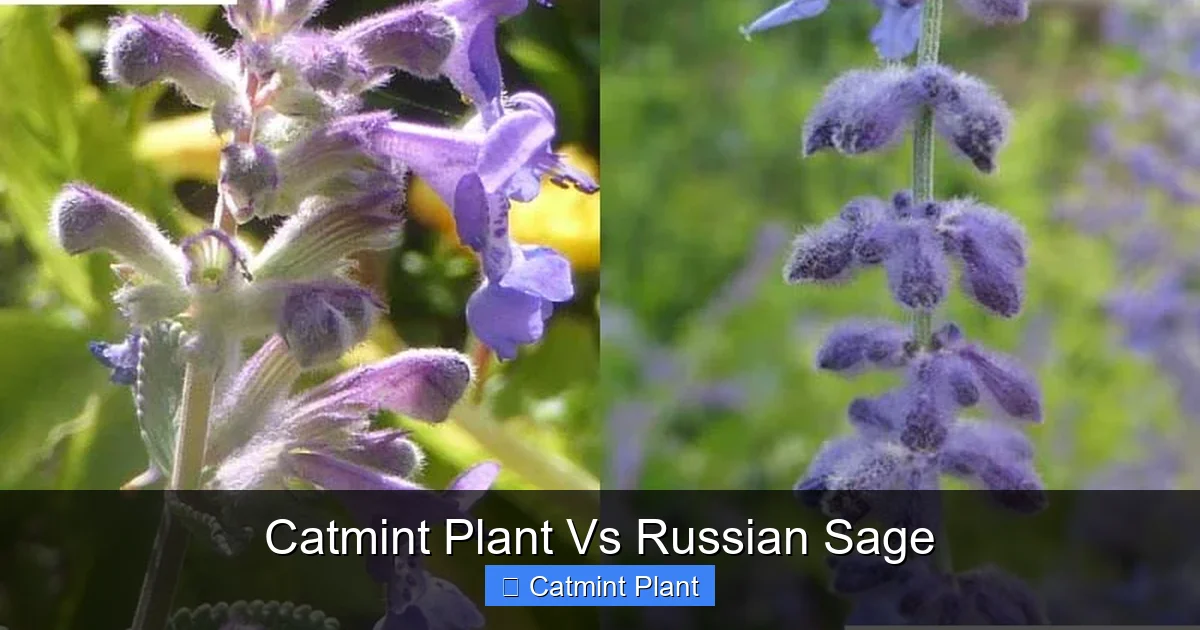
Catmint Plant Vs Russian Sage
Catmint and Russian sage are both drought-tolerant perennials with lavender-blue flowers, but they differ in size, bloom time, and foliage texture. Catmint forms low mounds with aromatic gray-green leaves and blooms from late spring to fall. Russian sage grows taller with silvery, finely cut foliage and airy flower spikes from mid-summer to frost.
Standing in the nursery aisle, you hold two pots. One label says catmint. The other says Russian sage. Both show pretty purple flowers. Both promise easy care. But which one belongs in your garden? This question stops many gardeners in their tracks. The plants look similar at first glance. Both offer silvery foliage and lavender blooms. Both laugh at drought and deer. Yet they play very different roles in the landscape. Choosing the wrong one can leave you with a floppy mess or a gap in your border. Let us walk through the differences together. By the end, you will know exactly which perennial fits your space, your style, and your schedule.
I have grown both plants in my own zone 6 garden for over a decade. I have watched catmint edge my rose bed with tidy mounds. I have seen Russian sage tower behind my coneflowers like a purple haze. I have made the mistakes so you do not have to. This guide draws on real experience, not just catalog descriptions. We will cover size, bloom time, foliage, care, design uses, and even the cat factor. Grab a cup of tea. Let us dig in.
Key Takeaways
- Size difference: Catmint stays compact at 12-24 inches tall while Russian sage reaches 3-5 feet in height.
- Bloom timeline: Catmint flowers earlier starting in late spring; Russian sage blooms mid-summer through fall.
- Foliage contrast: Catmint has soft, scalloped gray-green leaves; Russian sage features lacy, silvery-white foliage.
- Hardiness range: Both thrive in USDA zones 4-9, but Russian sage handles heat slightly better.
- Pollinator appeal: Both attract bees and butterflies, though catmint is especially beloved by cats.
- Maintenance needs: Catmint benefits from shearing after first bloom; Russian sage needs hard pruning in early spring.
- Design roles: Use catmint for edging and front borders; plant Russian sage as a backdrop or specimen.
Quick Answers to Common Questions
Which plant blooms first, catmint or Russian sage?
Catmint blooms first, starting in late spring to early summer. Russian sage begins flowering in mid-summer.
Does Russian sage attract cats like catmint does?
No, Russian sage does not contain nepetalactone and does not attract cats. Only catmint triggers the euphoric response in felines.
Can I grow catmint and Russian sage in containers?
Yes, both grow well in pots. Choose compact cultivars like ‘Junior Walker’ catmint and ‘CrazyBlue’ Russian sage. Ensure excellent drainage.
When should I prune Russian sage?
Prune Russian sage in early spring when new growth appears at the base. Cut woody stems back to 6-12 inches. Never prune in fall.
Why is my catmint flopping open in the center?
Catmint centers die out after 3-4 years. Divide the plant in spring, discarding the woody center and replanting vigorous outer sections.
📑 Table of Contents
- Meet the Contenders: Basic Profiles
- Size and Habit: Low Mound vs. Tall Cloud
- Bloom Time and Flower Power
- Foliage Texture and Seasonal Interest
- Growing Conditions and Care Requirements
- Wildlife Value: Pollinators, Pests, and Cats
- Design Ideas: Where Each Plant Shines
- Popular Cultivars: Choosing the Right Variety
- Troubleshooting Common Problems
- Making the Final Decision
- Conclusion
Meet the Contenders: Basic Profiles
What Is Catmint?
Catmint belongs to the genus Nepeta. The most popular garden variety is Nepeta x faassenii, a sterile hybrid that does not self-sow aggressively. You will often see cultivars like ‘Walker’s Low’, ‘Cat’s Meow’, and ‘Junior Walker’. These plants form low, spreading mounds. Their leaves are gray-green, softly hairy, and scalloped at the edges. Crush a leaf and you get a minty, slightly citrusy scent. That aroma comes from nepetalactone, the compound that sends cats into euphoria. Catmint is a member of the mint family, Lamiaceae, but it lacks the thuggish runners of true mint. It stays put. It plays nice.
What Is Russian Sage?
Russian sage is not a true sage. Its botanical name is Salvia yangii, formerly Perovskia atriplicifolia. It hails from the steppes of Central Asia, not Russia. The plant grows as a woody-based sub-shrub. Stems are stiff, square, and silver-white. Leaves are deeply dissected, almost feathery, giving a lace-like texture. When brushed, they release a sage-like, herbal fragrance. Flowers appear in airy panicles along the upper stems. Each tiny bloom is tubular, pale lavender-blue, with a slightly fuzzy calyx that persists after petals drop. This creates a long-lasting haze of color.
Quick Comparison Snapshot
Before we dive deeper, here is the bird’s-eye view. Catmint grows 12 to 24 inches tall and 18 to 30 inches wide. Russian sage reaches 3 to 5 feet tall and 2 to 4 feet wide. Catmint blooms late spring to early summer, then again if sheared. Russian sage blooms mid-summer to hard frost. Catmint leaves are broad and scalloped. Russian sage leaves are finely cut and silvery. Catmint is herbaceous, dying to the ground each winter. Russian sage is semi-woody, keeping a skeleton of stems. Both want full sun and sharp drainage. Both shrug off deer and rabbits. Now let us explore each dimension in detail.
Size and Habit: Low Mound vs. Tall Cloud
Catmint’s Compact Form
Catmint hugs the ground. Most cultivars stay under two feet tall. ‘Walker’s Low’ sounds short but actually reaches 24 to 30 inches. ‘Junior Walker’ and ‘Cat’s Meow’ stay closer to 12 to 18 inches. The plant spreads outward from a central crown. Stems radiate like spokes, creating a billowy mound. This habit makes catmint perfect for the front of the border. It softens hard edges. It spills over retaining walls. It knits together to form a living mulch that suppresses weeds. In my garden, a row of ‘Cat’s Meow’ along the driveway creates a tidy lavender ribbon all summer. It never flops. It never smothers neighbors.

Visual guide about Catmint Plant Vs Russian Sage
Image source: a-z-animals.com
Russian Sage’s Vertical Presence
Russian sage stands tall. Standard varieties hit four to five feet. Newer compact cultivars like ‘Little Spire’ and ‘Denim ‘n Lace’ stay around 24 to 32 inches. Even the dwarf versions have an upright, vase-shaped habit. Stems shoot up from a woody base. They branch only in the upper third. This creates a see-through quality. You can plant things behind Russian sage and still see them. The plant adds height without visual weight. In my backyard, ‘Denim ‘n Lace’ anchors a corner bed. Its silvery stems catch the evening light. Fireflies gather there at dusk. The vertical lines draw the eye upward, making the small garden feel larger.
When Size Matters Most
Choose catmint when you need a ground cover, an edger, or a filler under roses. Choose Russian sage when you need a backdrop, a screen, or a focal point. Do not plant standard Russian sage in front of a low window. It will block the view. Do not plant catmint behind tall ornamental grasses. It will disappear. Match the plant’s mature size to its garden role. Check the label for specific cultivar dimensions. Sizes vary more than you might expect.
Bloom Time and Flower Power
Catmint’s Long Opening Act
Catmint starts the show early. In my zone 6 garden, buds appear in mid-May. Full bloom hits by early June. The flowers are small, two-lipped, and clustered in whorls along the stems. Color ranges from soft lavender-blue to deep violet depending on cultivar. ‘Walker’s Low’ leans blue. ‘Cat’s Meow’ reads more purple. The display lasts four to six weeks. Then the plant looks tired. Stems elongate. Flowers fade to brown. This is your cue to shear. Cut the whole plant back by half. Within two weeks, fresh foliage emerges. A second flush of blooms arrives in late summer. In cool climates, you might get a third round before frost.
Russian Sage’s Late Summer Spectacle
Russian sage waits its turn. Buds form in early July. Peak bloom spans August through September. Some years it flowers into October. The inflorescence is a branched panicle, 12 to 18 inches long. Individual flowers are tiny, but the sheer number creates a purple mist. From a distance, the plant looks like a lavender cloud. Up close, you see delicate tubular blossoms with protruding stamens. The calyxes stay colorful after petals fall, extending the show. There is no need to deadhead. The plant blooms once, continuously, for months. In my garden, Russian sage bridges the gap between summer phlox and autumn asters.
Staggering for Continuous Color
Smart gardeners use the different bloom windows. Plant catmint in front of Russian sage. Catmint covers the ground in June. Russian sage takes over in August. The transition is seamless. Add early bulbs like alliums behind both. Add fall sedum in front. You get five months of color from one bed. I use this combo along my fence line. Allium ‘Globemaster’ rises in May. Catmint ‘Walker’s Low’ fills June. Russian sage ‘Denim ‘n Lace’ dominates August. Sedum ‘Autumn Joy’ finishes October. One planting. Four seasons of interest.
Foliage Texture and Seasonal Interest
Catmint’s Soft Gray-Green Carpets
Catmint foliage is tactile. Leaves are oval, toothed, and covered in fine hairs. They feel like velvet. Color is a soothing gray-green that reads as neutral in the garden. This makes catmint a great mixer. It pairs with hot reds, cool blues, chartreuse, and white. The mound stays dense from spring to frost. In winter, the herbaceous stems die back completely. You see bare soil until April. Some gardeners leave the dead foliage for winter interest and crown protection. I cut mine back in late fall. It looks cleaner. Mulch protects the crown just as well.
Russian Sage’s Silvery Lace
Russian sage foliage is architectural. Leaves are deeply lobed, almost fern-like. The color is bright silver-white. Stems are also silver. The whole plant glows in moonlight. This foliage shines in hot, sunny spots where green leaves would scorch. The texture contrasts beautifully with broad-leaved plants like hostas, hydrangeas, or cannas. In winter, the woody stems remain. They catch frost and snow, creating sculptural interest. I leave Russian sage standing until March. The silver skeleton against red twig dogwood is a winter highlight.
Using Foliage as a Design Tool
Think beyond flowers. Foliage carries the garden when blooms fade. Catmint’s mounded habit and soft texture make it a perfect foil for spiky plants. Try it with iris, yucca, or ornamental grasses. Russian sage’s vertical lines and lace texture complement bold shapes. Pair it with coneflowers, black-eyed Susans, or shrub roses. Both plants offer aromatic foliage. Brush past them on a warm day. The scent adds an invisible layer to your garden experience.
Growing Conditions and Care Requirements
Sun and Soil: The Non-Negotiables
Both plants demand full sun. Six hours minimum. Eight is better. In shade, they stretch, flop, and flower poorly. Both need sharp drainage. Wet clay in winter kills them faster than cold. Amend heavy soil with grit, compost, or expanded shale. Plant high, with the crown slightly above grade. Mulch with gravel or pine fines, not bark. Bark holds moisture against the crown. I learned this the hard way. My first Russian sage rotted in a wet spring. Now I plant in raised beds or mounded soil. Problem solved.
Watering: Establish Then Ignore
Water regularly the first season. Deep soakings encourage deep roots. After establishment, both plants are remarkably drought tolerant. Catmint may look wilty in extreme heat. It bounces back with a drink. Russian sage barely blinks. Its silvery leaves reflect heat. Its deep taproot finds moisture. In my garden, I water catmint once a week in July. I never water established Russian sage. Overwatering causes weak, floppy growth. It also reduces essential oils, meaning less fragrance and less deer resistance.
Fertilizing: Less Is More
Skip the fertilizer. Rich soil produces lush foliage but fewer flowers. It also weakens stems. If your soil is truly poor, scratch in an inch of compost in spring. That is plenty. I have not fertilized either plant in years. They thrive on neglect. This makes them ideal for low-maintenance landscapes, hellstrips, and vacation homes.
Pruning: The Critical Difference
Here is where care diverges. Catmint gets sheared. After the first flush fades, cut the whole plant back to 6 inches. Use hedge shears or a string trimmer. It looks brutal. New growth appears in days. You get a second bloom. In late fall, cut to the ground. Russian sage gets hard pruned once a year. In early spring, when new buds swell at the base, cut all woody stems to 6-12 inches. Do not prune in fall. The hollow stems collect water and rot the crown. Do not prune in summer. You remove flower buds. I set a calendar reminder for March 15. That is Russian sage day.
Division and Longevity
Catmint centers die out after three to four years. The plant becomes a donut. Dig it up in spring. Discard the woody center. Replant the vigorous outer pieces. Russian sage rarely needs division. It is a sub-shrub with a single woody base. It can live 10-15 years. If it outgrows its space, you can dig and divide in spring. But it resents root disturbance. Better to choose a compact cultivar from the start.
Wildlife Value: Pollinators, Pests, and Cats
The Cat Factor
Let us address the elephant in the room. Catmint contains nepetalactone. About 70% of cats react to it. They roll, rub, drool, and zone out. If you have outdoor cats, they will find your catmint. They may flatten it. ‘Walker’s Low’ and ‘Cat’s Meow’ are less potent than the species Nepeta cataria (true catnip). But they still attract attention. I plant catmint in a dedicated “cat corner” away from prized specimens. The cats get their fun. My display plants stay upright. Russian sage does not affect cats. Its scent is herbal, not minty. Choose Russian sage if neighborhood cats treat your garden as a salon.
Pollinator Magnetism
Both plants are pollinator powerhouses. Bees, butterflies, and hummingbirds visit constantly. Catmint’s early bloom feeds spring emergents. Bumblebee queens love it. Russian sage’s late bloom sustains fall migrants. Monarchs fuel up on it before migration. The tubular flowers suit long-tongued bees. The airy habit lets butterflies navigate easily. I have counted six pollinator species on a single Russian sage plant in August. Plant both. You support insects across the whole season.
Deer and Rabbit Resistance
Both plants rate high on resistance lists. The aromatic oils deter browsing. Deer may nibble new growth in spring desperation. They rarely return for seconds. Rabbits generally ignore them. In my deer-heavy area, both survive unscathed. No sprays. No fences. This alone makes them valuable.
Design Ideas: Where Each Plant Shines
Catmint as the Ultimate Edger
Line a path with catmint. The soft mounds spill over pavers. They release scent the air when brushed. Plant it at the front of a rose bed. It hides bare canes. Its blue flowers complement pink, yellow, and red roses. Use it under standard trees. It tolerates root competition. Try a ribbon of catmint along a stone wall. The gray foliage echoes the stone. The flowers soften the hardscape. In containers, catmint plays thriller or filler. Pair it with trailing verbena and upright salvia. It blooms all summer with minimal care.
Russian Sage as a Structural Star
Plant Russian sage where you need height and transparency. Behind a perennial border, it creates a purple backdrop. The see-through stems let light filter to shorter plants. Use it as a seasonal screen. A row along a property line defines space without blocking views. In a gravel garden, its silver foliage harmonizes with stone. Pair it with lavender, santolina, and thyme for a Mediterranean vibe. In a prairie planting, mix it with coneflowers, blazing star, and native grasses. The vertical accents break the horizontal grass matrix. As a specimen, give it room. A single ‘Denim ‘n Lace’ in a courtyard becomes living sculpture.
Combining Both in One Garden
This is my favorite strategy. Use catmint low. Use Russian sage high. The color harmony is automatic. Both share lavender-blue flowers. Both have silver-tinged foliage. The repetition ties the garden together. The height difference creates layers. Layering adds depth. Depth makes small spaces feel larger. In my front yard, I planted three ‘Cat’s Meow’ along the sidewalk. Behind them, two ‘Little Spire’ Russian sage. Behind those, a ‘Limelight’ hydrangea. Four seasons. Three layers. One cohesive color story. Neighbors stop to ask. It looks designed. It was easy.
Companion Plant Pairings
Catmint loves company. Try it with: Salvia ‘May Night’ for deeper purple spikes. Penstemon ‘Husker Red’ for white flowers on burgundy foliage. Allium ‘Millenium’ for pink pom-poms at the same height. Sedum ‘Angelina’ for chartreuse ground cover contrast. Russian sage partners well with: Echinacea ‘Magnus’ for bold pink daisies. Rudbeckia ‘Goldsturm’ for golden black-eyed Susans. Panicum ‘Northwind’ for upright steel-blue grass. Perovskia ‘Blue Spire’ (another Russian sage) for a mass planting. The key is matching cultural needs. Full sun. Lean soil. Low water. When companions share requirements, maintenance drops.
Popular Cultivars: Choosing the Right Variety
Top Catmint Cultivars
‘Walker’s Low’ is the classic. Perennial Plant of the Year 2007. It grows 24-30 inches tall. Flowers are lavender-blue. It blooms heavily in June, then again after shearing. It can flop in rich soil. ‘Cat’s Meow’ is newer, more compact at 18-20 inches. It holds its shape better. Flowers are a richer violet-blue. It reblooms without shearing, though shearing helps. ‘Junior Walker’ is the dwarf version, 12-18 inches. Perfect for small spaces and pots. ‘Neptune’ offers deep blue flowers on 12-inch mounds. ‘Purrsian Blue’ stays tight at 14-18 inches with profuse blooms. For white flowers, try ‘Snowflake’ or ‘White Wonder’. They lack the blue tone but offer the same habit.
Top Russian Sage Cultivars
‘Denim ‘n Lace’ is the current star. Compact at 28-32 inches. Stems are strong, not floppy. Flowers are intense lavender-blue. Calyxes are purple, extending color. ‘Little Spire’ was the first dwarf, 24-30 inches. It blooms earlier than the species. Stems can splay in rain. ‘Blue Spire’ is the standard tall form, 4-5 feet. Use it where you need height. ‘Lacey Blue’ is another compact, 24-30 inches, with very lacy foliage. ‘CrazyBlue’ is the shortest at 18-24 inches. Good for containers. ‘Rocketman’ is new, 30-36 inches, with exceptionally sturdy stems. For pure silver foliage, ‘Silver Ghost’ has almost white leaves.
Matching Cultivar to Situation
Small urban garden? Choose ‘Junior Walker’ catmint and ‘CrazyBlue’ Russian sage. Large rural border? Go ‘Walker’s Low’ and ‘Blue Spire’. Windy site? Pick ‘Rocketman’ Russian sage. Humid climate? ‘Cat’s Meow’ resists fungal issues better. Container planting? ‘Purrsian Blue’ catmint and ‘Lacey Blue’ Russian sage. Read labels. Ask local nurseries. Regional performance varies. What stands tall in Ohio may flop in Georgia.
Troubleshooting Common Problems
Flopping Stems
Both plants flop from too much shade, too much water, too much fertilizer, or too little pruning. Catmint flops when the center opens up. Shear it. Russian sage flops when stems get too long. Prune harder in spring. Stake early if needed. Use peony rings or grow-through supports. Install them in April. The foliage hides them by June.
Woody Centers and Die-Out
Catmint gets woody. Divide every three years. Russian sage gets woody at the base. This is normal. Do not divide unless necessary. If the center dies, the plant may be in too-wet soil. Improve drainage. Replant higher.
Powdery Mildew
Catmint can get mildew in humid summers with poor air flow. Space plants properly. Water at the base, not overhead. Choose resistant cultivars like ‘Cat’s Meow’. Russian sage rarely gets mildew. Its silver leaves and open habit discourage it.
Winter Kill
Both are hardy to zone 4. But wet winter soil kills them. Plant in well-drained spots. Mulch with gravel. Do not cut Russian sage in fall. The stems protect the crown. Cut catmint in fall or spring. Both work.
Making the Final Decision
Choose Catmint If:
- You need a plant under 2 feet tall.
- You want early summer color starting in May.
- You love the idea of shearing for a second bloom.
- You are edging a path or border.
- You don’t mind cats visiting.
- You want a fast filler that suppresses weeds.
Choose Russian Sage If:
- You need height, 3 feet or more.
- You want late summer to fall color.
- You prefer once-a-year pruning in spring.
- You need a backdrop or screen.
- You have cat problems and want to avoid them.
- You love silvery, architectural foliage.
Choose Both If:
- You have space for layers.
- You want continuous bloom from June to frost.
- You love the lavender-blue color theme.
- You want maximum pollinator support.
- You appreciate contrasting textures.
There is no wrong choice. Only the right plant for the right place. I grow both. You probably have room for both too. Start with one of each. Watch them. Learn their rhythms. Then expand. Gardening is a conversation with plants. Catmint and Russian sage are excellent conversationalists. They ask for little. They give months of beauty. They bring life to the garden. What more could you want?
Conclusion
Catmint and Russian sage share a color palette and a tough constitution. But they play different positions on the garden team. Catmint is the reliable infielder, covering ground, starting early, responding to a mid-season trim. Russian sage is the towering outfielder, arriving late, soaring high, asking only for a spring haircut. Both are drought-tolerant, deer-resistant, pollinator-friendly perennials that thrive on neglect. Your choice comes down to scale, season, and style. Need a low lavender cloud in June? Plant catmint. Need a tall purple haze in September? Plant Russian sage. Want the full symphony? Plant both. Layer them. Stagger them. Repeat them. Your garden will thank you. The bees will thank you. And you will have one less decision to stress over at the nursery. Happy planting.
Frequently Asked Questions
Is catmint the same as catnip?
Catmint (Nepeta x faassenii) and catnip (Nepeta cataria) are different species. Catnip is weedy and less ornamental. Catmint is a sterile hybrid bred for garden performance with a tidier habit and showier flowers.
Can Russian sage grow in part shade?
Russian sage requires full sun (6+ hours) to stay upright and flower well. In part shade, stems stretch, become weak, and flop. Flower production drops significantly.
How do I stop catmint from spreading aggressively?
Modern catmint cultivars like ‘Walker’s Low’ and ‘Cat’s Meow’ are sterile hybrids that do not self-sow. They spread slowly by widening at the crown, not by runners. Divide every few years to control width.
Will Russian sage survive in clay soil?
Russian sage struggles in heavy clay that stays wet. Amend clay with coarse sand, grit, or compost to improve drainage. Planting on a slope or in a raised bed helps prevent winter rot.
Do I need to deadhead catmint or Russian sage?
Catmint benefits from shearing after the first bloom to trigger a second flush. Russian sage does not need deadheading; its calyxes remain attractive after petals drop, providing a long season of color.
Which plant is better for a hot, dry slope?
Both excel on hot, dry slopes. Russian sage’s deep taproot makes it slightly more drought-tolerant once established. Catmint’s dense mat better controls erosion. Plant both for maximum coverage and seasonal interest.