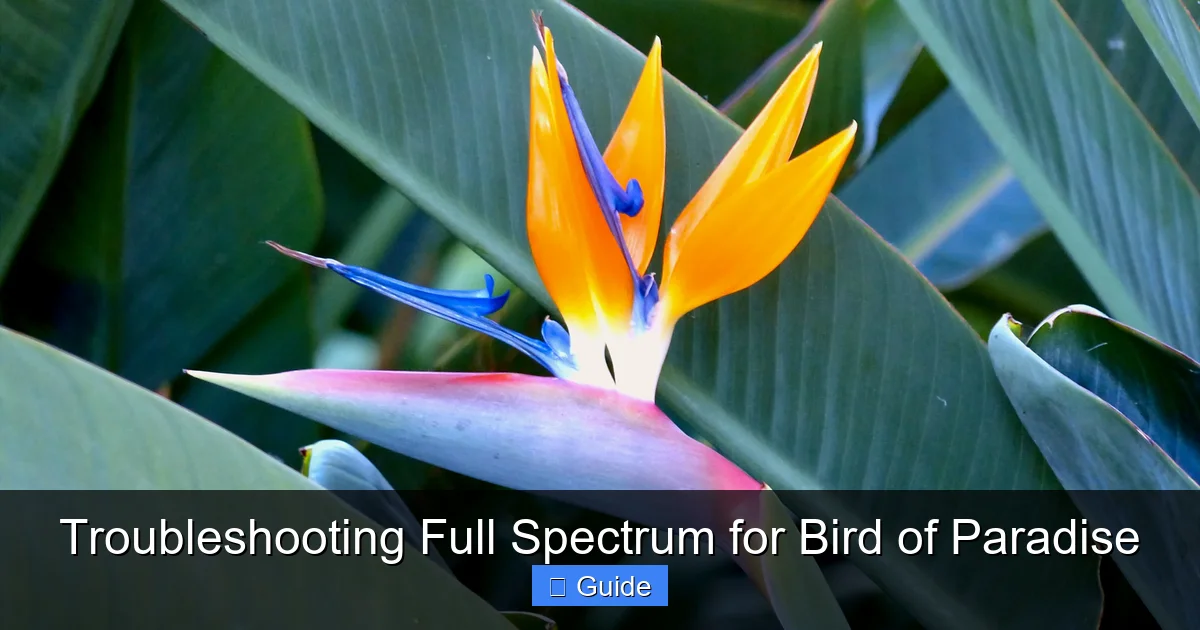
Troubleshooting Full Spectrum for Bird of Paradise
Bird of Paradise plants thrive under proper full spectrum lighting, but many growers struggle with intensity, duration, and positioning issues. This comprehensive guide covers everything from choosing the right grow light to diagnosing common problems like leaf burn, etiolation, and failure to bloom, helping you create the perfect light environment for stunning tropical growth.
Key Takeaways
- Light intensity matters most: Bird of Paradise needs 400-600 PPFD for healthy growth and 600+ PPFD to trigger flowering, measured at canopy level.
- Duration mimics nature: Provide 12-14 hours of light daily in growing season, reducing to 10-12 hours in winter to match natural photoperiods.
- Distance prevents damage: Keep LED lights 12-24 inches from foliage depending on wattage; too close causes bleaching, too far causes stretching.
- Spectrum quality affects results: Full spectrum lights with enhanced red (660nm) and blue (450nm) peaks plus UV/IR supplementation produce the strongest, most colorful growth.
- Watch for early warning signs: Pale new leaves mean insufficient light; brown crispy tips mean too much intensity or heat stress.
- Rotate for even growth: Turn your plant weekly to prevent lopsided development toward the light source.
- Supplement don’t replace: Even with grow lights, Bird of Paradise benefits from some natural light exposure when possible.
Quick Answers to Common Questions
How far should my full spectrum LED light be from my Bird of Paradise?
Start with the light 18-24 inches above the canopy for most quality LED panels. Adjust based on PPFD readings: aim for 500-600 PPFD at the top leaves. Dimmable lights can be placed closer (12-16 inches) at 70-80% power for better coverage.
Why is my Bird of Paradise growing tall and skinny under grow lights?
This is etiolation caused by insufficient light intensity or a spectrum deficient in blue light. Increase PPFD to 400-600 at canopy level, ensure your spectrum has strong 450nm blue output, and verify the light is centered overhead, not from the side.
What photoperiod triggers flowering in Bird of Paradise?
Mature plants need 12 hours of light / 12 hours of darkness for 8+ weeks to initiate flowering, preceded by a winter rest of 10 hours light. Constant 14-16 hour days suppress flowering even with high intensity.
Can I use regular household LED bulbs for my Bird of Paradise?
Standard household LEDs lack the intensity (PPFD) and spectral quality needed. They may keep a small plant alive but won’t support healthy growth or flowering. Invest in a horticultural LED panel with 200+ watts actual draw.
How do I know if my grow light is too strong for my Bird of Paradise?
Signs of excessive light: white/bleached patches on upper leaves, crispy brown leaf tips with yellow halos, leaves feeling hot to touch, and downward curling. Raise the light, dim it, or reduce photoperiod immediately.
📑 Table of Contents
- Why Full Spectrum Lighting Matters for Your Bird of Paradise
- Understanding Bird of Paradise Light Requirements
- Choosing the Right Full Spectrum Grow Light
- Setting Up Your Lighting System Correctly
- Diagnosing Common Light Related Problems
- Advanced Troubleshooting Techniques
- Seasonal Adjustments and Long Term Management
- Maintenance and Upgrades for Consistent Results
- Conclusion
Why Full Spectrum Lighting Matters for Your Bird of Paradise
If you have ever brought home a stunning Bird of Paradise only to watch it slowly decline indoors, you are not alone. These majestic tropical plants, with their iconic paddle shaped leaves and exotic crane like flowers, evolved under the intense, unfiltered sun of South Africa. When we bring them into our homes, even near bright windows, they often receive a fraction of the light energy they crave. That is where full spectrum grow lights enter the picture, and where many well meaning plant parents run into trouble.
The term full spectrum gets thrown around a lot in the grow light world, but not all lights labeled this way deliver what your Strelitzia actually needs. True full spectrum lighting mimics the complete range of wavelengths found in natural sunlight, from ultraviolet through visible light into infrared. Your Bird of Paradise uses different parts of this spectrum for different biological processes. Blue light drives compact, sturdy leaf development and strong root systems. Red light powers flowering and stem elongation. Green light penetrates deeper into the canopy. Even UV and far red play roles in stress resistance and morphological signaling. When any piece of this puzzle is missing or imbalanced, your plant tells you through its growth patterns.
Troubleshooting full spectrum lighting for Bird of Paradise is not about buying the most expensive fixture on the market. It is about understanding how light intensity, spectrum quality, photoperiod, and positioning interact with this specific species’ needs. A 100 watt panel placed six inches from the leaves creates a very different environment than a 400 watt fixture hung three feet away, even if both claim full spectrum output. Throughout this guide, we will walk through every variable, diagnose the most common problems growers face, and give you practical solutions to help your Bird of Paradise not just survive but thrive under artificial light.
Understanding Bird of Paradise Light Requirements
Natural Habitat Light Conditions
To troubleshoot effectively, you first need to understand what you are trying to replicate. In their native Eastern Cape region of South Africa, Bird of Paradise plants grow in open grasslands and along riverbanks where they receive full sun for six to eight hours daily, with total daylight exposure often exceeding twelve hours in summer. Light intensity at midday regularly hits 1500 to 2000 micromoles per square meter per second (PPFD). Even in the shade of taller vegetation, they still receive 400 to 800 PPFD of diffuse light. The spectrum is the full, continuous output of the sun, rich in blue and red with significant UV-A and UV-B components that trigger protective pigment production in the leaves.
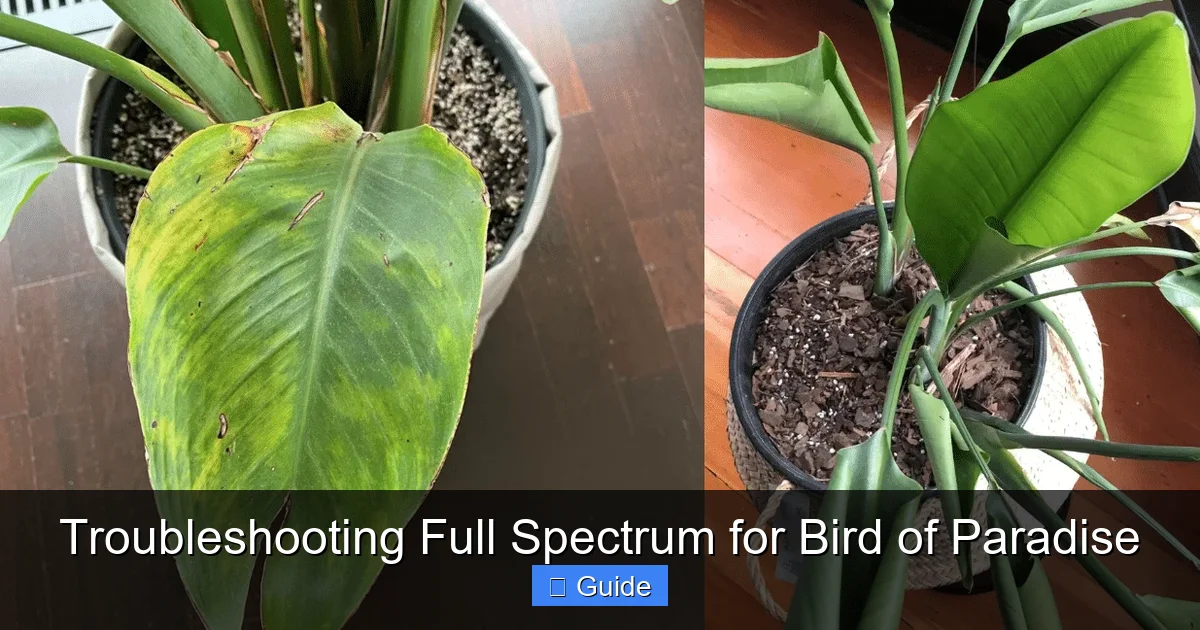
Visual guide about Troubleshooting Full Spectrum for Bird of Paradise
Image source: houseplantsnook.com
This evolutionary history explains why your plant struggles on a north facing windowsill. Indoor light levels, even at a bright south facing window, rarely exceed 400 PPFD on a clear day and drop dramatically just a few feet back. Window glass filters out most UV-B and a portion of UV-A, removing the wavelengths that stimulate flavonoid and anthocyanin production, the compounds that give leaves their deep green color and structural rigidity. The photoperiod indoors is also static, disconnected from seasonal changes that signal flowering cycles. Full spectrum grow lights solve these deficits, but only when configured correctly.
Minimum vs Optimal Light Levels
There is a critical difference between the light level that keeps a Bird of Paradise alive and the light level that makes it flourish. The absolute minimum PPFD for maintenance growth is around 200 micromoles. At this level, the plant will survive but produce small, thin leaves with wide internodal spacing. It will not flower. For healthy vegetative growth with good leaf size and thickness, you need 400 to 600 PPFD at the canopy. To trigger and sustain flowering, consistent levels of 600 to 800 PPFD or higher are required, combined with the right photoperiod and maturity.
Many growers make the mistake of assuming their light is sufficient because the plant is green and putting out new leaves. But new growth under insufficient light looks different. The petioles stretch long and weak. The leaf blades emerge smaller, thinner, and lighter in color. The characteristic split leaves that make mature Bird of Paradise so dramatic may never form, or form only on the oldest leaves. If your plant looks leggy and pale despite regular watering and fertilizing, light is almost certainly the limiting factor.
Seasonal Light Changes and Dormancy Signals
Bird of Paradise does not have a true dormancy period like deciduous trees, but it does respond to seasonal light cues. In nature, shortening days and lower sun angles in winter slow growth and help the plant conserve energy for the spring flowering push. Indoor growers often make two opposing mistakes. Some run their grow lights on a fixed twelve hour timer year round, denying the plant seasonal signals. Others reduce light too dramatically in winter, causing the plant to shed older leaves and weaken. The sweet spot is a gradual reduction from fourteen hours in summer to ten or eleven hours in winter, with a corresponding slight drop in intensity. This mimics the natural progression and keeps the plant’s internal clock calibrated for flowering when conditions improve.
Choosing the Right Full Spectrum Grow Light
LED vs Fluorescent vs HID for Bird of Paradise
When troubleshooting lighting issues, the fixture type is your starting point. High intensity discharge (HID) lights like metal halide and high pressure sodium were once the gold standard for large tropical plants, but they run hot, consume massive electricity, and require frequent bulb replacement. Their spectrum is also fixed and heavy on green yellow output, wasting energy on wavelengths plants use less efficiently. Fluorescent T5 high output tubes work well for seedlings and small plants but lack the penetration depth for a mature Bird of Paradise with its thick, upright canopy. The leaves shade each other, and fluorescent light drops off sharply with distance.
LED technology has effectively solved these problems for home growers. Modern full spectrum LED panels use a blend of white diodes (usually 3000K to 4000K for a sunlight like appearance) supplemented with deep red 660nm, royal blue 450nm, and sometimes UV 395nm and far red 730nm diodes. This creates a continuous spectrum with peaks in the photosynthetic action spectrum. LEDs run cool enough to place close to foliage without heat damage, penetrate deeply into the canopy, and allow precise spectrum tuning. For Bird of Paradise, a quality LED panel of 200 to 400 watts actual draw (not equivalent wattage marketing claims) is ideal for a single mature plant.
Decoding Spectrum Charts and Marketing Claims
One of the biggest sources of confusion when buying grow lights is interpreting spectrum graphs. Manufacturers love to show pretty rainbow charts, but the details matter. Look for a spectrum that shows substantial output across 400 to 700 nanometers (PAR range) with clear peaks around 450nm (blue) and 660nm (red). A high color rendering index (CRI above 90) indicates a full, continuous spectrum similar to sunlight, which is better for plant morphology and your ability to spot pests and deficiencies. Be wary of “blurple” lights that only have red and blue diodes with huge gaps in between. These can grow plants but often produce abnormal morphology, thin leaves, and poor flowering in broadleaf tropicals like Strelitzia.
Also check for UV and far red inclusion. UV-A (315 to 400nm) and UV-B (280 to 315nm) in small doses stimulate thicker cuticles, stronger leaf structure, and richer coloration. Far red (700 to 750nm) influences the phytochrome system, affecting stem elongation and flowering responses. Some premium fixtures include supplemental UV and far red bars you can run independently. These are valuable for Bird of Paradise but not strictly necessary if your main spectrum is robust.
PPFD Maps and Coverage Area Reality
Every reputable LED manufacturer publishes a PPFD map showing light intensity at various distances and positions across the coverage area. This is your most important troubleshooting tool before you even buy. A light might claim 800 PPFD at twelve inches, but that is usually the center point directly under the fixture. At the edges of a three by three foot coverage area, intensity might drop to 200 PPFD. Since Bird of Paradise grows upright with leaves radiating from a central crown, you need relatively even intensity across a circle roughly two to three feet in diameter for a mature plant.
When evaluating a fixture, look at the PPFD at the recommended hanging height for the outer edges of your plant’s canopy. If the map shows 600 PPFD in the center but only 150 PPFD at eighteen inches out, your outer leaves will be light starved. You either need a larger fixture, multiple fixtures, or to accept that you can only grow a smaller plant under that light. For a single large Bird of Paradise, a fixture with a four by four foot or larger even coverage area at 24 inch height is ideal. This usually means a 300 to 400 watt actual draw panel or a pair of 200 watt panels spaced apart.
Setting Up Your Lighting System Correctly
Hanging Height and the Inverse Square Law
The relationship between light distance and intensity follows the inverse square law. Double the distance, and intensity drops to one quarter. Halve the distance, and intensity quadruples. This is why hanging height is the single most powerful adjustment you have. Most quality LED panels for tropical plants are designed to hang twelve to twenty four inches above the canopy. At twelve inches, you get maximum intensity but a smaller coverage footprint. At twenty four inches, coverage expands but intensity drops significantly.
For Bird of Paradise, start with the light at eighteen to twenty inches above the highest leaf. Use a PAR meter if you have access to one, or a smartphone app with a cosine corrected sensor for a rough estimate. Aim for 500 to 600 PPFD at the top leaves and no less than 300 PPFD at the lowest leaves. If your light is dimmable, you can hang it closer and dim it to expand coverage while maintaining intensity. This is often the best strategy for broad canopy plants. Run the light at seventy to eighty percent power at sixteen to eighteen inches for a balance of intensity and spread.
Photoperiod Programming for Growth Stages
Your timer settings should change with the seasons and the plant’s life stage. For a young plant focused on vegetative establishment, fourteen to sixteen hours of light daily works well. This mimics the long days of a South African spring and summer, pushing maximum leaf production. Once the plant reaches maturity (usually three to five years from seed, two to three from division), you want to encourage flowering. Shift to twelve hours on, twelve hours off. This equal day night cycle is a strong floral inductive signal for many tropical species. In winter, drop to ten hours on, fourteen hours off for six to eight weeks, then gradually increase back to twelve. This simulated winter rest often triggers the flower spike initiation that constant long days suppress.
Use a quality digital timer with battery backup. Mechanical timers drift and fail. Smart plugs with sunrise sunset scheduling are even better, as they automatically adjust for seasonal day length changes at your latitude. Just ensure the schedule matches the plant’s needs, not your local sunrise if you live far from the tropics.
Light Positioning and Plant Rotation Strategy
Bird of Paradise grows with a strong phototropic response. Leaves orient perpendicular to the light source to maximize interception. Under a stationary overhead light, this creates a beautiful symmetrical rosette. Under a side mounted light or window, the plant leans dramatically, petioles elongate on the shaded side, and the crown becomes lopsided. If your grow light cannot be centered overhead, you must rotate the plant. A quarter turn weekly is standard. For larger specimens in heavy pots, use a rotating plant caddy or build a lazy susan platform. This simple habit prevents the need for drastic corrective pruning later.
Also consider light direction relative to leaf architecture. Bird of Paradise leaves are designed to intercept overhead light. Their thick, waxy cuticles and vertical orientation reduce midday sun exposure in nature. Under artificial light, if the fixture is too close, the top leaves can receive excessive intensity while lower leaves sit in deep shade. Angling the light slightly or using a secondary side fill light for the lower canopy can create more even growth. Some growers use a main overhead panel plus two lower wattage strip lights on the sides aimed upward at the lower petioles.
Diagnosing Common Light Related Problems
Etiolation and Leggy Growth
Etiolation is the classic symptom of insufficient light. The plant stretches desperately toward the source, producing long, weak petioles, small pale leaf blades, and wide gaps between leaves. The overall silhouette becomes sparse and floppy rather than dense and architectural. New leaves may fail to develop the characteristic splits or fenestrations. The plant feels lightweight for its size because the tissues are thin and watery rather than dense and fibrous.
To fix this, first verify your actual PPFD at canopy level. If it is below 300, you need more light. Options include lowering the fixture, increasing wattage, adding a second light, or extending photoperiod (but not beyond sixteen hours). If intensity is adequate but the plant is still stretching, check spectrum. A deficiency in blue light relative to red causes elongation. Some “bloom booster” LED modes are heavy on red and light on blue. Switch to a veg or full spectrum mode with stronger blue output. Also ensure the light is centered overhead. Side lighting creates one sided etiolation even if total photons are sufficient.
Existing etiolated growth will not correct itself. You can either let it be and wait for new proper growth to replace it over time, or prune the worst offenders once the plant has produced several strong new leaves under corrected conditions. Never remove more than one third of the foliage at once.
Light Bleaching and Photoinhibition
On the opposite end, too much light causes bleaching. The uppermost leaves develop white, yellow, or silver patches where chlorophyll has been destroyed. These areas become papery and necrotic. The damage usually starts at the leaf tips and margins and progresses inward. In severe cases, entire leaves turn a ghostly pale green or yellowish white. This is photoinhibition, where the photosynthetic apparatus is overwhelmed and damaged by excess photon flux.
Bird of Paradise is fairly tolerant of high light if acclimated gradually, but a sudden move from low light to intense grow light will bleach leaves in days. The fix is immediate: raise the light, dim the fixture, or reduce photoperiod. Damaged leaves will not recover. Remove severely bleached leaves to prevent fungal entry. Partially damaged leaves can stay if the green portions are still photosynthesizing. When reintroducing light after a bleaching event, increase intensity by ten percent every three days over two weeks.
Leaf Burn vs Nutrient Burn Confusion
Growers often mistake light stress for nutrient problems. Light burn appears as crispy brown tips and margins on the leaves closest to the light, often with a yellow halo between the brown and green tissue. The damage is localized to the upper canopy. Nutrient burn from overfertilization typically shows as brown tips on older, lower leaves first, often with a more uniform yellowing progressing from the tip back. Light burn also correlates with the light schedule, appearing or worsening after a recent intensity increase.
If you suspect light burn, check leaf temperature with an infrared thermometer. Leaves under intense LED light can run several degrees warmer than ambient air, especially if airflow is poor. Transpiration cannot keep up, and tissues cook. A simple clip fan blowing across the canopy solves this by breaking the boundary layer and enhancing cooling. Aim for leaf temperature within two degrees of room temperature.
Failure to Flower Despite Good Growth
This is the most frustrating scenario. Your Bird of Paradise looks magnificent, huge glossy leaves, strong upright form, but year after year, no flowers. Light is usually the culprit, but in subtle ways. First, the plant must be mature. Seed grown plants take three to five years. Division propagated plants may bloom in two to three. If yours is mature and vegetative, check these light factors:
- Is PPFD consistently above 600 at the crown during the flowering inductive period?
- Is the photoperiod twelve hours or less for at least eight weeks? Continuous long days suppress flowering in many Strelitzia varieties.
- Does your spectrum include far red (730nm)? The phytochrome far red form (Pfr) to red form (Pr) ratio influences flowering. End of day far red treatment (ten minutes of far red only after main lights off) can promote flowering in some long day plants, but Bird of Paradise responds better to short days with a natural spectrum.
- Is there a distinct seasonal change? Constant conditions year round can keep the plant in perpetual vegetative mode.
Try a dedicated winter rest: ten hours light at 400 PPFD for eight weeks, then ramp up to twelve hours at 700+ PPFD. Combine with slightly cooler nights (sixty to sixty five Fahrenheit) and reduced watering. This combination often breaks the flowering barrier.
Uneven Growth and Crown Leaning
If your plant develops a pronounced lean or the crown grows sideways, the light is not centered or the plant is not rotating. Bird of Paradise has a strong apical dominance. The newest leaves emerge from the center and orient toward the brightest direction. If that direction is constant, the entire crown shifts. Over years, this creates a permanently twisted plant that is difficult to correct.
Fix by centering the light directly over the crown. If using multiple lights, balance them symmetrically. Implement weekly rotation. For an already leaning mature plant, you can try strategic pruning of leaves on the leaning side to shift the center of gravity, combined with a stake and gentle correction over months. But prevention through rotation is far easier.
Advanced Troubleshooting Techniques
Using a PAR Meter for Precision
If you are serious about optimizing light for Bird of Paradise, a PAR meter is the single best investment after the light itself. Smartphone apps are better than nothing but can be off by fifty percent or more due to sensor limitations and lack of cosine correction. A dedicated quantum PAR meter like the Apogee MQ-500 or similar gives you accurate PPFD readings across the canopy. Map your light footprint at different heights and dimming levels. Create a spreadsheet. This data lets you dial in the exact hanging height and power setting for your target PPFD at every leaf level.
With a meter, you can also verify manufacturer claims. Many budget LEDs overstate output by thirty to fifty percent. You can measure degradation over time. LED output drops gradually, and after twenty thousand hours, you may have lost fifteen to twenty percent intensity. A meter tells you when to replace or supplement.
Daily Light Integral (DLI) Tracking
PPFD is instantaneous. Daily Light Integral (DLI) is the total photons delivered over the full photoperiod, measured in moles per square meter per day. Bird of Paradise thrives at a DLI of twenty to thirty moles for vegetative growth and thirty to forty for flowering. Calculate your DLI: PPFD (micromoles) times photoperiod (hours) times 3600 divided by one million. For example, 500 PPFD for fourteen hours equals 25.2 moles DLI. Perfect for vegetative growth. 700 PPFD for twelve hours equals 30.2 moles, entering the flowering zone.
Tracking DLI helps you balance intensity and duration. If you must hang the light higher for coverage, dropping to 400 PPFD, extend the photoperiod to sixteen hours to maintain DLI (23 moles). But remember, photoperiod also signals season. Do not extend beyond sixteen hours, and avoid long days during the flowering inductive period.
Spectrum Tuning for Specific Goals
If your fixture has independently controllable channels (white, red, blue, UV, far red), you can tune spectrum for different objectives. For maximum leaf size and thickness, boost blue to twenty to thirty percent of total output. For flowering induction, ensure red is strong (sixty to seventy percent of output) and run a short far red pulse at end of day. For color enhancement and stress hardening, run UV-A for thirty minutes at midday, three times per week. Start with low UV doses (one to two watts per square foot) and monitor for stress.
Keep a lighting journal. Note spectrum settings, hanging height, photoperiod, and plant response weekly. Photos with date stamps are invaluable. This turns troubleshooting from guesswork into a controlled experiment.
Supplemental Lighting Strategies
For very large specimens or multi plant setups, a single overhead light leaves the lower canopy and outer leaves light starved. Supplemental lighting solves this. Add LED strip lights or small panels vertically along the sides of the plant, aimed at the lower petioles and inner canopy. Run these at lower intensity (one hundred to two hundred PPFD) on the same timer as the main light. This fills the “light wells” created by self shading.
Another strategy: interlighting. Place a linear LED fixture horizontally at mid canopy height, shining upward into the lower leaf axils. This is common in commercial greenhouse production and works beautifully for Bird of Paradise’s upright architecture. The lower leaves contribute significantly to whole plant carbon gain when illuminated.
Seasonal Adjustments and Long Term Management
Spring Ramp Up Protocol
As winter transitions to spring, your Bird of Paradise needs a gradual light increase to avoid shock. If you ran a winter rest at ten hours and 400 PPFD, increase by thirty minutes and fifty PPFD per week over six weeks until you reach your summer target (fourteen hours, 600 PPFD). This mimics the natural rate of day length and sun angle change. During this ramp, watch for the first signs of flower spike emergence, a thick, pointed bud pushing from the crown center, distinct from a leaf bud which is flatter and more rounded. Once you see a flower spike, lock in twelve hours at maximum intensity. Do not revert to long days.
Summer Heat Management
Grow lights add heat to your grow space. In summer, ambient temperatures may already be high. LED fixtures convert forty to fifty percent of electricity to heat. A 400 watt panel adds 150 to 200 watts of heat, roughly equivalent to a small space heater. In a closed room, this can push temperatures above the eighty five Fahrenheit threshold where Bird of Paradise photosynthesis declines. Monitor canopy temperature. If it exceeds eighty degrees, increase airflow with additional fans, vent the room, or run lights during cooler night hours (if your photoperiod allows). Some growers shift to a night light schedule in summer: lights on 8 PM to 8 AM. The plant does not care about clock time, only duration and intensity.
Fall Transition and Winter Rest
In fall, reverse the spring ramp. Gradually reduce photoperiod and intensity over six weeks to your winter targets. This signals the plant to harden off, store carbohydrates, and prepare for flowering initiation. Reduce watering frequency and stop fertilizing during the winter rest. The plant’s metabolic rate drops, and excess water or nutrients cause root issues. Resume fertilizing at half strength when you begin the spring ramp up.
Acclimating to Outdoor Summer Conditions
Many growers move Bird of Paradise outdoors for summer. This provides unbeatable light intensity and spectrum but requires careful acclimation. Indoor leaves, even under strong grow lights, lack the UV protection and cuticle thickness for full sun. Start with full shade for one week. Then dappled shade for one week. Then morning sun only for one week. Then full sun. This four week process prevents catastrophic bleaching. When bringing the plant back indoors in fall, reverse the process over two weeks. Also inspect thoroughly for pests before reintroduction. Outdoor exposure often brings spider mites, scale, or thrips that explode indoors without natural predators.
Maintenance and Upgrades for Consistent Results
Cleaning and Dust Management
Dust on your light’s lens or diodes reduces output significantly. A thin layer of dust can cut PPFD by ten to fifteen percent. Clean monthly with a microfiber cloth and isopropyl alcohol (seventy percent) on the diodes and lens. Power off and cool completely first. Dust on the plant’s leaves also reduces light absorption. Wipe leaves with a damp cloth monthly, supporting each leaf from underneath to avoid cracking the petiole. Clean leaves also discourage spider mites.
Monitoring LED Degradation
Quality LEDs maintain seventy percent output at fifty thousand hours. Cheap LEDs may hit that mark at fifteen thousand hours. If you run fourteen hours daily, that is three to ten years. But spectrum also shifts over time, usually toward the blue end as red phosphors degrade faster. This changes the blue red ratio, potentially causing elongation. If your plant starts stretching despite unchanged settings, and the fixture is over two years old, spectrum shift may be the cause. A PAR meter with spectral capability (like the Apogee SQ-520) can detect this. Otherwise, plan on fixture replacement or supplementation every three to five years for critical applications.
Upgrading Your System
As your Bird of Paradise grows, its light needs expand. A fixture that perfectly covered a two foot plant will be inadequate for a five foot specimen. Plan upgrades proactively. Modular systems let you add panels. Daisy chainable drivers let you expand without new outlets. If you are building a dedicated grow area, consider a rail system that moves a single high power light slowly across the canopy, simulating the sun’s arc and delivering even intensity to a large area with one fixture. This is advanced but highly effective for specimen plants.
Integrating Environmental Controls
Light does not exist in isolation. Temperature, humidity, CO2, and airflow all interact with light response. At high PPFD (above 600), photosynthesis becomes limited by CO2 availability at ambient levels (four hundred ppm). Supplemental CO2 to eight hundred to one thousand ppm can increase growth rate twenty to thirty percent under high light. But this requires a sealed room, CO2 controller, and safety measures. For most home growers, simply ensuring good air exchange (complete air change every five to ten minutes) maintains adequate CO2.
Vapor pressure deficit (VPD) should match light level. High light drives high transpiration. If humidity is too low, stomata close to conserve water, limiting photosynthesis despite abundant light. Target VPD of 0.8 to 1.2 kPa for Bird of Paradise. At eighty degrees Fahrenheit, this means sixty to seventy percent relative humidity. Use a humidifier if needed. The combination of high light, proper VPD, and good airflow creates the engine for explosive tropical growth.
Conclusion
Troubleshooting full spectrum lighting for Bird of Paradise is a journey of observation, adjustment, and patience. These plants are communicative. Every leaf tells a story about the light it received during its development. By learning to read those stories, pale new growth whispering for more photons, bleached tips screaming for distance, a stubborn refusal to flower begging for a winter rest, you become not just a plant owner but a light architect.
Start with the fundamentals. Choose a quality full spectrum LED with verified PPFD output. Position it for even coverage at the right intensity. Program a photoperiod that respects seasonal rhythms. Rotate weekly. Monitor with a PAR meter if possible. Adjust gradually. Keep records. And above all, enjoy the process. There is deep satisfaction in coaxing a tropical masterpiece to bloom under your care, guided by the same photons that drive life on Earth, delivered on your schedule, tuned to your plant’s needs.
Your Bird of Paradise wants to thrive. It evolved for three hundred million years to capture sunlight and turn it into beauty. With the right full spectrum setup, troubleshot and refined, you give it that sunlight on your terms. The reward, those impossible orange and blue flowers rising from a fountain of glossy green, is worth every hour of learning and adjusting. Happy growing.
Frequently Asked Questions
What is the minimum light requirement for Bird of Paradise to survive indoors?
Bird of Paradise needs a minimum of 200 PPFD (photosynthetic photon flux density) to survive, but will only maintain, not thrive. At this level, expect small leaves, no splits, and no flowers. For healthy growth, provide 400-600 PPFD.
How many hours of grow light does a Bird of Paradise need daily?
Provide 12-14 hours daily during active growth (spring/summer). Reduce to 10-12 hours in fall/winter to mimic seasonal changes. This photoperiod shift is crucial for triggering flowering in mature plants.
Can Bird of Paradise get too much artificial light?
Yes. Excessive PPFD (above 800-1000) or too-close placement causes photoinhibition: bleached white/yellow patches, crispy leaf tips, and heat stress. Always acclimate gradually when increasing intensity.
Do I need UV light for my Bird of Paradise?
UV-A/UV-B is not strictly required but highly beneficial. UV exposure thickens leaf cuticles, deepens green coloration, increases pest resistance, and produces more compact growth. Many premium fixtures include supplemental UV bars.
Why are my Bird of Paradise leaves splitting under grow lights?
Leaf splitting (fenestration) is a sign of maturity and good light! Mature leaves naturally split to allow wind passage and light penetration in nature. It indicates your plant is receiving sufficient intensity to develop proper adult foliage.
Should I rotate my Bird of Paradise under a centered grow light?
Yes, rotate 90 degrees weekly even with overhead lighting. Slight fixture asymmetry, room reflections, or plant morphology can cause subtle leaning over time. Weekly rotation ensures perfectly symmetrical crown development.