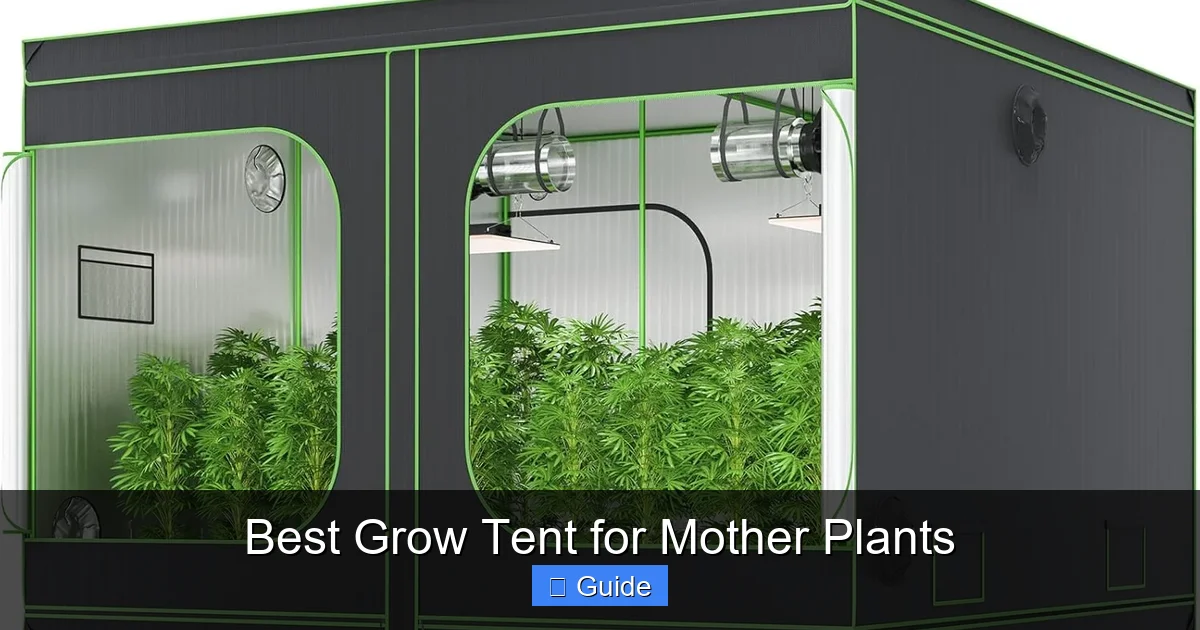
Best Grow Tent for Mother Plants
Finding the best grow tent for mother plants means prioritizing height, durability, and light-proofing to keep your genetics thriving year-round. This guide breaks down top models, must-have features, and setup tips so you can choose the perfect home for your prized mothers.
If you have been growing for a while, you know that mother plants are the backbone of a consistent garden. They hold the genetics you love. They give you clones that perform the same way every cycle. But mothers ask for something different than your flowering plants. They stay in veg for months. Sometimes years. They get big. They get heavy. They need a home that can handle that long haul.
Choosing the best grow tent for mother plants is not just about picking the biggest box. It is about finding a structure that stays light-tight after a year of daily zipper use. It is about a frame that will not bow when your plant spreads four feet wide. It is about ports that fit your actual ventilation gear, not some theoretical size. I have seen too many growers buy a cheap tent for their mothers, only to fight light leaks, collapsed poles, and heat issues six months later. Let us walk through what actually matters so you can buy once and grow for years.
Key Takeaways
- Height matters most: Mother plants need vertical space to grow tall and bushy, so choose a tent at least 6.5 feet high.
- Light-proof construction is non-negotiable: Even tiny light leaks can trigger hermaphroditism or stress your mothers.
- Heavy-duty frames support big plants: Steel poles rated for 100+ pounds prevent sagging when mothers get heavy.
- Multiple access points simplify maintenance: Large doors and observation windows let you prune, train, and inspect without disturbing the canopy.
- Ventilation ports must match your gear: Ensure ducting ports fit your inline fans and filters for proper climate control.
- Reflective interiors boost efficiency: Diamond Mylar or 600D fabric maximizes light distribution to lower branches.
- Budget for quality over size alone: A smaller premium tent outperforms a large flimsy one for long-term mother plant care.
Quick Answers to Common Questions
What size grow tent is best for mother plants?
A 4×4 tent with at least 7 feet of height is ideal for most home growers, providing enough vertical space for large pots and training while fitting in a standard room.
Can I use a cheap budget tent for mother plants?
Budget tents work short-term but often fail within a year due to light leaks, bent frames, and zipper failure; investing in a quality tent saves money long-term.
How many mother plants fit in a 4×4 tent?
One large mother in a 10-15 gallon pot or two medium mothers in 7-gallon pots fit comfortably with room for access and maintenance.
What light schedule do mother plants need?
Mother plants stay in vegetative growth with 18 hours of light and 6 hours of darkness (18/6) or continuous 24-hour light for maximum clone production.
How often should I replace my mother plants?
Replace mother plants every 18-24 months by cloning a vigorous branch from the original mother to reset vigor and prevent genetic drift.
📑 Table of Contents
Why Mother Plants Need a Specialized Tent
Mother plants live by different rules. Your flowering tents run twelve-twelve light cycles for eight to twelve weeks. Then they get cleaned and reset. A mother tent runs eighteen-six or twenty-four-zero for months on end. That constant light cycle changes everything about the environment.
The Long-Term Veg Cycle Demands
First, the plants get tall. A healthy mother in a five-gallon pot can hit five feet in a few months. In a ten-gallon fabric pot, she can push six feet with training. If your tent is only six feet tall, you lose a foot to the light hangers and another foot to the pot. You are left with four feet of plant space. That forces aggressive topping and training just to keep her from burning on the light. A seven-foot or eight-foot tent gives you breathing room.
Second, the canopy gets wide. Mothers are not pruned for bud production. They are pruned for clone sites. That means a broad, bushy shape with dozens of lateral branches. A standard four-by-four tent fills fast. A four-by-eight or five-by-five gives you room to walk around the plant, to reach the back branches, to actually see what you are doing.
Light Leaks Are a Silent Killer
This is the number one way mother tents fail. A flowering tent only needs to be dark for twelve hours. A mother tent needs to be dark for six hours, every single night, for potentially years. The zippers get used daily. The fabric stretches. The seams stress. Cheap tents develop pinhole leaks at the corners, around the ducting ports, along the zipper tracks. Those leaks send mixed signals to the plant. You get hermaphroditism. You get stressed growth. You get seeded clones. The best grow tent for mother plants uses overlapping flaps, double-stitched seams, and heavy-duty zippers rated for thousands of cycles.
Weight Capacity Is Real
A mother plant in a large fabric pot with wet soil weighs sixty to eighty pounds. Add a scrog net, a trellis, maybe a second plant. Your top frame bars need to hold that weight plus your light, your carbon filter, your ducting. Budget tents use sixteen-millimeter steel poles that bend under a hundred pounds. Quality tents use twenty-two-millimeter or twenty-five-millimeter steel with reinforced corners. That difference decides whether your tent stands straight or sags into a U-shape after six months.
Essential Features to Look For
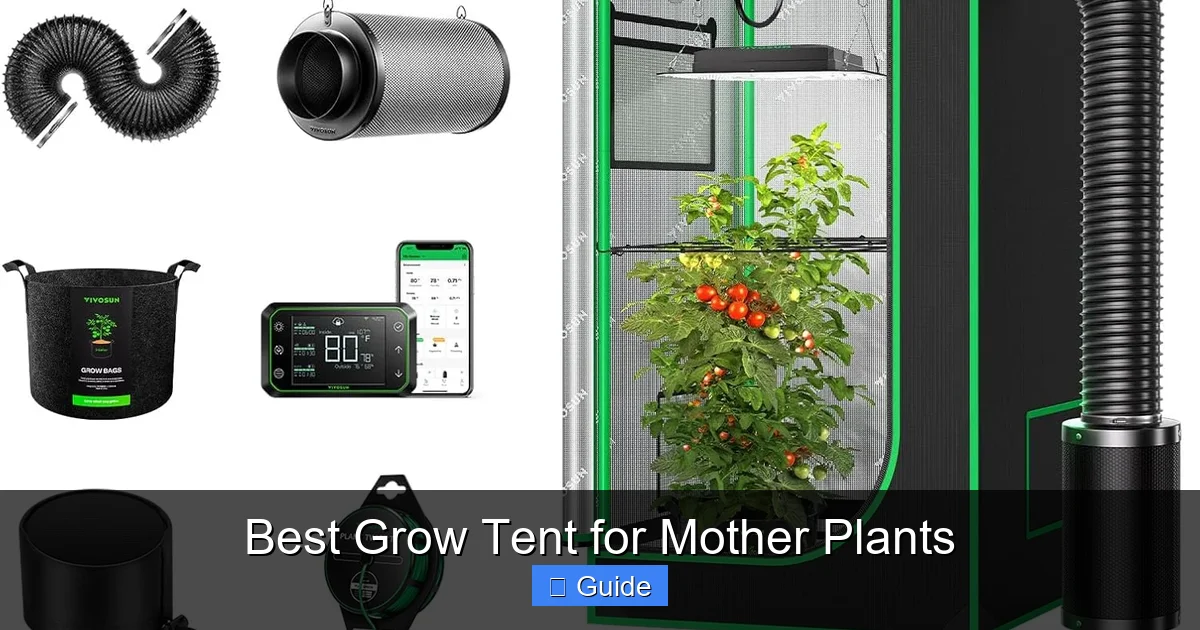
Before we look at specific models, let us lock down the feature checklist. Every tent on your shortlist should hit these marks.
Visual guide about Best Grow Tent for Mother Plants
Image source: m.media-amazon.com
Height: Seven Feet Minimum
I cannot stress this enough. A six-foot-six tent sounds tall until you hang a six-hundred-watt LED with a driver mounted on top. That light hangs eight to twelve inches below the top bar. Your pot sits six to eight inches off the floor. You just lost eighteen to twenty inches. Your plant has four and a half feet. That works for short mothers, but it limits your training options. A seven-foot or eight-foot tent lets you run taller pots, hang lights higher for better spread, and actually stand up straight when you walk in.
Frame Gauge: Twenty-Two Millimeters or Thicker
Look at the pole diameter in the specs. Sixteen millimeters is standard for budget two-by-two and three-by-three tents. It bends. Nineteen millimeters is better but still flexes under a heavy LED and filter combo. Twenty-two millimeters is the sweet spot for four-by-four and larger. Twenty-five millimeters is overkill for most but nice if you run big lights. Also check the corner connectors. Plastic corners crack. Metal corners with set screws last forever.
Fabric Density: Six Hundred Denier Minimum
The outer shell takes abuse. You brush past it. You lean tools against it. You wipe spills off it. Two hundred ten denier (210D) tears if you look at it wrong. Three hundred denier is okay for light use. Six hundred denier (600D) or sixteen-eighty denier (1680D) canvas stands up to years of daily entry. The inner reflective layer matters too. Diamond Mylar reflects ninety-five to ninety-seven percent of light. Cheap silver Mylar reflects eighty-five percent and creases into hot spots. Spend the extra money on the better liner.
Zipper Quality: Heavy-Duty SBS or YKK
You will zip and unzip the main door at least once a day. Maybe more. A cheap zipper splits, catches, or loses teeth within months. SBS and YKK are the industry standards for a reason. Look for double zippers so you can open just the top for a quick peek. Look for zipper flaps that overlap the teeth completely. That flap is your light seal.
Port Placement and Sizing
Count your gear. You need an intake port, an exhaust port, maybe a passive intake, a port for your AC infinity controller probe, a port for your humidifier hose, a port for your CO2 tubing. A good tent has multiple eight-inch and six-inch ports on different walls. Some have twelve-inch ports for big inline fans. Check the port locations against your room layout. You want the exhaust port near your window or vent hole. You want the intake port near your fresh air source. Adjustable drawstring ports seal better than fixed Velcro flaps.
Observation Windows
This seems like a luxury until you use one. A large Velcro-sealed window lets you check canopy height, spot pests, or admire your work without opening the door and dumping your climate. Get a tent with windows on at least two sides. Make sure the window covers have a light-proof flap behind the mesh.
Floor Tray and Spill Protection
Mothers drink a lot. A five-gallon pot can take two gallons a day in late veg. Spills happen. Nutrient solution eats stitching. A removable waterproof floor tray saves the tent bottom. Some tents have a built-in tray with Velcro corners. Others include a separate plastic tray. Either works. Just make sure it covers the full footprint and curves up the walls a few inches.
Top Grow Tent Picks for Mother Plants
Now let us look at specific models that earn the title of best grow tent for mother plants. I have grouped them by size class because your space dictates your options.
Best Four-by-Four: Gorilla Grow Tent GGT44
This is the gold standard for a reason. The GGT44 stands seven feet eleven inches tall with the included extension kit. That is nearly eight feet of vertical room. The poles are twenty-two-millimeter steel with metal corner connectors rated for three hundred pounds. The fabric is sixteen-eighty denier diamond reflective Mylar. The zippers are heavy-duty SBS with double flaps. It has two eight-inch ports, four six-inch ports, two four-inch ports, and large observation windows on three sides. The floor tray is removable and waterproof. It weighs forty-two pounds empty. That tells you the build quality. Price sits around four hundred fifty dollars. It is an investment, but a mother tent that lasts a decade costs forty-five dollars a year. Worth it.
Best Four-by-Eight: Secret Jardin Dark Room DR240
If you have the floor space, a four-by-eight lets you run two large mothers side by side or one massive mother with room to work. The DR240 is seven feet ten inches tall. The frame is twenty-five-millimeter steel tubes with a unique click-lock system that is absurdly strong. The fabric is 210D but with a double-layer construction that blocks light better than many 600D tents. It has massive ducting ports: four twelve-inch, four eight-inch, and several smaller ones. The doors are full-width roll-ups on both long sides. You can open the entire side of the tent. That access is a game changer for pruning big mothers. It runs about five hundred fifty dollars.
Best Five-by-Five: AC Infinity CloudLab 842
AC Infinity came in hot with the CloudLab line. The 842 is a five-by-five at six feet eleven inches tall. The frame is twenty-two-millimeter steel with a clever quick-lock design that makes setup take ten minutes. The fabric is 2000D canvas. That is thick. Like, canvas bag thick. The inner liner is diamond Mylar with a claimed ninety-nine percent reflectivity. Ports include two ten-inch, four eight-inch, and six six-inch. The controller mount is built into the frame for AC Infinity controllers. The observation window is huge and uses a magnetic seal. It costs around four hundred dollars. For the build quality, it is arguably the best value on the market right now.
Best Budget Option: Vivosun Mylar Hydroponic Grow Tent 4×4
If you absolutely cannot spend four hundred dollars, the Vivosun 4×4 at six feet seven inches tall is the least bad budget choice. It uses sixteen-millimeter poles, so do not hang a heavy ceramic metal halide or a massive COB LED. The fabric is 600D with standard Mylar. Zippers are generic but functional if you are gentle. Ports: two eight-inch, four six-inch. It has one observation window. The floor tray is thin plastic. It costs about one hundred thirty dollars. Will it last three years? Maybe. Will it last five? Probably not. But it gets you growing today. Reinforce the corners with zip ties. Baby the zippers. Plan to upgrade.
Best for Low Ceilings: Gorilla Grow Tent Shorty 4×4
Some grow spaces have seven-foot ceilings. Standard tents do not fit. The Shorty is four feet eleven inches tall. With the one-foot extension, it hits five feet eleven. That is tight. You lose the ability to run big pots or hang lights high. But if this is your only option, the Shorty uses the same twenty-two-millimeter poles, same 1680D fabric, same SBS zippers as the big Gorilla. It just has less vertical room. You will need to train your mothers flat. Scrog, LST, heavy topping. It works. It costs the same as the tall version, around four hundred fifty dollars.
Best Premium Splurge: Secret Jardin Lodge L300
This is a different beast. The Lodge L300 is a modular system. The base unit is a four-by-four mother tent at seven feet ten inches. But you can attach a three-by-three propagation tent and a three-by-three veg tent to the sides. Each module has its own light, its own climate, its own door. You create a perpetual harvest machine. The build is twenty-five-millimeter frame, 210D double-layer fabric, industrial zippers. It costs twelve hundred dollars for the mother module alone. Add the side modules and you are at three thousand. This is for the serious commercial or craft grower who wants a seamless workflow. If that is you, nothing else compares.
Setting Up Your Mother Tent for Success
Buying the best grow tent for mother plants is step one. Setting it up right is step two. A great tent set up poorly fails. A decent tent set up well thrives.
Light Selection and Hanging
Mothers want blue-heavy spectrum. You are not flowering them. You want tight internodes, strong stems, lots of clone sites. A full-spectrum LED with a veg switch or a dedicated veg spectrum works. Metal halide ceramic (CMH) 315-watt bulbs are legendary for mothers. The light quality is unmatched. But they run hot. In a tent, heat management matters. LED runs cooler. Look for a light with a dimmer. You want thirty to forty watts per square foot at canopy. For a four-by-four, that is four hundred eighty to six hundred forty watts. Hang the light on ratchet hangers from the top frame bars. Not from the crossbars. The top frame bars go to the corners. They take the weight. Center the light. Use a PAR meter or app to check uniformity. Adjust height for even coverage.
Ventilation Design
You need active intake and active exhaust. Passive intake works for flowering tents with lower heat loads. Mothers under eighteen hours of light build heat. Size your inline fan for one full air exchange per minute. Calculate tent volume in cubic feet. A four-by-four by seven-foot tent is one hundred twelve cubic feet. A six-inch fan rated at four hundred CFM gives you three and a half exchanges per minute. That is good. Pair it with a carbon filter on the intake side inside the tent. Run ducting straight and short. Every bend cuts airflow. Use insulated ducting to muffle fan noise. Mount the fan outside the tent if possible. It saves space and reduces vibration transfer.
Climate Control: Temperature and Humidity
Mothers like it warm and humid. Seventy-eight to eighty-two degrees Fahrenheit. Sixty to seventy percent relative humidity. That is higher humidity than flowering. It promotes vegetative growth. It keeps clone sites healthy. Use a humidifier with a built-in humidistat. Place it outside the tent, duct the output through a port. Use a heater with a thermostat if your room runs cold. Oil-filled radiators are safe and steady. Avoid ceramic heaters that cycle on and off hard. They create temperature swings. Place a digital hygrometer at canopy level. Not on the wall. Not at floor level. Canopy level tells you what the plant feels.
Pot Size and Media
Mother pots are permanent homes. Five gallons is the minimum. Seven gallons is better. Ten or fifteen gallons if you have the height and strength. Fabric pots air-prune roots. They prevent root binding. They breathe. Use a high-quality coco coir blend or a living soil mix. Living soil with worms and microbes feeds the plant for months with just water and top-dress amendments. Coco needs liquid feed every watering. Both work. Choose based on your style. Elevate pots on risers or a mesh table. Airflow under the pot prevents root rot and keeps the floor dry.
Training for Maximum Clone Production
You are not growing for buds. You are growing for nodes. Every node is a potential clone. Top early. Top often. First top at the fourth node. Then let each branch grow four nodes and top again. Repeat. You create a wide, flat canopy with dozens of tops. Use a scrog net at eighteen to twenty-four inches above the pot. Weave branches through the net. Keep the canopy even. Remove any growth below the net that will not get light. It wastes energy. Defoliate strategically. Remove large fan leaves that shade clone sites. Do this every two weeks. The plant responds with vigorous new growth at the nodes.
Integrated Pest Management
Mothers are in the tent for months. Pests have time to build populations. Spider mites, thrips, aphids, fungus gnats. They will find you. Prevention is everything. Hang yellow sticky traps at canopy level. One per nine square feet. Check them weekly. Run a weekly foliar spray rotation. Week one: neem oil. Week two: potassium silicate. Week three: insecticidal soap. Week four: just water. Repeat. This prevents resistance. Keeps the cuticle thick. Keeps the plant healthy. Quarantine any new clones entering the mother tent. Keep them in a separate tent for two weeks. Treat them. Then introduce them.
Maintaining Your Mother Tent Long-Term
The best grow tent for mother plants stays great only if you maintain it. Here is the routine.
Daily Checks
Walk in. Look at the canopy. Check the hygrometer. Feel the soil. Smell the air. Does it smell fresh? Earthy? Or sour? Stale? Check the fan speed. Is it running? Check the light timer. Is the cycle right? Zip the door fully. Check the zipper flap overlap. This takes two minutes. It saves crops.
Weekly Deep Clean
Once a week, turn off the light. Open the doors. Wipe the floor tray with diluted hydrogen peroxide. Check the corners for moisture. Check the zipper tracks for debris. Vacuum the floor. Inspect the fabric for pinholes. Shine a bright light outside the tent in a dark room. Look for leaks from inside. Patch any with tent repair tape. Clean the fan blades. Dust the carbon filter pre-filter. Check ducting connections. Tighten clamps.
Monthly Maintenance
Once a month, take the mother out. Really. Move the pot to a saucer outside the tent. Inspect the root zone. Check for root binding at the fabric edges. Top-dress with compost or amendments. Scratch it in. Water it in. Clean the tent interior walls with a microfiber cloth. Dust the light diodes. Check the PAR output. LEDs degrade. Two percent per year is normal. Ten percent means replace. Check the frame bolts. Tighten any loose set screws. Lubricate zippers with silicone zipper lube. Not WD-40. That eats fabric.
Annual Refresh
Once a year, break it down. Wash the fabric. Most 600D and 1680D tents can be hand-washed in a tub with mild detergent. Rinse thoroughly. Air dry completely. Inspect every seam. Re-tape if needed. Replace the carbon filter. They last twelve to eighteen months at full load. Replace the pre-filter. Check the fan bearings. Spin the blade. It should spin freely for ten seconds. If it stops in two, replace the fan. Upgrade any gear that has better tech now. Controllers get smarter. Lights get more efficient. Your tent is the constant. Everything else evolves.
Common Mistakes to Avoid
I have made all of these. Learn from my scars.
Buying Too Small
“I’ll just top it more.” Famous last words. A cramped mother gives you weak clones. The lower branches stretch. The internodes elongate. The clone sites are thin. You get fewer cuts. They root slower. They grow weaker. Buy the biggest tent your space and budget allow. You will fill it.
Skimping on the Frame
That ninety-nine dollar tent with sixteen-millimeter poles? It will bend. When it bends, the light hangs crooked. The canopy gets uneven light. The tent walls bow in. The zipper track misaligns. The door stops sealing. Light leaks start. You tape it. It leaks again. You buy a new tent in a year. Spend the extra two hundred dollars upfront. Cry once.
Ignoring Light Leaks
“It’s just a pinhole.” A pinhole at canopy level is a laser beam to a plant. It signals day length. It triggers flowering hormones. It causes hermaphroditism. You get seeds in your clones. You pass genetics you did not want. Fix every leak. Immediately. Carry tent repair tape in your pocket.
Running Flowering Nutrients
Mothers are in veg. Forever. They need nitrogen. Calcium. Magnesium. Silica. They do not need high phosphorus and potassium. Bloom boosters make them stretch. They make internodes long. They reduce clone quality. Use a veg formula. Or a balanced all-purpose. Keep EC moderate. One point two to one point eight. Push it and you burn tips. Burnt tips mean fewer healthy clone sites.
Neglecting Root Health
Out of sight, out of mind. Roots fill the pot. They circle. They choke. The plant slows down. Clones get weak. Once a year, root prune. Take the plant out. Shave an inch off the bottom and sides of the root ball. Replant in fresh media. Water with kelp and fulvic acid. She will explode with new growth. Do this in early spring before the heavy clone season.
Advanced Mother Plant Strategies
Once you have the best grow tent for mother plants running smooth, you can level up.
Perpetual Harvest Integration
Your mother tent feeds your veg tent. Your veg tent feeds your flower tent. Time it right. Take clones every two weeks. Root them in two weeks. Veg them for four weeks. Flower them. You harvest every two weeks. Forever. The mother tent is the engine. Keep it reliable. Keep it clean. Keep it productive.
Genetic Preservation
Run multiple mothers of your keeper phenotypes. Label them. Track them. One mother per strain per tent. Or use a larger tent with dividers. Keep a journal. Photos. Dates. Clone counts. Root times. Vigor notes. When a mother shows decline (usually after eighteen to twenty-four months), replace her with a vigorous clone from herself. Reset the clock. The genetics stay young.
Tissue Culture Prep
If you go deep, clean mothers are essential for tissue culture. Zero pests. Zero pathogens. Zero pesticides. Run a sterile protocol. HEPA filter on intake. Positive pressure. UV sterilization on water. Clean room suits for entry. This is next level. But it starts with the same tent principles. Light-tight. Cleanable. Controllable.
Breeding Projects
Mothers let you reverse. Spray silver thiosulfate on a branch. Collect pollen. Pollinate a different mother. Make seeds. Select the best. The tent isolates the project. No stray pollen. Controlled environment. You create your own strains. Your own genetics. That is the ultimate freedom.
Conclusion
Choosing the best grow tent for mother plants is one of the smartest investments a serious grower makes. It is not glamorous. It does not produce the harvest you show off. But it produces the genetics that make every harvest possible. A tall, strong, light-tight tent with good zippers and real ventilation ports pays for itself in healthy clones, consistent cycles, and peace of mind. You sleep better knowing your mothers are safe. Your genetics are secure. Your next run is already started.
Start with the space you have. Measure twice. Buy the tallest tent that fits. Spend on frame gauge and fabric density. Save on brand name if the specs match. Set it up with care. Light, air, water, media, training. Do the daily, weekly, monthly rituals. Your mothers will thank you with armfuls of perfect cuts. And every plant you grow from them will carry that care forward.
Now go measure your space. Pick your tent. Build the home your mothers deserve. The clones are waiting.
Frequently Asked Questions
What is the minimum height for a mother plant tent?
The minimum height for a mother plant tent is 6.5 feet, but 7 feet or taller is strongly recommended to accommodate large pots, light hangers, and plant training without height restrictions.
Do mother plants need a different light spectrum than flowering plants?
Yes, mother plants thrive under blue-heavy or full-spectrum veg lighting that promotes tight internodes and abundant lateral branching for clone sites, unlike red-heavy flowering spectra.
How do I prevent light leaks in my mother tent?
Use a tent with overlapping zipper flaps and double-stitched seams, regularly inspect for pinholes with a bright light in a dark room, and immediately patch any leaks with tent repair tape.
What pot size is best for long-term mother plants?
7-15 gallon fabric pots are ideal for long-term mothers, providing ample root space, air pruning benefits, and stability for large canopies while preventing root binding.
Can I keep mother plants in the same tent as flowering plants?
No, mother plants require 18/6 or 24/0 light cycles while flowering plants need 12/12; mixing them causes light cycle conflict that ruins both the mothers and the flower crop.
How often should I take clones from mother plants?
Take clones every 2-3 weeks from healthy lower branches, allowing the mother time to recover and produce new clone sites while maintaining a steady supply for perpetual harvests.