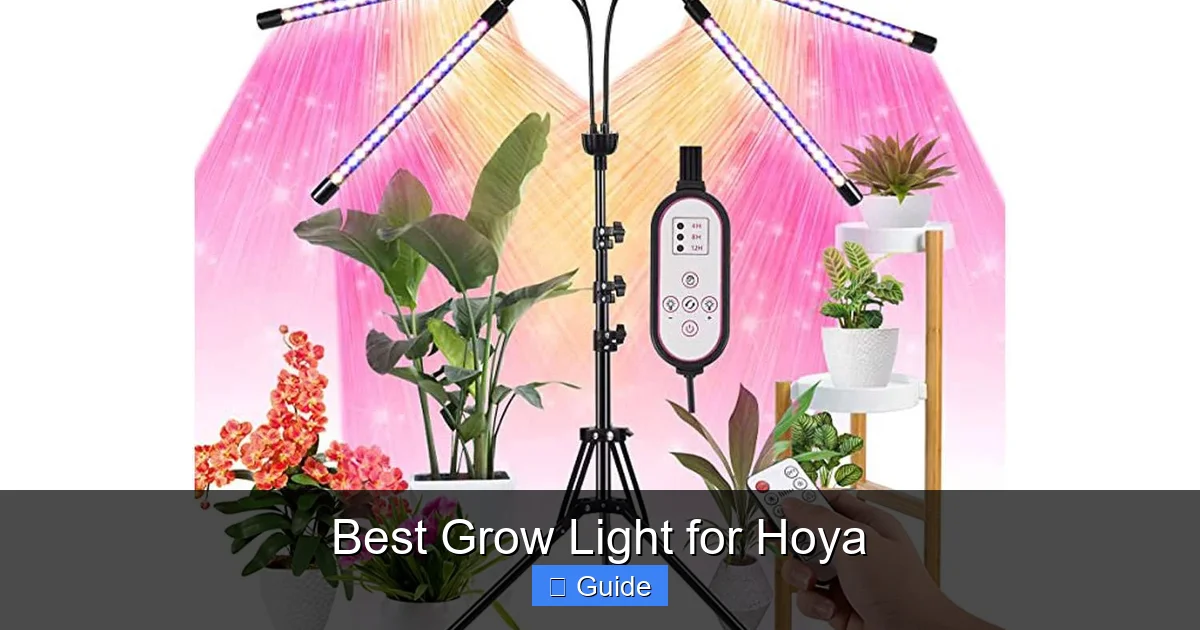
Best Grow Light for Hoya
Finding the best grow light for hoya plants transforms struggling vines into lush, blooming beauties. This guide breaks down spectrum needs, intensity requirements, and top-rated fixtures so you can give your wax plants the perfect indoor sunshine they crave.
Key Takeaways
- Full spectrum is non-negotiable: Hoyas need both blue and red wavelengths for vegetative growth and flowering triggers
- PPFD matters more than watts: Target 150-300 µmol/m²/s for mature plants and 100-150 µmol/m²/s for younger specimens
- Distance changes everything: Most LED fixtures perform best 12-24 inches above canopy depending on wattage and lens angle
- Photoperiod controls blooms: 12-14 hours daily mimics tropical day length and encourages flower initiation
- Heat management protects leaves: Quality drivers and passive cooling prevent leaf scorch on thick, succulent foliage
- Dimmable fixtures offer flexibility: Adjust intensity as seasons change or when moving plants between growth stages
- Budget options exist but have limits: Entry-level panels work for small collections but lack uniformity for larger setups
Quick Answers to Common Questions
What PPFD do hoyas need for flowering?
Mature hoyas flower best at 200-400 µmol/m²/s with a 12-14 hour photoperiod. Lower light may sustain foliage but rarely triggers reliable blooming.
Can I use regular LED shop lights for hoyas?
Yes, 4000K-5000K high-lumen shop lights work for propagation and moderate growth. They lack the efficiency and spectrum tuning of horticultural LEDs but cost far less.
How far should grow lights be from hoya leaves?
Most 100W quantum boards: 18-24 inches. 20W bars: 12-18 inches. Clip bulbs: 8-12 inches. Adjust based on plant response and manufacturer specs.
Do variegated hoyas need more or less light?
They need bright light to maintain variegation but burn easier. Target 200-300 µmol/m²/s with careful monitoring. Increase gradually during acclimation.
Should I run grow lights 24 hours for faster growth?
No. Hoyas need a dark period for respiration and flowering signals. 12-14 hours on, 10-12 hours off is optimal. Continuous light causes stress and metabolic issues.
📑 Table of Contents
- Why Your Hoya Deserves Better Light
- Understanding Hoya Light Requirements
- Types of Grow Lights Suitable for Hoyas
- Top Picks: Best Grow Light for Hoya at Every Budget
- Setting Up Your Grow Light System
- Species-Specific Light Nuances
- Common Mistakes and How to Fix Them
- Measuring and Monitoring Success
- Seasonal Adjustments and Long-Term Management
- Budget-Friendly Hacks and DIY Options
- Conclusion: Light Is the Foundation
Why Your Hoya Deserves Better Light
Let me start with a confession. I killed my first hoya carnosa compacta because I thought a sunny windowsill was enough. Three months of etiolation, zero blooms, and one very sad plant later, I learned the hard way that these tropical epiphytes have specific demands. The best grow light for hoya isn’t about blasting maximum photons. It’s about mimicking the dappled, bright-but-filtered light these plants receive clinging to tree branches in Southeast Asian rainforests.
Most houseplant parents underestimate how much light hoyas actually want. Yes, they’re “low light tolerant” in marketing speak. But tolerant doesn’t mean thriving. A hoya surviving in a dark corner will grow leggy, produce tiny leaves, and never reward you with those iconic waxy umbels. The right grow light changes everything. Compact growth. Rich color. And eventually, those fragrant star-shaped flowers that make the whole obsession worth it.
This guide walks through everything I’ve learned from years of trial, error, and conversations with commercial growers. We’ll cover spectrum science without the jargon, real-world fixture recommendations at different price points, and the setup details that separate decent results from spectacular ones. Whether you’re nursing a single cutting or managing a shelf full of rare cultivars, you’ll find actionable guidance here.
Understanding Hoya Light Requirements
Natural Habitat Clues
Hoyas evolved as epiphytes in tropical and subtropical forests across Asia, Australia, and the Pacific. They grow on tree trunks and branches, receiving bright indirect light filtered through the canopy. This tells us three critical things. First, they want high light intensity but not direct, scorching sun. Second, they experience consistent day lengths year-round near the equator. Third, the light spectrum they receive is full and balanced, not skewed toward any single wavelength.
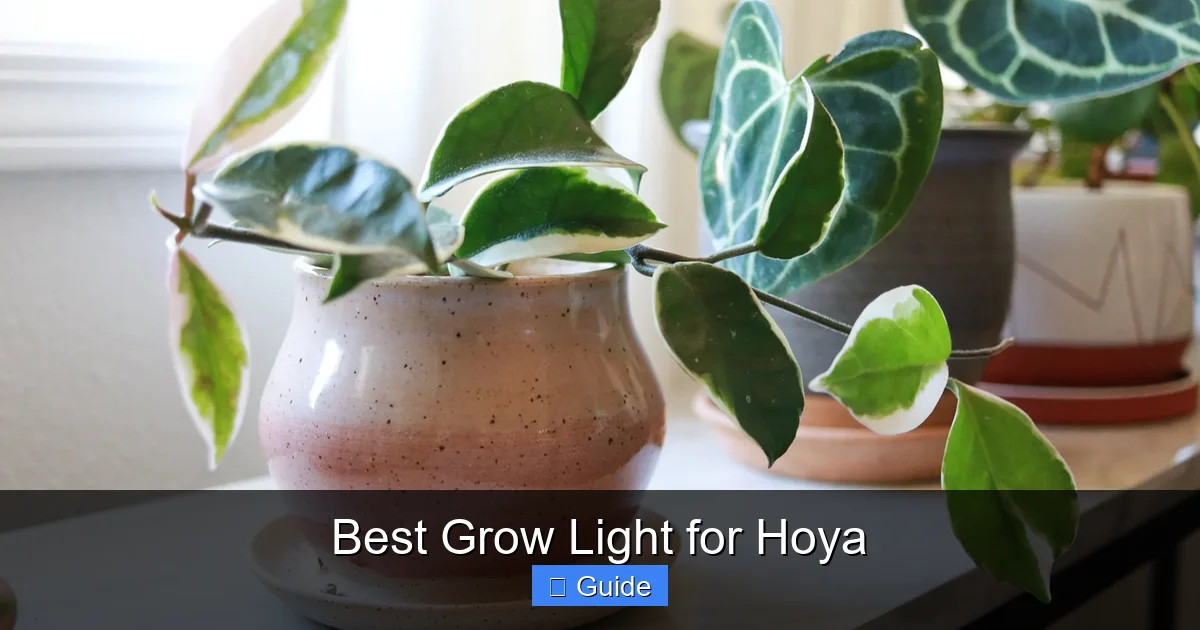
Visual guide about Best Grow Light for Hoya
Image source: cleverbloom.com
Translating this to indoor growing means we need fixtures that deliver substantial photon flux without excessive heat. We need consistent photoperiods. And we need full spectrum output that includes both the blue wavelengths driving compact vegetative growth and the red wavelengths triggering flowering responses. The best grow light for hoya collections balances all three factors.
PPFD Targets for Different Growth Stages
Photosynthetic Photon Flux Density (PPFD) measures usable light reaching your plant. For hoyas, here are the practical targets I’ve found work well. Seedlings and fresh cuttings need gentle light around 50-100 µmol/m²/s. Juvenile plants establishing root systems thrive at 100-150 µmol/m²/s. Mature, actively growing specimens want 150-300 µmol/m²/s. Flowering plants can handle up to 400 µmol/m²/s if humidity and airflow are adequate.
These numbers assume a 12-14 hour photoperiod. Daily Light Integral (DLI) matters too. Hoyas generally want 8-15 mol/m²/day. A fixture delivering 200 µmol/m²/s for 12 hours provides 8.6 mol/m²/day, right in the sweet spot. If you run lights 14 hours, that same fixture delivers 10 mol/m²/day. Adjust intensity or duration to hit your target DLI.
Spectrum Breakdown: What Wavelengths Do What
Blue light (400-500nm) promotes compact internodes, thick leaves, and strong root development. This prevents the leggy, stretched growth that signals insufficient light. Red light (600-700nm) drives photosynthesis efficiently and, critically for hoya collectors, influences flowering through phytochrome responses. Far-red (700-750nm) can encourage stem elongation, which we generally want to avoid.
Green light (500-600nm) penetrates deeper into leaf tissue and lower canopy layers. This matters for mature hoyas with dense foliage. UV-A (315-400nm) in small amounts can increase anthocyanin production, enhancing the beautiful red-bronze stress colors on varieties like hoya sunrise or hoya krohniana splash. The best grow light for hoya plants includes all these regions in balanced proportions, typically appearing as neutral white light around 4000K-5000K color temperature.
Types of Grow Lights Suitable for Hoyas
LED Panels and Quantum Boards
These dominate the serious hobbyist market for good reason. High efficacy (2.7-3.0+ µmol/J), passive cooling, and customizable spectra make them ideal. Quantum boards use Samsung LM301H or similar diodes on aluminum heatsinks. They run cool, last 50,000+ hours, and provide excellent canopy penetration. Panel-style fixtures with lenses offer more focused output for taller plants.
For a typical 2×2 foot growing area, a 100-150 watt quantum board delivers 200-400 µmol/m²/s at 18-24 inches. That’s perfect for a shelf of mature hoyas. Dimmable drivers let you dial back for younger plants. Brands like HLG, Spider Farmer, and Mars Hydro offer reliable options. The upfront cost is higher but efficiency savings and longevity make them economical long-term.
LED Bars and Linear Fixtures
Bars excel for shelving setups. Mount one bar per shelf, 12-18 inches above plants. They provide even coverage across rectangular footprints. Many commercial vertical farms use this format. For home growers, 20-30 watt bars spaced every 12-18 inches work beautifully. Look for full spectrum white diodes (4000K) rather than purple “blurple” mixes. White light lets you see true leaf color and spot pests early.
COB (Chip-on-Board) LEDs
COBs pack intense output in a small footprint. A single 50-100 watt COB can cover a 2×2 area with deep penetration. They run hotter than quantum boards and need active cooling (fans). The intense point source can create hot spots if not diffused. For hoyas, I’d recommend COBs only with good reflectors or diffusion lenses, and careful distance management to avoid leaf burn on succulent foliage.
T5 and T8 Fluorescent Fixtures
Old school but still viable. High-output T5s (54W, 6500K) deliver 100-150 µmol/m²/s at 12 inches. They’re cheaper upfront but less efficient, run warmer, and bulbs degrade yearly. T8 shop lights are even less intense. For a small propagation shelf or budget setup, they work. But the best grow light for hoya long-term is almost always LED. The electricity savings alone pay the difference within 12-18 months.
Clip Lights and Bulb Retrofits
E26/E27 screw-in LED grow bulbs (15-30W) work for single plants. Look for high CRI (>90) full spectrum white versions. Avoid cheap purple “plant bulbs” with poor spectrum. Clip lights with adjustable goosenecks let you position light precisely. These are great for spotlighting a prized specimen or supplementing a dark corner. Just don’t expect uniform coverage across multiple plants.
Top Picks: Best Grow Light for Hoya at Every Budget
Premium Choice: HLG 100 V2 Quantum Board
This 100-watt fixture uses Samsung LM301H diodes and a Mean Well driver. It delivers ~300 µmol/m²/s at 18 inches over a 2×2 foot area. Passive cooling means zero noise. The 4000K spectrum is perfect for hoyas, balancing vegetative and flowering needs. Dimmable from 60-100 watts. Build quality is exceptional. Price runs $150-180 but it’s a buy-once-cry-once investment.
Best Value Quantum Board: Spider Farmer SF-1000
Similar specs to the HLG at roughly $110-130. Uses Samsung LM301B diodes and a Mean Well driver. Slightly lower efficacy but still excellent. Covers 2×2 feet for veg, 1.5×1.5 for flower. Dimmable knob on the driver. Reliable warranty support. This is my go-to recommendation for someone buying their first serious LED.
Best Bar Light: Mars Hydro VG80
Four 20-watt bars (80W total) designed for 4×2 foot coverage or stacked shelves. Each bar puts out ~150 µmol/m²/s at 12 inches. Daisy-chainable. IP65 water resistance handles humidity. $120-140 for the 4-bar kit. Perfect for IKEA greenhouse cabinet builds or wire shelving units.
Budget Panel: Viparspectra P1000
100-watt SMD LED panel around $90-100. Samsung LM281B+ diodes. No-name driver but decent. Covers 2×2 veg, 1.5×1.5 flower. Dimmable. Fan-cooled so slight noise. Good entry point if quantum board pricing is steep. Expect 2-3 years before diode degradation becomes noticeable.
Best Clip Light: Sansi 36W Full Spectrum
E26 bulb with ceramic heat sink and high CRI white light. ~120 µmol/m²/s at 12 inches. $30-40. Pair with a quality clamp fixture ($15-20). Ideal for a single large hoya or supplementing a shelf corner. Not for whole-collection coverage but unbeatable for targeted use.
Best for Propagation: Barrina T5 LED Integrated Fixtures
4-foot, 22W LED tubes (4-pack for $60-70). 5000K full spectrum. Linkable up to 6 units. Mount under each shelf. 100-120 µmol/m²/s at 10 inches. Perfect for rooting cuttings and growing seedlings. Low heat won’t dry out propagation boxes. Replace entire fixture when diodes fade (30,000+ hour rating).
Setting Up Your Grow Light System
Distance and Coverage Calculations
Every fixture has a sweet spot. Too close causes photoinhibition and heat stress. Too far wastes photons via inverse square law. Start with manufacturer recommendations. For most 100W quantum boards, 18-24 inches above mature canopy is ideal. For 20W bars, 12-18 inches. For clip bulbs, 8-12 inches. Use a PAR meter if you have one. If not, watch your plants. Compact growth with slight reddish stress color on sun-loving varieties means you’re in the zone.
Coverage uniformity matters. A single point source creates a bright center and dim edges. For shelves wider than 2 feet, use multiple fixtures or bars spaced for overlap. Aim for less than 30% variation across the canopy. This prevents some plants stretching while others burn. The best grow light for hoya setups prioritize even distribution over maximum center intensity.
Photoperiod Programming
Consistency triggers flowering. Use a digital timer. 12 hours on, 12 off is safe year-round. 14 on, 10 off accelerates growth but may delay blooms on some species. Never run 24/7. Plants need dark period respiration. If your room gets natural light, sync artificial photoperiod to extend daylight, not create erratic cycles. Dawn/dusk dimming (30 min ramp up/down) mimics nature and reduces shock.
Heat and Airflow Management
LEDs run cooler than HID but still produce heat. Hoyas hate stagnant, hot air around their leaves. Ensure gentle air movement across the canopy. A small clip fan on low, oscillating, prevents boundary layer buildup. This reduces fungal risk and strengthens stems. Keep fixtures clean. Dust on diodes reduces output and traps heat. Wipe monthly with a dry microfiber cloth.
Humidity Considerations Under Lights
Grow lights increase transpiration. Hoyas want 60-80% humidity. In dry homes, lights can drop ambient humidity below 40%. Group plants together. Use humidity trays. Run a humidifier if needed. Monitor with a hygrometer at canopy level. Crispy leaf edges or stalled growth often signal humidity too low for the light intensity provided.
Mounting Solutions for Different Spaces
Wire shelving units (metro racks) are the gold standard. Mount bars or panels under each shelf with zip ties, S-hooks, or adjustable hangers. IKEA greenhouse cabinets (Milsbo, Detolf, Fabrikör) work beautifully with bar lights on each glass shelf. For window-adjacent setups, tension rods with hanging chains allow height adjustment. Wall-mounted track lighting with grow bulbs suits single-specimen displays.
Species-Specific Light Nuances
High Light Lovers
Hoya sunrise, hoya sp. aff. burtoniae, hoya wayetii, hoya bilobata, and hoya krohniana varieties want the upper end of PPFD ranges (250-400 µmol/m²/s). They develop stunning stress colors under intense light. Give them the brightest shelf positions. Monitor for bleaching (white patches) which signals too much.
Moderate Light Preferences
Hoya carnosa, hoya pubicalyx, hoya australis, hoya obovata, and hoya kerrii do beautifully at 150-250 µmol/m²/s. These are your workhorse varieties. They’ll bloom reliably without demanding the absolute brightest spots. Perfect for middle shelves or slightly further from fixtures.
Lower Light Tolerant
Hoya bella, hoya linearis, hoya curtisii, and hoya shepherdii handle 100-150 µmol/m²/s. They naturally grow in shadier understory positions. Don’t blast them. They’ll survive brighter spots but may stay smaller or show stress. Use dimmers or greater distance for these.
Variegated Varieties Need Special Care
Variegated hoyas (carnosa ‘Krimson Queen’, ‘Krimson Princess’, pubicalyx ‘Splash’, etc.) have less chlorophyll. They need bright light to compensate but burn easier. Target moderate-high PPFD (200-300 µmol/m²/s) but watch closely. White/pink sectors scorch first. If reverting to all-green, increase light slightly. If burning, back off immediately.
Common Mistakes and How to Fix Them
Mistake 1: Relying on Window Light Alone
Even south-facing windows deliver 50-70% less PPFD than outdoor shade. Glass filters UV. Winter days are short. Etiolation happens fast. Fix: Supplement with a clip light or bar fixture on a timer. Even 50 µmol/m²/s extra for 14 hours makes a measurable difference.
Mistake 2: Buying “Blurple” Lights
Red/blue only fixtures make plants look alien and hide pests, nutrient issues, and variegation changes. They also lack green and far-red for canopy penetration and morphological balance. Fix: Choose full spectrum white LEDs (3500K-5000K, CRI >80). Your eyes and plants will thank you.
Mistake 3: Setting and Forgetting Distance
Plants grow. Canopy rises. Light intensity increases exponentially as distance decreases. A fixture perfect at 24 inches burns leaves at 12 inches. Fix: Adjust height weekly. Use adjustable hangers (ratchet ropes, chain, pulleys). Mark positions for different growth stages.
Mistake 4: Ignoring Photoperiod Consistency
Random on/off cycles confuse phytochrome systems. Hoyas measure night length to trigger flowering. Interrupted dark periods reset the clock. Fix: Digital timer. Battery backup. Never manually override except for maintenance.
Mistake 5: Underpowering for the Footprint
A 30W panel over a 3×3 foot shelf delivers ~30 µmol/m²/s. That’s barely survival light. Fix: Match fixture output to coverage area. Use PPFD maps from manufacturers. When in doubt, over-provision and dim down.
Mistake 6: Neglecting Acclimation
Moving a windowsill hoya directly under 300 µmol/m²/s causes severe sunburn. Fix: Harden off over 2-3 weeks. Start at 24+ inches or 50% dimmer. Increase intensity 10-15% every 3-4 days. Watch for stress signals.
Measuring and Monitoring Success
Visual Indicators You’re Nailing It
Compact internodes (short gaps between leaves). Leaves thick, turgid, held horizontally or slightly upward. Rich green color (or variety-appropriate stress colors). Active growth points at multiple nodes. Peduncles (flower spurs) forming and persistent. No stretching toward light source. These signs confirm your best grow light for hoya setup is working.
Warning Signs of Too Much Light
Yellowing or bleaching on upper leaves. Brown crispy patches (necrosis). Leaves folding upward (taco-ing) to reduce exposure. Red/purple stress color on varieties that don’t normally show it. Stunted new growth. If you see these, raise lights or dim immediately.
Warning Signs of Too Little Light
Long internodes (leggy growth). Small, thin leaves. Petioles elongating. Leaves angling toward light source. No new peduncles. Aborted flower buds. Pale green color. Slow or no growth. Lower leaves yellowing and dropping. Fix: Increase intensity, duration, or both.
Using Technology to Optimize
PAR meters (Apogee, SpotOn) give absolute PPFD readings. Worth it for serious collectors. Smartphone apps (Photone, PPFD Meter) work surprisingly well for relative comparisons if calibrated. Lux meters help with white LEDs (rough conversion: 1 lux ≈ 0.0185 µmol/m²/s for 4000K). Data logs help correlate light changes with growth responses.
Seasonal Adjustments and Long-Term Management
Winter Strategy
Natural light drops. Days shorten. Hoyas may slow growth or enter semi-dormancy. Maintain 12-14 hour photoperiod. Keep intensity steady. Reduce watering and fertilizer to match slower metabolism. Watch for stretch if plants sense shortening days despite artificial light. Some growers increase to 14-16 hours in winter to maintain active growth.
Summer Strategy
Ambient heat rises. Lights add more heat. Monitor canopy temperature. If exceeding 85°F (29°C), raise lights, increase airflow, or reduce photoperiod to 10-12 hours. Humidity drops faster. Increase humidifier runtime. Summer is prime bloom season for many hoyas. Consistent light helps maximize flower production.
Fixture Maintenance Schedule
Monthly: Wipe diodes and lenses. Check fan operation (if applicable). Verify timer accuracy. Quarterly: Measure PPFD at canopy level. Compare to baseline. 10%+ drop indicates diode degradation or dust buildup. Annually: Inspect driver connections. Check for discoloration on PCBs. Plan replacement around 50,000 hours (5-6 years at 14 hrs/day).
Scaling Your Setup
Collection grows. Light needs grow. Modular systems (bars, daisy-chainable panels) scale easiest. Add fixtures rather than replacing. Keep spare dimmable drivers. Standardize on one spectrum (4000K) for consistency. Document what works for each species. Share cuttings with notes on light preferences.
Budget-Friendly Hacks and DIY Options
Repurposing Shop Lights
4-foot LED shop lights (4000K, 4000+ lumens) from hardware stores cost $20-30 each. Two per shelf deliver ~100 µmol/m²/s at 12 inches. Not as efficient as horticultural LEDs but 1/3 the price. Replace stock lenses with clear acrylic for better output. Great for propagation shelves where intensity needs are lower.
Building a Quantum Board Kit
Buy bare PCB strips (Samsung LM301H, 560mm), Mean Well HLG driver, and heatsink separately. Assemble with thermal paste and screws. Saves 30-40% vs pre-built. Requires basic electrical comfort. Many YouTube tutorials. Custom sizes fit odd spaces perfectly.
Supplementing with Natural Light
Place highest-light hoyas in brightest windows. Use grow lights for everything else. Rotate plants weekly for even exposure. This hybrid approach stretches fixture budget. Just ensure artificial photoperiod extends natural day, not replaces it chaotically.
Conclusion: Light Is the Foundation
After years of growing hoyas under every conceivable light source, one truth stands out. You can perfect your soil mix, nail your watering schedule, and curate the rarest cultivars. But without appropriate light, you’re fighting biology. The best grow light for hoya plants isn’t a luxury. It’s the single most impactful investment you can make in your collection’s health and beauty.
Start where you are. A single Sansi bulb on a clip light beats zero supplemental light. A Spider Farmer SF-1000 transforms a bookshelf into a hoya factory. An HLG quantum board over a metro rack builds a world-class collection. Match your budget, space, and ambition. Then watch. Learn. Adjust. The plants will tell you everything you need to know.
Your next bloom spike. Your first hoya sunrise showing true crimson. The day you realize every leaf is perfect, compact, and glowing with health. That day comes from photons delivered consistently, thoughtfully, and generously. Give your hoyas the light they evolved for. They’ll repay you with growth that takes your breath away.
Frequently Asked Questions
What is the best grow light for hoya carnosa?
A full spectrum LED (4000K) delivering 150-250 µmol/m²/s at canopy level works perfectly for hoya carnosa. Quantum boards like the Spider Farmer SF-1000 or HLG 100 V2 at 18-24 inches provide ideal coverage for mature plants.
Can hoya plants grow under fluorescent lights?
Yes, high-output T5 fluorescents (6500K) support healthy hoya growth at 12-inch distance. They’re less efficient than LEDs and require annual bulb replacement, but work well for small setups or propagation shelves.
How many hours of artificial light do hoyas need daily?
Hoyas thrive with 12-14 hours of quality light daily. This mimics tropical day length and supports both vegetative growth and flowering. Use a timer for consistency, as interrupted dark periods can prevent blooming.
Why are my hoya leaves turning red under grow lights?
Red or bronze coloration is a protective stress response (anthocyanin production) to high light intensity. It’s normal for varieties like hoya sunrise or krohniana splash. If leaves bleach white or crisp, reduce intensity or increase distance.
Do I need different lights for hoya propagation vs mature plants?
Propagation needs lower intensity (50-100 µmol/m²/s) to prevent drying cuttings. Barrina T5 LED bars or dimmed quantum boards at 24+ inches work well. Mature plants want 150-300 µmol/m²/s for compact growth and flowering.
What color temperature is best for hoya grow lights?
4000K-5000K (neutral to cool white) provides balanced blue and red wavelengths for both vegetative growth and flowering. Avoid “blurple” red/blue only lights, which hinder visual monitoring and lack canopy-penetrating green wavelengths.