Complete Guide to T8 for Golden Pothos
T8 fluorescent lights are excellent for golden pothos when set up correctly. This guide covers optimal distance, daily light hours, color temperature, and common mistakes to avoid for thriving plants.
Key Takeaways
- T8 lights work well for pothos: They provide adequate intensity for this low-to-medium light plant without overheating.
- Distance matters most: Keep tubes 6 to 12 inches above foliage for best results without burning leaves.
- Use 6500K daylight tubes: Cool white spectrum mimics natural sunlight and promotes healthy variegation.
- Run lights 12 to 14 hours daily: Consistent photoperiod supports steady growth and prevents leggy stems.
- Rotate plants weekly: Even light distribution keeps growth balanced on all sides.
- Watch for light stress signs: Bleached patches or curling leaves mean the light is too close or too intense.
- Combine with natural light when possible: A bright window plus T8 backup gives the best year-round results.
Quick Answers to Common Questions
What color temperature T8 bulb is best for golden pothos?
6500K daylight tubes are ideal. They provide strong blue spectrum light that maintains variegation and prevents leggy growth.
How far should T8 lights be from pothos leaves?
Keep tubes 6 to 12 inches above the highest foliage. Start at 10 inches and adjust based on plant response.
How many hours of T8 light does golden pothos need daily?
12 to 14 hours per day is optimal. Use a timer for consistency. Never run lights 24/7.
Can I use regular shop light T8 bulbs or do I need special grow bulbs?
Standard 6500K shop light tubes work perfectly. Special plant bulbs offer no real advantage for foliage plants like pothos.
Why is my pothos losing variegation under T8 lights?
Usually means insufficient light intensity. Lower the fixture, add a second tube, or extend the photoperiod by 1-2 hours.
📑 Table of Contents
- Why Golden Pothos and T8 Lights Are a Perfect Match
- Understanding T8 Fluorescent Technology
- Choosing the Right T8 Bulbs for Pothos
- Setting Up Your T8 Fixture Correctly
- Light Schedule and Photoperiod Management
- Monitoring Plant Response and Troubleshooting
- Advanced Tips for T8 Pothos Success
- Common Mistakes and How to Avoid Them
- Budget Friendly T8 Setup Examples
- Seasonal Care Adjustments
- Propagation Under T8 Lights
- Conclusion
Why Golden Pothos and T8 Lights Are a Perfect Match
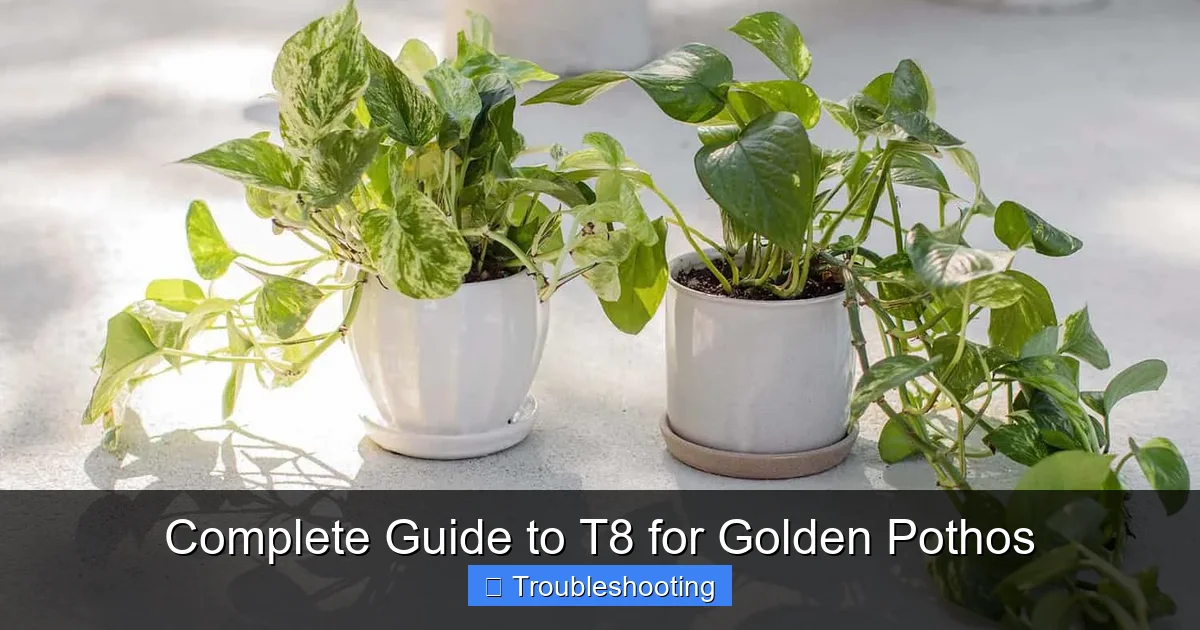
Golden pothos is one of the most popular houseplants for good reason. It tolerates neglect. It purifies air. It looks stunning trailing from a shelf or climbing a moss pole. But even this tough plant needs decent light to keep its signature yellow variegation bright. That is where T8 fluorescent tubes come in.
Many plant parents start with a sunny windowsill. Then winter arrives. Or they move to a darker apartment. Or they want to grow pothos in a basement office. Natural light becomes unreliable. T8 fixtures solve this problem. They are affordable. They run cool. They fit standard shelves. And they deliver the spectrum pothos needs to thrive indoors year round.
This guide walks you through everything. Choosing the right bulbs. Setting the correct distance. Timing the photoperiod. Troubleshooting common issues. By the end you will know exactly how to use T8 for golden pothos like a pro.
Understanding T8 Fluorescent Technology
What Does T8 Actually Mean
The T in T8 stands for tubular. The number 8 refers to the diameter in eighths of an inch. So a T8 tube is exactly one inch thick. This is the standard size for most modern fluorescent fixtures. You will also see T12 (older, thicker) and T5 (newer, thinner). T8 hits the sweet spot for home growers. Widely available. Reasonably priced. Good output.
Visual guide about Complete Guide to T8 for Golden Pothos
Image source: younghouselove.com
How Fluorescent Light Works
Electricity excites mercury vapor inside the glass tube. This produces ultraviolet light. The phosphor coating on the inner wall converts UV to visible light. Different phosphor blends create different color temperatures. This matters because plants use specific wavelengths for photosynthesis. Blue light drives leaf growth. Red light encourages flowering. Pothos is a foliage plant so we want strong blue output.
Why Not LED Instead
LED grow lights are fantastic. They are efficient. They last decades. They run very cool. But quality LED fixtures cost more upfront. T8 tubes and shop light fixtures cost a fraction of the price. For a few pothos plants on a shelf T8 makes financial sense. You can always upgrade later. Many growers run both. T8 for vegetative growth. LED for flowering plants.
Choosing the Right T8 Bulbs for Pothos
Color Temperature Is Critical
Look at the Kelvin rating on the package. This tells you the color appearance. Warm white is 2700K to 3000K. Cool white is 4000K to 4100K. Daylight is 5000K to 6500K. For golden pothos you want 6500K daylight tubes. This spectrum mimics midday sun. It keeps variegation vivid. It prevents stretching. It produces compact healthy growth.
Visual guide about Complete Guide to T8 for Golden Pothos
Image source: thespruce.com
Lumen Output and Wattage
Standard four foot T8 tubes run 32 watts and produce around 2800 to 3100 lumens each. Two tubes give you 5600 to 6200 lumens total. That is plenty for a two foot by four foot shelf. If you use a two foot fixture with 17 watt tubes expect roughly 1300 to 1400 lumens per tube. Still adequate for a small collection. Higher lumen tubes exist but cost more. Standard output works fine.
CRI and Full Spectrum Claims
Color Rendering Index measures how accurately a light shows colors compared to sunlight. Higher CRI (90+) looks more natural to human eyes. Plants do not care about CRI. They care about photosynthetic photon flux density. Some brands market full spectrum or plant specific T8 tubes. These often just have a higher blue peak. Standard 6500K shop light tubes perform nearly as well for foliage plants. Save your money.
Recommended Bulb Models
Philips Alto 32W 6500K. GE Sunshine 32W 6500K. Sylvania Octron 32W 6500K. Hyperikon 32W 6500K ballast bypass LED tubes if you want to convert an old fixture. Any major brand 6500K T8 will work. Avoid plant grow bulbs with pink or purple tint. They look weird in living spaces and offer no real advantage for pothos.
Setting Up Your T8 Fixture Correctly
Fixture Types and Mounting Options
Shop lights are the classic choice. Two tube or four tube. Chain hang from ceiling hooks. Screw into underside of shelves. Use S hooks for height adjustment. Some have built in pull chains. Others plug into a timer. Four tube fixtures give more intensity but cost more to run. Two tubes are sufficient for most pothos setups. Look for fixtures with reflective hoods. They direct light downward where plants need it.
Optimal Distance From Foliage
This is the single most important setting. Too close burns leaves. Too far causes leggy weak growth. The sweet spot for T8 and golden pothos is 6 to 12 inches from the top of the canopy. Measure from the tube surface to the highest leaves. Start at 10 inches. Observe for one week. If leaves look happy stay there. If variegation fades lower to 8 inches. If you see bleaching raise to 12 inches.
Adjusting Height As Plants Grow
Pothos grows fast under good light. Vines can add several inches per week in summer. You must raise the fixture or lower the plants regularly. Chain hangers make this easy. Check distance every Monday. Adjust as needed. Some growers put plants on wire shelves and lower the shelf instead. Either way maintain that 6 to 12 inch gap consistently.
Coverage Area Per Fixture
A standard four foot two tube fixture covers roughly two feet wide by four feet long at 10 inch height. Light intensity drops sharply at the edges. Place your healthiest most variegated plants directly under the center. Put greener more tolerant plants toward the ends. Rotate positions monthly so every plant gets prime time.
Light Schedule and Photoperiod Management
How Many Hours Per Day
Golden pothos evolved in tropical forests with consistent day length. Twelve to fourteen hours of light daily works best. Less than twelve hours slows growth. More than sixteen hours can stress the plant. Fourteen hours is a safe middle ground. It mimics long summer days. It gives plenty of photosynthetic time without overexposure.
Using Timers for Consistency
Plants hate irregular schedules. Forgetting to turn lights on or off confuses their internal clock. A simple mechanical or digital timer solves this. Set it once. Plug the fixture in. Done. Mechanical timers with pins are cheap and reliable. Digital timers offer more precision and battery backup. Either works. Just use one.
Seasonal Adjustments
In nature day length changes with seasons. You can mimic this if you want. Fourteen hours in spring summer. Twelve hours in fall winter. This may encourage a natural rest period. However pothos grows year round indoors without a dormancy phase. Keeping fourteen hours constant is perfectly fine. Many growers never change the timer. Their plants do great.
Dark Period Importance
Plants need darkness too. Respiration happens at night. Cells repair. Hormones regulate. Never run lights twenty four hours. At minimum give ten hours of true darkness. No night lights. No streetlight leaking in. If your grow area is in a living space use a blackout curtain or tent. Consistent dark period equals healthier plants.
Monitoring Plant Response and Troubleshooting
Signs Your Light Setup Is Working
New leaves emerge regularly. Variegation stays bright yellow and green. Stems are thick not spindly. Internodes (space between leaves) are short. Leaves face the light source. Growth is upward and outward. The plant looks perky not droopy. These are all green flags. Keep doing what you are doing.
Too Much Light Symptoms
Bleached white or yellow patches on leaves. Crispy brown leaf edges. Leaves curling downward or cupping. Stunted new growth. Reddish pigment on stems (stress anthocyanin). Soil drying extremely fast. If you see these raise the fixture two inches immediately. Check again in three days. Reduce photoperiod by one hour if needed.
Too Little Light Symptoms
Long gaps between leaves (leggy growth). New leaves smaller than old ones. Variegation fading to mostly green. Stems leaning dramatically toward light. Slow or no new growth. Lower leaves yellowing and dropping. If you see these lower the fixture two inches. Add a second fixture if possible. Extend photoperiod by one hour.
Uneven Growth Patterns
One side bushy the other bare. This means light is directional. Rotate the pot a quarter turn weekly. Or add a reflective barrier on the dark side. Mylar emergency blankets work great. White foam board works too. Even a mirror helps. Goal is even light from all angles.
Advanced Tips for T8 Pothos Success
Supplementing With Natural Light
If you have a bright window use it. Place T8 fixture on the opposite side of the plant. This gives wrap around light. Morning sun plus afternoon T8. Or T8 morning plus afternoon sun. Plants love the combination. Natural light has infrared that fluorescents lack. This warms leaves slightly and drives transpiration. Just avoid hot direct midday sun through glass. It can scorch even with T8 running.
Using Reflectors to Boost Output
Standard shop light hoods are white painted steel. They reflect maybe 70 percent. Mylar film reflects 95 percent. Line the inside of your hood with Mylar tape. Or buy Mylar lined hoods. This effectively gives you 30 percent more light for zero extra electricity. Huge win. Cover the sides too. Light bouncing off walls reaches lower leaves.
Grouping Plants by Light Needs
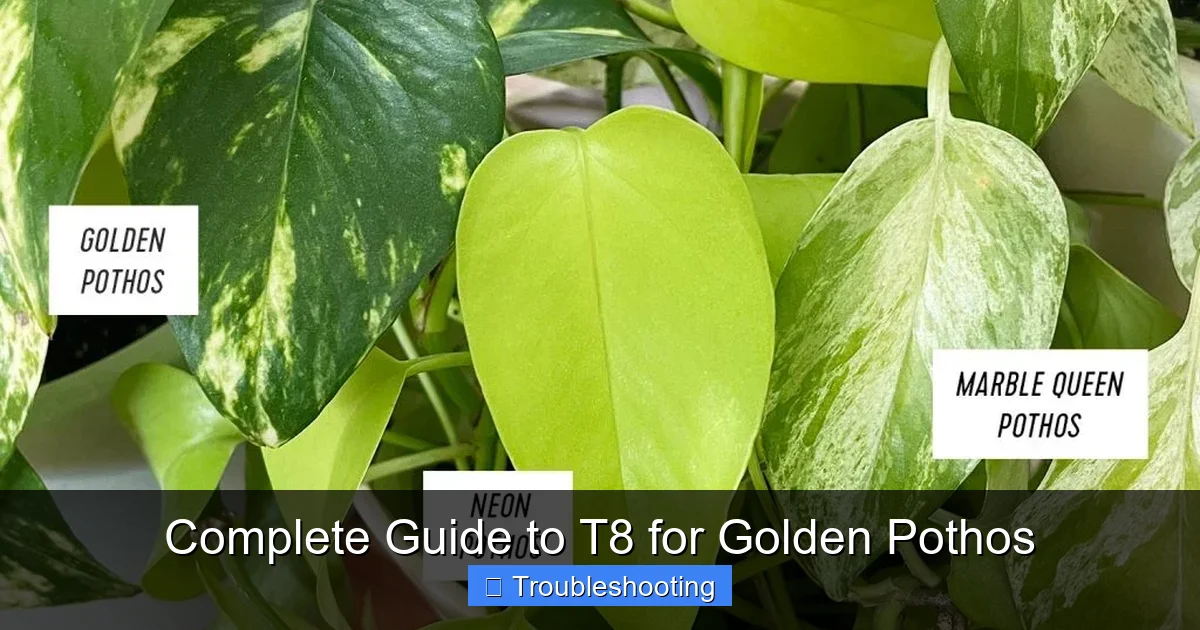
Not all pothos varieties want the same intensity. Golden pothos and marble queen handle brighter light. Neon pothos and jade pothos prefer slightly less. Group similar varieties under the same fixture. Put high light plants center. Lower light plants edges. This prevents burning the sensitive ones while satisfying the hungry ones.
Cleaning Tubes and Fixtures
Dust builds up fast on horizontal tubes. A dusty tube loses 15 to 20 percent output. Wipe tubes monthly with a dry microfiber cloth. Unplug first. Let cool. Clean the reflector hood too. Cobwebs love fixture corners. A clean system runs brighter and cooler. Your plants will notice the difference.
Replacing Tubes on Schedule
Fluorescent tubes degrade slowly. After 18 to 24 months they lose 20 to 30 percent intensity even though they still light up. Human eyes barely notice. Plants absolutely notice. Mark install date on the tube with a sharpie. Replace every two years. Or buy a cheap light meter app for your phone. When PAR drops below 100 at canopy level swap tubes.
Common Mistakes and How to Avoid Them
Mistake 1 Using Warm White Bulbs
Warm white 3000K looks cozy to humans. It is heavy on red light. Pothos stretches toward it. Variegation fades. Growth gets floppy. Always choose 6500K daylight. The bluish tint looks clinical at first. Your plants will thank you. Your eyes adjust in a day.
Mistake 2 Mounting Fixture Too High
Six feet up on the ceiling looks neat. At that height T8 provides almost nothing useful. Inverse square law kills intensity fast. Keep it close. Six to twelve inches. If that looks messy use a dedicated plant shelf. Hide the fixture under the next shelf up. Function over aesthetics.
Mistake 3 Running Lights 24/7
More light equals more growth right? Wrong. Plants need sleep. Continuous light causes oxidative stress. Leaves yellow. Tips burn. Growth stalls. Always use a timer. Fourteen hours on. Ten hours off. Non negotiable.
Mistake 4 Ignoring Heat Buildup
T8 runs cooler than old T12 or HID lights. But four tubes in a closed hood still generate warmth. In a small tent or enclosed shelf temperatures can climb. Add a small clip fan blowing across the tubes. Keeps leaves cool. Strengthens stems. Prevents fungal issues. Five dollar fan saves fifty dollar plants.
Mistake 5 Watering on a Schedule Instead of Need
Under lights soil dries faster. But not on a fixed schedule. Check soil with your finger. Top inch dry? Water. Still damp? Wait. Light intensity changes with tube age. Season changes humidity. Plant size changes uptake. Finger test never lies. Calendar lies often.
Budget Friendly T8 Setup Examples
Beginner Shelf Setup Under Fifty Dollars
Two foot shop light fixture two tube: twenty dollars. Two 17 watt 6500K T8 tubes: ten dollars. Mechanical timer: eight dollars. Chain and S hooks: five dollars. Wire shelf (existing or thrifted): free to fifteen dollars. Total roughly forty three dollars. Covers four to six small pothos pots. Perfect for a bedroom corner.
Intermediate Four Foot System
Four foot shop light four tube: forty dollars. Four 32 watt 6500K T8 tubes: twenty dollars. Digital timer with battery backup: fifteen dollars. Adjustable chain hangers: ten dollars. Mylar lining roll: twelve dollars. Wire shelving unit four tier: sixty dollars. Total roughly one hundred fifty seven dollars. Covers twenty plus plants. Scales beautifully.
Converting Old Fixtures to LED T8
Have an ancient T12 fixture? Do not toss it. Buy ballast bypass LED T8 tubes. Hyperikon or Barrina brands. Twelve dollars each. Remove ballast. Wire direct to mains (or hire electrician). Instant 50 percent energy savings. Zero flicker. Fifty thousand hour life. Modernizes your setup cheaply.
Seasonal Care Adjustments
Winter Low Humidity Management
Heating systems dry indoor air. T8 fixtures add slight warmth. Combined effect can drop humidity below 30 percent. Pothos tolerates this but prefers 50 percent plus. Group plants together. Use pebble trays. Run a humidifier. Mist daily if you enjoy it. Higher humidity keeps leaf tips green and prevents spider mites.
Summer Heat Considerations
Ambient temps rise. Tubes add heat. Canopy temperature may exceed 85F. Pothos slows growth above 90F. Add a fan. Raise fixture one inch. Reduce photoperiod to twelve hours. Water more frequently. Monitor closely during heat waves. Move setup to coolest room if needed.
Spring Growth Surge
Longer natural days trigger growth hormones. Even under artificial light plants sense season. Expect faster vine extension. Larger leaves. More frequent watering. Fertilize monthly with half strength balanced fertilizer. This is prime time for cuttings. Propagation success rates peak.
Fall Transition
Growth naturally slows. Reduce fertilizer to quarter strength. Water less often. Keep light schedule constant. Do not panic over fewer new leaves. Plant is storing energy. This is normal. Resist urge to increase light. Let the plant rest.
Propagation Under T8 Lights
Rooting Cuttings Successfully
T8 is fantastic for propagation. Cool temperature prevents cooking delicate cuttings. Even light encourages uniform root development. Take four to six inch cuttings with two to three nodes. Remove bottom leaf. Place in water or moist perlite. Put under T8 at twelve inch distance. Fourteen hour timer. Roots appear in ten to fourteen days. Pot up when roots are one inch long.
Transitioning Water Roots to Soil
Water roots are fragile. Soil transition shocks them. Keep newly potted cuttings under T8 at fourteen inches for first week. High humidity helps. Cover with clear plastic bag (vent daily). Gradually lower to standard ten inches over two weeks. Fertilize at quarter strength after first month.
Growing Mother Plants for Continuous Cuttings
Dedicate one large pot as a mother plant. Keep it under prime center light. Fertilize regularly. Prune aggressively to encourage branching. Each pruning yields new cuttings. Mother plant stays bushy and productive. Rotate which vines you cut to maintain shape.
Conclusion
Golden pothos and T8 fluorescent lights are a match made in indoor gardening heaven. The plant is forgiving. The lights are affordable. The setup is simple. But the details matter. Choose 6500K daylight tubes. Mount them 6 to 12 inches above the canopy. Run them 14 hours a day on a timer. Rotate plants weekly. Clean tubes monthly. Replace tubes every two years. Watch your plants. They will tell you if something needs adjusting.
Start small. A two foot fixture on a bookshelf. One timer. Two tubes. Three pothos pots. Observe. Learn. Expand when you feel confident. Before long you will have a wall of golden green vines thriving under cool white light. Even in the dead of winter. Even in a windowless basement. That is the power of understanding T8 for golden pothos.
Your pothos does not care about brand names or fancy specs. It cares about photons. Give it the right photons at the right distance for the right duration. Everything else is just details. Happy growing.
Frequently Asked Questions
Can golden pothos grow under T8 lights alone without any natural light?
Yes, golden pothos grows well under T8 lights alone. Many growers successfully cultivate pothos in basements, windowless offices, and interior rooms using only fluorescent lighting. The key is using 6500K daylight tubes at the correct distance and duration.
How often should I replace T8 tubes for optimal plant growth?
Replace T8 tubes every 18 to 24 months. Even though they still appear bright, fluorescent tubes lose 20-30% of their photosynthetic output over time. Mark the installation date on each tube with a permanent marker.
Will T8 lights burn my pothos leaves if placed too close?
Yes, placing T8 tubes closer than 6 inches can cause leaf burn, bleaching, and heat stress. Always maintain at least 6 inches of clearance. If you see white patches or crispy edges, raise the fixture immediately.
Do I need a ballast for T8 tubes or can I wire them directly?
Standard fluorescent T8 tubes require a ballast to operate. However, you can buy ballast-bypass LED T8 tubes that wire directly to line voltage. These are more energy efficient but cost more upfront. Match the tube type to your fixture.
Can I mix different Kelvin temperature T8 tubes in the same fixture?
You can mix them, but it is not recommended. Different color temperatures create uneven spectrum distribution. Plants under the warmer tube will stretch more. Use matching 6500K tubes across the entire fixture for consistent growth.
Is it okay to leave T8 lights on for 16 or 18 hours to get faster growth?
No, exceeding 14-16 hours of light causes stress. Plants need a dark period for respiration and hormone regulation. Continuous or near-continuous light leads to oxidative damage, leaf yellowing, and stunted growth. Stick to 12-14 hours.