Rosemary Care in Low Light
Rosemary care in low light is challenging but possible with the right adjustments. This guide covers everything from recognizing light deficiency signs to using grow lights, adjusting watering habits, and choosing the best soil mix to keep your rosemary healthy even in dim conditions.
Growing rosemary indoors feels rewarding until you notice the stems stretching thin, the leaves turning pale, and that signature piney scent fading away. You water it. You talk to it. You even move it closer to the window. But something still feels off. If this sounds familiar, you are not alone. Rosemary care in low light is one of the most common struggles for indoor herb gardeners. This Mediterranean native craves intense sun, dry air, and rocky soil. Most homes offer none of those things. But here is the good news. You can keep rosemary alive and even thriving in less-than-ideal light. It just takes a few smart adjustments and a little patience.
In this guide, we will walk through everything you need to know about rosemary care in low light. You will learn how to spot trouble early, how to supplement light effectively, how to change your watering routine, and which common mistakes to avoid. Whether you are growing on a north-facing windowsill or in a corner of your kitchen, these tips will help your plant stay green, fragrant, and useful all year long.
Key Takeaways
- Rosemary needs 6-8 hours of direct sun: Low light causes leggy growth, pale leaves, and weak flavor.
- Grow lights are essential indoors: Use full-spectrum LED lights for 12-14 hours daily to mimic sunlight.
- Water less in low light: Reduced photosynthesis means slower water uptake; let soil dry between waterings.
- Choose well-draining soil: Add perlite or sand to prevent root rot in dim, damp conditions.
- Rotate plants weekly: Even light distribution prevents one-sided growth and leaning stems.
- Prune regularly to encourage bushiness: Pinch back leggy stems to promote compact, healthy growth.
- Monitor for pests and disease: Low light stresses plants, making them vulnerable to spider mites and powdery mildew.
Quick Answers to Common Questions
Can rosemary survive in low light without a grow light?
It can survive for a few months but will become leggy, pale, and weak. Long-term survival requires at least 4-6 hours of direct sun or a supplemental grow light running 12-14 hours daily.
How often should I water rosemary in low light?
Water only when the soil is dry 2 inches deep. In low light, this may be every 10-14 days in summer and every 3-4 weeks in winter. Always use the finger test rather than a schedule.
What type of grow light is best for rosemary?
Full-spectrum white LED grow lights (4000K-6500K) are best. They provide the blue and red wavelengths rosemary needs for vegetative growth, run cool, and use little electricity. Aim for 20-30 watts per plant.
Why is my rosemary turning yellow in low light?
Yellowing usually means insufficient light for chlorophyll production. It can also indicate overwatering (roots rotting in damp, low-light soil) or nitrogen deficiency. Fix the light first, then check watering.
Can I use regular potting soil for rosemary in low light?
Regular potting soil holds too much moisture for low-light rosemary. Mix 2 parts cactus soil with 1 part perlite and 1 part coarse sand for fast drainage. This prevents root rot in dim conditions.
📑 Table of Contents
- Understanding Rosemary’s Light Needs
- Signs Your Rosemary Isn’t Getting Enough Light
- Best Practices for Rosemary Care in Low Light
- Supplemental Lighting Solutions
- Watering and Soil Adjustments for Low Light Conditions
- Common Mistakes to Avoid
- Seasonal Care Calendar for Low Light Rosemary
- Troubleshooting Specific Low Light Scenarios
- Propagation: Making More Plants for Low Light Spaces
- Choosing the Best Rosemary Varieties for Low Light
- Conclusion
Understanding Rosemary’s Light Needs
Before we fix the problem, we need to understand why it exists. Rosemary (Salvia rosmarinus) comes from the Mediterranean coast. Think rocky cliffs, blazing sun, and sea breezes. In its native habitat, it gets six to eight hours of direct sunlight every day. The light is intense. The air is dry. The soil drains instantly. That is what rosemary expects. When we bring it indoors, we change all three factors at once.
Why Light Matters So Much
Light drives photosynthesis. That is how plants make food. Rosemary is a woody perennial with thick, needle-like leaves. Those leaves are designed to conserve water in hot sun. They are not designed to capture dim, filtered light. When light levels drop, the plant cannot produce enough energy to maintain its structure. It responds by stretching toward the nearest light source. This creates long, weak stems with wide gaps between leaves. Gardeners call this etiolation. The leaves also lose their deep green color and become pale or yellowish. The essential oils that give rosemary its flavor and scent diminish. The plant becomes more susceptible to pests and disease. In short, low light stresses every system in the plant.
What Counts as Low Light
Low light does not mean no light. It means the plant receives less than four hours of direct sun per day. A north-facing window in winter is low light. A spot several feet from a south-facing window is low light. An office with only fluorescent overhead lights is low light. Even a bright east-facing window may count as low light in December if the days are short and clouds are thick. If you cannot cast a sharp shadow with your hand at noon, the light is probably too weak for rosemary.
The Minimum Threshold
Rosemary can survive with four to six hours of direct sun. It will not thrive. It will grow slowly. It may drop some lower leaves. But it can hang on. Below four hours, decline accelerates. The plant uses stored energy in its woody stems. Once those reserves run out, recovery becomes difficult. This is why rosemary care in low light requires either a very bright window or supplemental lighting. There is no workaround for the physics of photosynthesis.
Signs Your Rosemary Isn’t Getting Enough Light
Plants communicate through their appearance. Learning to read these signals lets you act before permanent damage occurs. Here are the most common signs that your rosemary needs more light.

Visual guide about Rosemary Care in Low Light
Image source: images.tenthacrefarm.com
Leggy, Stretched Growth
This is the classic sign. The spaces between leaf nodes (internodes) become longer. The stems grow tall and thin. They lean dramatically toward the window. The plant looks sparse and open instead of dense and bushy. New growth is weak and floppy. If you rotate the pot, the stems bend back toward the light within days. This stretching is the plant’s desperate attempt to reach more photons.
Pale or Yellowing Leaves
Healthy rosemary leaves are deep green with a slight blue-gray cast. In low light, they turn pale green, then yellow. This chlorosis happens because chlorophyll production slows down. The plant cannot maintain its pigment factories without adequate energy. Older leaves yellow first. They may drop off. The plant looks thin at the base with a tuft of growth at the top.
Reduced Fragrance and Flavor
Run your fingers along a stem. Crush a leaf. Smell your fingers. Strong rosemary releases a potent, piney, camphoraceous aroma instantly. Light-starved rosemary smells faint or grassy. The essential oil glands on the leaf surface need high light to develop fully. If your rosemary tastes bland in cooking, low light is likely the cause.
Slow or No New Growth
During the growing season (spring through early fall), rosemary should put out new stems regularly. In low light, growth may stop entirely. The plant enters a holding pattern. It stays alive but does not increase in size. This is a survival strategy. The plant waits for better conditions. If conditions do not improve, it slowly declines.
Increased Pest Problems
Stressed plants emit different chemical signals. Spider mites, aphids, and whiteflies detect these signals. They target weak plants. Low light also means higher humidity around the foliage (less air movement, slower evaporation). This favors fungal issues like powdery mildew. If you suddenly see webbing, sticky residue, or white powder on leaves, check your light levels first.
Root Rot Despite Careful Watering
This one surprises people. You water sparingly. The soil feels dry on top. But the roots are rotting. Why? In low light, the plant transpires less. It pulls less water from the soil. The soil stays wet longer at the bottom of the pot. Roots suffocate. Fungal pathogens move in. This is why rosemary care in low light always involves adjusting watering habits alongside light improvements.
Best Practices for Rosemary Care in Low Light
Now that you know the signs, let’s talk solutions. You cannot change your window orientation. But you can change how you care for the plant. These practices work together to compensate for limited light.
Choose the Brightest Spot Available
This sounds obvious, but many people place herbs where they look pretty, not where they grow well. South-facing windows are best in the northern hemisphere. West-facing is second best. East-facing works in summer but may be too dim in winter. North-facing is rarely enough on its own. Place the plant right against the glass. Every inch matters. Light intensity drops by the inverse square law. A plant two feet from the window gets one-quarter the light of a plant touching the glass.
Keep Windows Clean
Dust, grime, and window screens block surprising amounts of light. A dirty window can reduce transmission by 20 to 30 percent. Clean the glass inside and out at least twice a year. Remove screens during the growing season if possible. This simple step costs nothing and makes a measurable difference.
Rotate the Pot Weekly
Rosemary leans toward light. If you never turn it, one side gets strong and the other side gets weak. The plant becomes lopsided. Roots may also grow unevenly. Rotate the pot a quarter turn every week. This promotes symmetrical growth and prevents the plant from toppling over as it reaches.
Use Reflective Surfaces
Place a mirror, white board, or aluminum foil behind the plant (on the room side). This bounces light back onto the shaded side of the foliage. It effectively increases the total photons hitting the leaves. Mylar emergency blankets work well and are cheap. Even a piece of white poster board helps. This trick is especially useful for plants in corners or against walls.
Prune Strategically
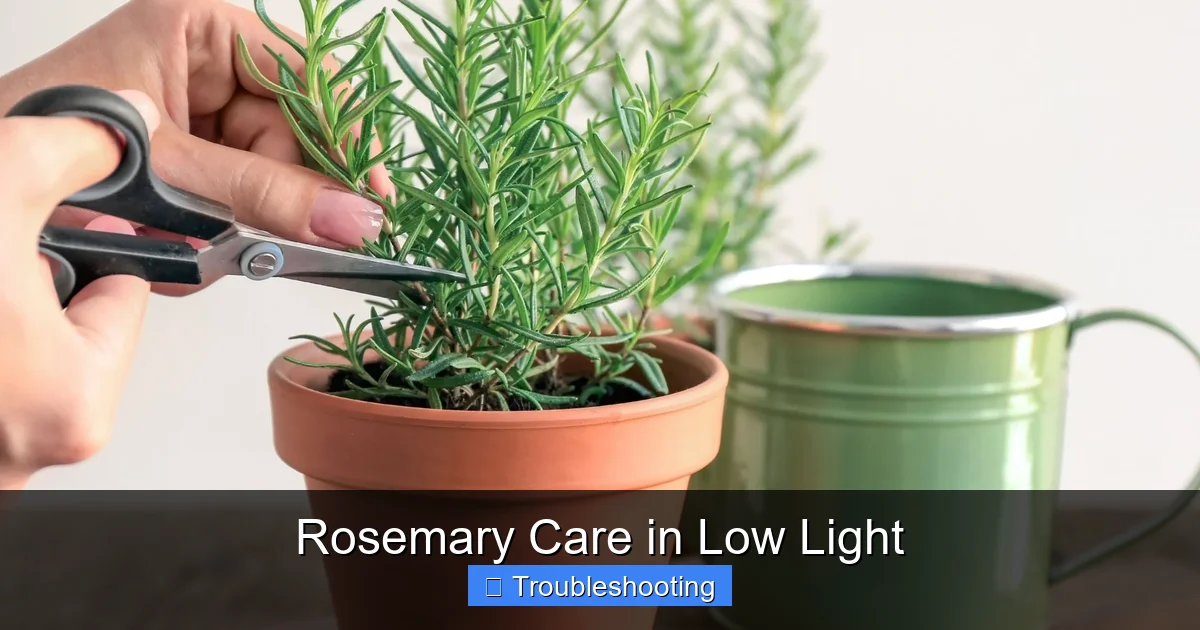
Pruning does two things in low light. First, it removes leggy, weak growth that drains energy. Second, it stimulates branching from lower nodes. This creates a denser, more compact plant. Pinch or snip the tips of long stems just above a leaf node. Do this in spring and early summer. Avoid heavy pruning in fall and winter when the plant is semi-dormant. Never remove more than one-third of the foliage at once.
Repot Only When Necessary
Rosemary prefers to be slightly root-bound. A large pot holds too much soil. That soil stays wet too long in low light. Only repot when roots circle the bottom or grow out of drainage holes. Move up just one pot size (e.g., from 6-inch to 8-inch). Use a pot with multiple drainage holes. Terra cotta is ideal because it wicks moisture away from the roots.
Fertilize Sparingly
Low light means slow growth. Slow growth means low nutrient demand. Fertilizing a light-starved plant forces weak, leggy growth. It also builds up salts in the soil. Feed only during active growth (spring to early fall). Use a balanced liquid fertilizer at quarter strength once a month. Or use a slow-release organic pellet at half the recommended rate. Stop fertilizing entirely in winter.
Supplemental Lighting Solutions
For most indoor gardeners, rosemary care in low light eventually requires artificial light. The good news: grow lights have become affordable, efficient, and easy to use. You do not need a fancy setup. You need the right spectrum, the right intensity, and the right duration.
Why LED Grow Lights Are Best
Old fluorescent shop lights work but run hot and use more electricity. Incandescent bulbs are useless (wrong spectrum, too hot). Modern full-spectrum LED grow lights give you the exact wavelengths plants need (blue for vegetative growth, red for flowering, plus white for visual appeal). They run cool. They last 50,000 hours. They use half the electricity of fluorescents. Look for lights labeled “full spectrum” or “white light” with a color temperature around 4000K to 6500K.
Understanding PPFD and DLI
Two numbers matter: PPFD (Photosynthetic Photon Flux Density) and DLI (Daily Light Integral). PPFD measures how many photons hit a square meter per second (µmol/m²/s). DLI measures the total photons delivered over a day (mol/m²/day). Rosemary needs a DLI of at least 12 to 15 mol/m²/day for decent growth. In a dim window, you might get 3 to 5. A good LED light at 12 inches can deliver 200 to 400 µmol/m²/s. Run it 14 hours, and you get 10 to 20 mol/m²/day. That meets the target.
Choosing the Right Fixture
For a single rosemary plant, a 20 to 30 watt LED panel or gooseneck light works well. For two to three plants, a 50 to 100 watt panel is better. Look for adjustable height. The light should hang 6 to 12 inches above the plant canopy. Too close causes light burn (bleached spots on leaves). Too far wastes photons. Many lights come with dimmers. Start at 50 percent power and watch the plant. Increase if stems still stretch.
Light Duration and Timing
Rosemary is a long-day plant. It wants 12 to 14 hours of light per day. In winter, natural daylight may only give 8 to 9 hours. Supplement with artificial light to reach 14 hours total. Use a timer. Consistency matters. Plants have circadian rhythms. Erratic lighting confuses them. Set the timer for 6 AM to 8 PM or 7 AM to 9 PM. If the plant gets some window light, you can run the grow light for fewer hours. But keep the schedule fixed.
Positioning for Even Coverage
Light intensity drops sharply at the edges of a grow light’s footprint. A 12-inch panel lights a 12-inch circle well. Outside that circle, intensity falls by half. Center the plant under the light. If you have multiple plants, arrange them in a circle under a larger panel. Rotate positions weekly so each plant gets time in the sweet spot. Use a small fan to strengthen stems. Air movement mimics outdoor breezes and reduces fungal risk.
Budget-Friendly Options
You do not need a $200 fixture. A $30 full-spectrum LED clip light from a reputable brand works for one plant. Shop lights (4-foot LED tubes, 4000K) mounted under a shelf cost $40 for a two-tube fixture and light four plants. Avoid “blurple” lights (blue + red only) unless you like the alien aesthetic. White full-spectrum lights let you see the plant’s true color and spot problems early.
Watering and Soil Adjustments for Low Light Conditions
This is where most people go wrong. They keep watering on a schedule. They use standard potting soil. The plant rots. Rosemary care in low light demands a different approach to water and soil. The rules change because the plant’s metabolism slows down.
The Finger Test Is Non-Negotiable
Forget the calendar. Forget the moisture meter (most are inaccurate). Stick your finger into the soil up to the second knuckle. Feel for moisture at the tip. If it feels cool and damp, wait. If it feels dry and warm, water. In low light, the top inch may dry fast while the bottom stays soggy. That is why you must check deep. Water only when the lower root zone is dry.
Water Deeply, Then Wait
When you water, water thoroughly. Pour until water runs out the drainage holes. This ensures the entire root ball gets moistened. It also flushes accumulated salts. Then do not water again until the finger test says so. In a bright window, this might be every 5 to 7 days. In low light, it could be 10 to 14 days or even longer in winter. The plant dictates the schedule, not you.
Use a Fast-Draining Soil Mix
Standard potting mix holds too much water. It contains peat moss, which becomes hydrophobic when dry and soggy when wet. Make your own mix: two parts cactus/succulent soil, one part perlite, one part coarse sand or fine pumice. Or buy a gritty mix formulated for Mediterranean herbs. The goal is soil that drains in seconds, not minutes. When you water, it should flow through like a sieve.
Add a Drainage Layer (Optional but Helpful)
Place a half-inch layer of pea gravel, lava rock, or broken pottery shards at the bottom of the pot. This prevents the drainage holes from clogging with soil particles. It also creates an air gap at the bottom. Some gardeners skip this, saying it creates a perched water table. In practice, for rosemary in low light, the extra insurance against standing water is worth it.
Bottom Watering Can Help
If you struggle with overwatering, try bottom watering. Place the pot in a tray of water for 15 to 20 minutes. The soil wicks up moisture from below. The top stays dry. This discourages fungus gnats and surface mold. Remove the pot and let it drain fully. Do not leave it sitting in water. Bottom watering also encourages roots to grow downward, which is good for stability.
Humidity Traps Are Dangerous
Do not mist rosemary. Do not use pebble trays. Do not group it tightly with tropical plants that need humidity. Rosemary wants dry air. High humidity plus low light equals powdery mildew and botrytis. If your home is very dry (winter heating), that is actually fine for rosemary. The plant prefers 30 to 50 percent relative humidity. A small fan on low, running a few hours a day, keeps air moving and foliage dry.
Winter Watering: Less Is More
From November through February, rosemary growth slows or stops. Light levels are lowest. Temperatures may be cooler near windows. Water needs drop dramatically. You might water once every three to four weeks. The finger test still rules. But expect long intervals. Many indoor rosemary deaths in winter are from overwatering during dormancy. When in doubt, wait two more days.
Common Mistakes to Avoid
Even experienced gardeners make these errors with rosemary care in low light. Knowing them ahead of time saves you frustration and dead plants.
Mistake 1: Treating It Like a Tropical Houseplant
Pothos, philodendron, and snake plants tolerate low light. Rosemary does not. It is a woody shrub from a sunny climate. Putting it on a bookshelf across the room from a window is a death sentence. If you want a low-light herb, try mint, parsley, or chives. They handle shade better. Rosemary needs the brightest spot you have, plus supplemental light.
Mistake 2: Using a Pot Without Drainage Holes
Decorative cachepots are pretty. They are also rosemary killers. Water pools at the bottom. Roots rot. Always use a pot with holes. If you love a decorative pot, put the rosemary in a plastic nursery pot with holes, then set that inside the decorative pot. Remove the inner pot to water. Let it drain completely before returning it.
Mistake 3: Overpotting
A small plant in a large pot is a recipe for root rot. The excess soil holds water the roots cannot reach. It stays wet. Fungi thrive. Only size up when roots fill the current pot. And only go up one size. A root-bound rosemary is a happy rosemary.
Mistake 4: Fertilizing a Struggling Plant
You see pale leaves. You think “it needs food.” You fertilize. The plant pushes weak, leggy growth. The roots burn from salt buildup. The decline accelerates. Pale leaves in low light usually mean “I need more photons,” not “I need more nitrogen.” Fix the light first. Fertilize only when the plant is growing vigorously in good light.
Mistake 5: Ignoring Pests Until It’s Too Late
Spider mites love dry, stressed rosemary. They are tiny. You might not see them until webbing appears. Check the undersides of leaves weekly. Use a magnifying glass. Look for stippling (tiny white dots) on the upper leaf surface. That is mite feeding damage. Catch them early. Spray with insecticidal soap or neem oil every 5 days for three treatments. Increase humidity slightly during treatment (mites hate moisture), then return to dry conditions.
Mistake 6: Bringing It Inside Too Late in Fall
If you grow rosemary outdoors in summer, bring it in before night temperatures drop below 45°F (7°C). A sudden cold shock followed by low indoor light causes massive leaf drop. The plant may not recover. Acclimate it gradually. Move it to a shady outdoor spot for a week. Then a bright indoor spot for a week. Then its final location. This reduces transplant shock.
Mistake 7: Expecting Outdoor Performance Indoors
Indoor rosemary will never look like outdoor rosemary. It will be smaller. Less dense. Less fragrant. That is okay. It is still alive. It still provides fresh sprigs for cooking. Adjust your expectations. Celebrate the fact that you are keeping a Mediterranean shrub alive in a Minnesota kitchen in January. That is a win.
Seasonal Care Calendar for Low Light Rosemary
Rosemary care in low light changes with the seasons. Here is a month-by-month breakdown for the northern hemisphere. Adjust for your latitude and local conditions.
January to February: Deep Winter Survival
Light is at its lowest. Growth is minimal or zero. Water every 3 to 4 weeks (finger test). No fertilizer. Run grow lights 14 hours daily. Keep away from cold drafts and heating vents. Check for spider mites weekly. Prune only dead or diseased stems. Do not repot. Expect some lower leaf drop. This is normal.
March to April: Spring Awakening
Days lengthen. Window light improves. You may see new growth at tips. Increase watering frequency slightly (check every 7 to 10 days). Start fertilizing at quarter strength once a month if new growth is strong. Pinch back leggy stems from winter. Repot now if needed. This is the best time for major pruning.
May to June: Active Growth
This is the easiest season. Natural light may be enough to reduce grow light hours to 10 to 12. Water every 5 to 7 days. Fertilize monthly at half strength. Harvest regularly for kitchen use. This encourages bushiness. Watch for aphids on new growth. Move outdoors to a sunny patio if nights stay above 50°F (10°C). Harden off gradually over 7 to 10 days.
July to August: Peak Summer
If outdoors, water daily in heat. Fertilize every 2 weeks at half strength. Harvest heavily. Prune after flowering to shape. If indoors, keep grow lights on 12 hours. Air conditioning dries air. That is good for rosemary. Check soil every 4 to 5 days. Spider mites can explode in hot, dry indoor air. Rinse foliage monthly with strong water spray to dislodge mites.
September to October: Transition Season
Days shorten. Growth slows. Reduce fertilizing to quarter strength monthly. Stop fertilizing by mid-October. Reduce watering frequency. Bring outdoor plants in before first frost. Inspect thoroughly for pests. Quarantine for 2 weeks away from other plants. Treat preventively with neem oil if you saw any bugs outdoors.
November to December: Pre-Winter Prep
Light drops fast. Resume 14-hour grow light schedule. Water every 2 to 3 weeks. No fertilizer. Clean windows. Check grow light bulbs (replace if dim). Plan holiday harvests (rosemary makes great garnish and gifts). Enjoy the scent on gray days.
Troubleshooting Specific Low Light Scenarios
Every home is different. Here are tailored strategies for common challenging situations.
North-Facing Window Only
This is the hardest scenario. You get zero direct sun. You must rely entirely on grow lights. Use a 50-watt full-spectrum LED panel 8 inches above the plant. Run 14 to 16 hours. Water very sparingly. Expect slow growth. Choose a compact variety like ‘Blue Boy’ or ‘Prostratus’ (creeping rosemary). They tolerate lower light better than upright types.
Office with Fluorescent Lights Only
Standard office fluorescents (T8, 3500K) provide about 50 to 100 µmol/m²/s at desk level. That is not enough for rosemary. Add a clip-on LED grow light on your desk. Point it at the plant. Run 12 hours (8 AM to 8 PM). Use a timer so weekends are covered. Water every 2 weeks. Accept that this is a foliage plant, not a harvest plant.
Basement Apartment with Small Windows
Treat this like the north-facing window scenario. Full artificial light. Consider a small grow tent (2×2 feet) with a 100-watt LED. This creates a controlled environment. You control light, humidity, airflow. Rosemary thrives in tents. It is an investment but yields the best results in truly dark spaces.
Sunny Window But Short Winter Days
You have a great south window. In summer, the plant is happy. In winter, days are 8 hours long. The sun is low. The plant stretches. Supplement with a grow light for 4 to 6 hours in the evening (4 PM to 10 PM). This extends the photoperiod. The plant gets natural morning sun plus artificial evening light. Total 12 to 14 hours. This is the ideal hybrid approach.
Kitchen Counter Far from Window
You want fresh herbs while cooking. The counter is 6 feet from the window. Light there is 10 percent of window light. Not enough. Keep the plant at the window. Bring a sprig to the counter when cooking. Or grow a second, sacrificial plant on the counter under a grow light. Rotate them weekly. One recovers at the window. One serves on the counter.
Propagation: Making More Plants for Low Light Spaces
If you have one healthy rosemary, you can make more. This is useful because low light plants have shorter lifespans. Starting fresh cuttings every year or two keeps your supply going.
Stem Cuttings in Water
Take 4 to 6 inch cuttings from non-flowering stems in spring or early summer. Strip the lower 2 inches of leaves. Place in a glass of water. Change water every 2 days. Roots appear in 2 to 4 weeks. Pot up when roots are 1 inch long. Use the gritty soil mix. Keep in bright light (not direct sun) for 2 weeks. Then move to final location.
Stem Cuttings in Soil (Higher Success Rate)
Dip stripped cuttings in rooting hormone powder (optional but helpful). Stick in moist perlite or 50/50 perlite/peat mix. Cover with a clear plastic bag (vent daily). Place in bright indirect light. Roots in 3 to 4 weeks. Tug gently. Resistance means roots. Pot up. This method produces stronger roots than water propagation.
Layering (Easiest for Leggy Plants)
If your rosemary has long, flexible stems touching the soil, pin one down. Bury a node under 1 inch of soil. Weight it with a stone. Keep moist. Roots form at the node in 4 to 6 weeks. Cut from mother plant. Pot up. This works well for creeping varieties and for plants that have become leggy and floppy.
Choosing the Best Rosemary Varieties for Low Light
Not all rosemary is created equal. Some cultivars handle shade slightly better. If you are starting fresh or replacing a plant, choose wisely.
‘Arp’ – Cold Hardy, Moderately Shade Tolerant
This variety survives zone 6 winters outdoors. It has a more open habit. The leaves are slightly larger. It seems to photosynthesize a bit better in lower light. Upright growth to 3 to 4 feet. Good flavor.
‘Hill Hardy’ – Similar to Arp
Another cold-tolerant variety. Compact growth. Good for containers. Handles indoor conditions better than many.
‘Prostratus’ (Creeping Rosemary) – Best for Low Light
This trailing variety has a lower light compensation point. It naturally grows on cliffs where it may get partial shade. The stems cascade. It looks beautiful in hanging baskets. Flavor is milder but still good. Stays under 1 foot tall, spreads 3 to 4 feet.
‘Blue Boy’ – Dwarf Variety
Compact, slow-growing, only 12 to 18 inches tall. Small leaves. Dense habit. Good for windowsills. Lower total leaf area means lower total light requirement. A great choice for tight spaces.
‘Tuscan Blue’ – Standard Culinary Type
This is the classic upright rosemary. Strong flavor. Blue flowers. Needs the most light. If you have a bright window plus grow light, this is the one for flavor. In pure low light, it struggles more than the others.
Conclusion
Rosemary care in low light is not about perfection. It is about adaptation. You are asking a sun-loving Mediterranean shrub to live in a cave. That it survives at all is remarkable. With the right light supplement, the right soil, the right watering rhythm, and a little attentiveness, your rosemary can do more than survive. It can give you fragrant sprigs for roasted potatoes, focaccia, and herbal tea all winter long.
Remember the core principles. Light first. Everything else follows. If you do one thing, add a grow light. If you do two things, add a grow light and switch to gritty soil. If you do three, add the finger test for watering. These three changes solve 90 percent of low light rosemary problems.
Do not be discouraged by a few yellow leaves or a leggy stem. Plants are resilient. They want to live. Give them what they need, and they will reward you. Touch the leaves. Smell your fingers. That piney scent on a gray February day? That is the smell of success.
Now go check your window. Order that grow light. Mix that gritty soil. Your rosemary is waiting.
Frequently Asked Questions
How many hours of artificial light does rosemary need indoors?
Rosemary needs 12 to 14 hours of total light per day. If your window provides 4 hours of direct sun, supplement with a grow light for 8 to 10 hours. Use a timer to keep the schedule consistent every day.
Should I mist my rosemary to increase humidity in winter?
No. Rosemary prefers dry air (30-50% humidity). Misting encourages powdery mildew and fungal diseases, especially in low light where foliage stays damp longer. Use a small fan for air circulation instead.
Can I grow rosemary under a regular desk lamp?
A regular desk lamp with an LED bulb does not provide enough intensity or the right spectrum. You need a dedicated full-spectrum LED grow light positioned 6-12 inches above the plant for meaningful photosynthesis.
Why does my rosemary keep dying in winter?
Winter kills rosemary through a combination of low light, overwatering, cold drafts, and dry indoor heat. Reduce watering drastically, add a grow light, keep away from heating vents, and maintain temperatures above 50°F.
Is creeping rosemary better for low light than upright varieties?
Yes. Creeping rosemary (‘Prostratus’) has a lower light compensation point and naturally tolerates partial shade better than upright types. Dwarf varieties like ‘Blue Boy’ also perform well in lower light conditions.
When should I repot my indoor rosemary?
Repot only when roots circle the bottom or emerge from drainage holes, typically every 2-3 years. Spring is the best time. Move up just one pot size and use a gritty, fast-draining mix in a terra cotta pot with drainage holes.