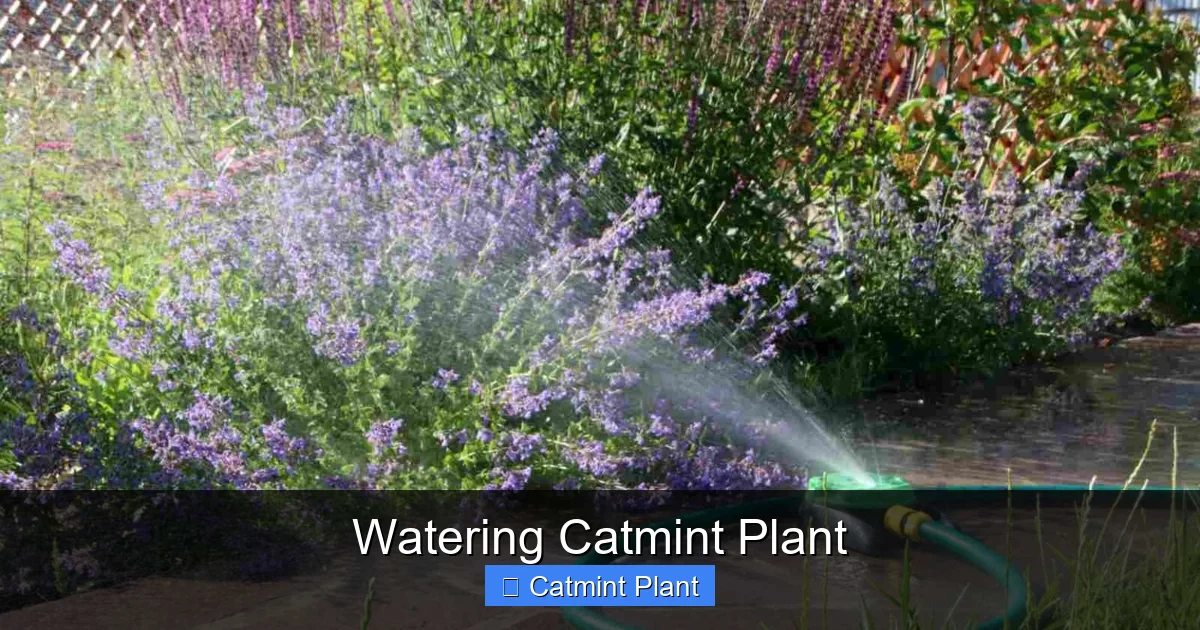
Watering Catmint Plant
Catmint thrives on neglect once established, needing water only during extended dry spells. New plants need consistent moisture for the first growing season, while mature plants prefer deep, infrequent watering. The key is letting soil dry completely between drinks.
If you’ve ever killed a plant with kindness, you’re not alone. I’ve done it too. There’s something deeply satisfying about caring for your garden — checking the soil, giving each plant a drink, feeling like a good plant parent. But here’s the thing about catmint: it doesn’t want your constant attention. It wants you to back off.
Watering catmint plant correctly is less about following a rigid schedule and more about understanding what this Mediterranean native actually needs. Catmint (Nepeta) evolved in dry, rocky soils where rain comes in bursts and then disappears for weeks. Its roots go deep searching for moisture. When we water too often, we keep those roots near the surface where they become dependent and weak. The result? A plant that looks lush for a month then collapses at the first heat wave.
This guide covers everything you need to know about watering catmint plant at every stage of life — from tiny nursery plug to mature mound buzzing with bees. You’ll learn when to water, how much to give, which techniques work best, and how to read the signs when something’s wrong. By the end, you’ll have the confidence to let your catmint thrive on its own terms.
Key Takeaways
- Established catmint is drought-tolerant: Mature plants rarely need supplemental watering except during severe drought.
- New plants need consistent moisture: Water regularly for the first 4-6 weeks until roots establish.
- Deep, infrequent beats shallow, frequent: Water thoroughly to encourage deep root growth rather than light daily sprinkles.
- Check soil before watering: Stick your finger 2 inches deep — if it’s dry, water. If moist, wait.
- Morning watering is best: Early watering reduces evaporation and prevents fungal issues from wet foliage overnight.
- Container catmint needs more attention: Pots dry out faster; check daily in hot weather.
- Overwatering kills more catmint than underwatering: Soggy soil leads to root rot, the number one killer of Nepeta.
Quick Answers to Common Questions
How often should I water newly planted catmint?
Water newly planted catmint daily for the first week, then every 2-3 days for weeks 2-4, checking soil moisture each time. The goal is consistent moisture (not soggy) until roots establish, usually 4-6 weeks.
Can catmint survive without any supplemental watering?
Yes, established catmint in the ground can survive on rainfall alone in most climates. It may go summer dormant during extreme drought but will recover when moisture returns. Container catmint always needs supplemental water.
What’s the best time of day to water catmint?
Early morning (5-8 AM) is ideal. Foliage dries quickly, reducing fungal risk, and less water evaporates in cooler temperatures. Avoid evening watering which leaves leaves wet overnight.
How do I know if I’m overwatering my catmint?
Signs of overwatering include yellowing lower leaves, wilting despite wet soil, blackened stems at the base, a sour soil smell, and mushy roots. Catmint prefers dry conditions — when in doubt, wait another day.
Should I water catmint after cutting it back in summer?
Yes, water deeply after the midseason shear (cutting back by 1/3 to 1/2). This strategic watering fuels the second flush of growth and flowers. Skip it, and rebloom will be weak or absent.
📑 Table of Contents
- Understanding Catmint’s Natural Habitat and Water Needs
- How Often to Water Catmint at Every Growth Stage
- Best Watering Techniques for Catmint
- Seasonal Watering Adjustments
- Signs of Overwatering and Underwatering
- Special Situations: Containers, New Plants, and Drought
- Troubleshooting Common Watering Problems
- Creating a Catmint Watering Calendar
- Conclusion: Trust the Plant, Trust the Process
Understanding Catmint’s Natural Habitat and Water Needs
Where Catmint Comes From Matters
Catmint isn’t a thirsty plant. Most Nepeta species originate from Europe, Asia, and North Africa — places with hot, dry summers and poor, well-draining soil. Think rocky hillsides in Turkey, sun-baked slopes in Spain, or the steppes of Central Asia. In these landscapes, rain falls in spring and maybe autumn. Summer brings weeks of baking heat with zero precipitation. The plants that survive develop deep taproots and woody crowns that store energy.
This evolutionary history tells you everything about watering catmint plant in your garden. It doesn’t want constant moisture. It wants a good soak followed by a long dry period. That cycle — wet, dry, wet, dry — triggers the root growth that makes catmint resilient. When you interrupt that cycle with frequent light watering, you’re essentially telling the plant “stay shallow, the water’s always right here.” The plant listens. Then July hits, you forget to water for three days, and your catmint crashes because its roots never learned to go deep.
The Difference Between Survival and Thriving
Here’s a distinction that matters: catmint can survive on almost no supplemental water once established. But “survive” and “thrive” are different. A surviving plant stays small, flowers sparsely, and looks a bit ragged by August. A thriving plant forms a generous mound, blooms heavily in early summer, often reblooms after shearing, and supports clouds of pollinators. The difference usually comes down to strategic watering at key moments — not constant watering.
Strategic watering means: deep soaks during establishment, occasional drinks during extreme heat or drought, and a boost after midseason pruning to encourage that second flush of flowers. That’s it. Three scenarios. Everything else is overwatering.
Soil Type Changes Everything
Before you set any watering routine, know your soil. Catmint in sandy soil needs more frequent watering than catmint in clay — but less water per session. Sandy soil drains fast. Water runs straight through. You’ll water more often but with less volume each time. Clay soil holds water like a sponge. You’ll water less often but need to apply water slowly so it penetrates instead of running off.
Loamy soil — that perfect mix of sand, silt, and clay — is the sweet spot. Water penetrates evenly, drains well, and holds moisture long enough for roots to drink. If you’re blessed with loam, watering catmint plant becomes almost intuitive. Most of us aren’t that lucky. Do a simple jar test: fill a jar one-third with soil, add water, shake, let settle. The layers will show you exactly what you’re working with.
How Often to Water Catmint at Every Growth Stage
Newly Planted Catmint: The Critical First Weeks
This is the only time catmint wants consistent moisture. For the first 4-6 weeks after planting, the root ball is only as big as the nursery pot. Those roots haven’t explored your garden soil yet. They’re confined to that original potting mix, which often dries faster than the surrounding earth. Check daily. Water when the top inch feels dry. This might mean watering every day in hot weather, every 2-3 days in cool weather.

Visual guide about Watering Catmint Plant
Image source: preview.gettyimagesbank.com
Here’s a pro tip: create a small berm or basin around each new plant. A 3-inch high ring of soil about 12 inches from the stem catches water and directs it straight down over the root zone. Without it, water runs off into the surrounding bed, leaving the root ball dry. I learned this the hard way after losing three ‘Walker’s Low’ plants one July. The soil looked wet. The root balls were bone dry.
After 4-6 weeks, start stretching the interval. Water every 3 days. Then every 4. Then weekly. You’re training roots to chase moisture downward. By week 8, your catmint should be on the same schedule as established plants. If you planted in fall, the timeline stretches — cooler weather means slower root growth. Keep checking through the first winter if the ground isn’t frozen.
First-Year Plants: Still Building Reserves
Even after establishment, first-year catmint appreciates a watchful eye. The root system is expanding but hasn’t reached full depth. During the first summer, water deeply every 7-10 days if rain hasn’t done the job. “Deeply” means 1 inch of water — enough to wet the top 12-18 inches of soil. Use a tuna can or rain gauge to measure. This encourages roots to follow the moisture down.
First-year plants also benefit from mulch. A 2-inch layer of shredded bark, straw, or pine needles keeps soil cooler and reduces evaporation. Keep mulch away from the crown — wet mulch against stems invites rot. Think donut, not volcano. This simple step can cut your watering frequency by 30%.
Mature Catmint: The “Ignore It” Phase
Year two and beyond? Catmint becomes one of the lowest-maintenance perennials in your garden. Established plants with full root systems can go 2-3 weeks without water in normal summer conditions. In many climates, rainfall alone suffices. I water my established catmint maybe 4-5 times per summer — only during genuine heat waves or when we’ve had three weeks without rain.
The “ignore it” approach works because mature catmint has a woody crown and deep roots that access moisture far below the surface. The plant essentially manages its own water budget. It may look a bit wilted at 3 PM on a 95-degree day. That’s normal. Check again at 7 PM. If it’s perked up, it’s fine. If it’s still limp, give it a deep soak. This is called “transpirational wilt” — the plant closes stomata to conserve water. It’s a survival mechanism, not a distress signal.
Container-Grown Catmint: Different Rules Apply
Catmint in pots is a different beast entirely. Container soil heats up faster, dries out faster, and holds less total water. The roots can’t go deeper — they hit the pot bottom. In summer heat, a container catmint may need water daily. In spring and fall, every 2-3 days. The finger test is non-negotiable here. Stick your finger in to the second knuckle. Dry? Water. Moist? Wait.
Choose your container wisely. Larger pots (14+ inches diameter) hold more soil, dry slower, and insulate roots better. Terra cotta breathes — great for preventing rot, but it dries fast. Glazed ceramic or plastic retains moisture longer. Add a saucer? Only if you empty it within 30 minutes. Standing water is a death sentence for catmint roots.
Best Watering Techniques for Catmint
Hand Watering: The Gold Standard
Nothing beats a watering can or hose with a gentle shower nozzle for watering catmint plant. You control exactly where water goes, how fast it flows, and when to stop. Aim at the soil, not the foliage. Wet leaves invite powdery mildew and fungal issues, especially in humid climates. Water slowly enough that it soaks in rather than pooling or running off. A 30-second soak per plant, move to the next, then come back for a second round — this “cycle and soak” method prevents runoff on slopes or heavy soil.
Hand watering also lets you inspect each plant. You’ll spot aphids, notice powdery mildew early, see if a plant needs dividing. It’s garden time, not chore time. I actually look forward to my Sunday morning watering rounds. Coffee in one hand, hose in the other, checking on the catmint, the salvias, the lavender. It’s the best part of the week.
Soaker Hoses and Drip Irrigation: Set It and Forget It
If you have a large catmint planting or travel frequently, soaker hoses or drip lines are excellent. Lay them on the soil surface (or bury under 1 inch of mulch) in a loose spiral around each plant or along the row. Cover with mulch to hide them and reduce evaporation. Run for 30-60 minutes depending on your water pressure and soil type. The goal: wet the root zone to 12-18 inches deep.
Drip emitters deliver water right to each plant’s base. Use 1/2 GPH (gallons per hour) emitters for catmint — one per small plant, two for large mature clumps. Run the system early morning, 2-3 times per week during establishment, then weekly or biweekly for mature plants. Add a timer and rain sensor so you’re not watering during a downpour. Smart controllers that adjust for weather are worth the investment if you automate.
Sprinklers: Use With Caution
Overhead sprinklers work but have drawbacks for catmint. Wet foliage + humidity = fungal problems. Water evaporates before hitting soil, especially in wind or heat. Coverage is uneven — some plants get drenched, others missed. If sprinklers are your only option, run them early morning (4-7 AM) so leaves dry fast. Run long enough to apply 1 inch of water — use tuna cans to measure. And accept that you’ll use more water than targeted methods.
The “Cycle and Soak” Method for Heavy Soil
Clay soil? Water runs off before it penetrates. The solution: cycle and soak. Run your watering (hose, soaker, drip) for 10 minutes. Stop. Wait 30-60 minutes for water to soak in. Run another 10 minutes. Repeat until you’ve applied your target amount. This prevents runoff and ensures deep penetration. It takes longer but wastes zero water. Your catmint roots will thank you — they’ll grow deeper where moisture persists.
Water Quality Considerations
Most municipal water is fine for catmint. But if you have very hard water (high calcium/magnesium), long-term use can raise soil pH. Catmint prefers slightly alkaline to neutral soil (pH 6.5-7.5), so this rarely causes problems. Softened water? Avoid it. The sodium content builds up in soil and damages roots. If you have a softener, use an outdoor bypass spigot or collect rainwater. Rainwater is ideal — neutral pH, no chemicals, free. A 50-gallon rain barrel covers a lot of catmint watering.
Seasonal Watering Adjustments
Spring: Wake-Up Watering
Spring watering catmint plant depends entirely on rainfall. In most regions, spring rains handle it. But watch for dry spells — especially in April and May when plants are pushing new growth and forming flower buds. A deep soak every 10-14 days during dry springs ensures strong stems and maximum blooms. New spring plantings need the establishment routine: frequent checks, consistent moisture for 4-6 weeks.
Spring is also when you might divide mature catmint. Divisions are essentially new plants. Treat them like nursery stock: water well at planting, then daily for a week, then taper off. The divided sections have reduced root systems and need extra support until they regenerate.
Summer: The Testing Ground
Summer separates the gardeners who understand catmint from those who don’t. Established catmint in the ground: water only during extended heat waves (90°F+ for a week) or genuine drought (3+ weeks without rain). Container catmint: check daily. First-year plants: weekly deep soaks unless rain provides.
July and August often bring “flash droughts” — 10-14 days of heat and zero rain. This is when mature catmint might need help. Water deeply once during the dry spell. Don’t start a frequent schedule. One good soak, then back to ignoring it. The plant will use that reserve to bridge the gap.
Summer is also rebloom season. After the first flush fades (usually late June to early July), shear plants back by 1/3 to 1/2. This triggers a second bloom cycle. Water deeply after shearing — this one strategic drink fuels the regrowth. Skip it, and the second flush will be weak or nonexistent.
Fall: Preparing for Dormancy
Fall watering catmint plant is about root health, not top growth. As temperatures cool and days shorten, catmint shifts energy to roots. Keep soil moderately moist (not wet) through October in most zones. This helps roots store energy for winter survival and spring emergence. Stop watering 2-3 weeks before your average first hard freeze date. You want the plant to harden off, not push tender new growth that frost will kill.
Fall-planted catmint (September-October in most zones) needs the establishment routine but on a slower timeline. Cooler soil = slower root growth. Water at planting, then every 3-4 days for 3-4 weeks, then weekly until ground freezes. Mulch heavily (3-4 inches) after the ground freezes to prevent frost heave.
Winter: Hands Off (Mostly)
In zones 5-8, winter watering catmint plant is unnecessary. Snow and rain provide moisture. Frozen ground can’t absorb water anyway. In zones 9-10 where ground doesn’t freeze, occasional winter watering during dry spells keeps roots alive. But catmint is often semi-evergreen in warm winters — don’t let it dry out completely.
Container catmint in winter needs protection. Move pots to an unheated garage, shed, or against a protected wall. Water once a month — just enough to keep roots from desiccating. Don’t fertilize. Don’t overwater. The goal is survival, not growth.
Signs of Overwatering and Underwatering
Overwatering: The Silent Killer
Overwatering kills more catmint than drought, pests, and disease combined. The symptoms sneak up on you because they look like underwatering at first. Yellowing lower leaves. Wilting despite wet soil. Stems turning brown or black at the base. A sour, swampy smell from the crown. Mushy roots when you gently probe. The plant collapses suddenly — one day it’s there, the next it’s flat.
The mechanism is simple: roots need oxygen. Waterlogged soil pushes air out of pore spaces. Roots suffocate, die, and rot. Fungi (Phytophthora, Pythium, Rhizoctonia) invade the dead tissue. The rot travels up into the crown. Game over. Catmint has zero tolerance for wet feet. None. Even 48 hours of saturated soil in summer heat can start the process.
If you catch it early — yellowing leaves, soil staying wet 3+ days — stop watering immediately. Improve drainage if possible: aerate with a fork, add grit, create a raised bed. But often by the time you see symptoms, the root system is compromised. Prevention is everything. Water less. Check soil first. Trust the finger test.
Underwatering: Easier to Fix
Underwatered catmint tells you clearly. Leaves curl inward, turn gray-green, then crisp at edges. The whole plant looks “deflated” — stems lose turgor, flowers droop. Growth stops. In extreme cases, the plant goes summer dormant: drops leaves, looks dead. But the crown and roots survive. Water deeply, and it usually bounces back in 2-3 days.
Chronic underwatering (repeated cycles of severe stress) weakens the plant long-term. Fewer flowers, smaller stature, reduced winter hardiness. But a single drought episode? Catmint laughs it off. This plant evolved for exactly this. The recovery ability is remarkable — I’ve seen completely crispy ‘Six Hills Giant’ return from the crown after a deep soak.
The Finger Test: Your Most Reliable Tool
Forget moisture meters. Forget schedules. Your index finger is the most accurate, calibrated, free moisture meter ever invented. Push it into the soil near the plant (not right at the crown — you’ll damage roots) to the second knuckle. That’s about 2 inches. Feel the tip. Cool and damp? Don’t water. Warm and dry? Water. Slightly cool, barely moist? Check tomorrow.
Do this at the same time each day — morning is best. Soil moisture fluctuates. Morning readings are consistent. Keep a mental log or actual notebook: “Monday dry, watered. Tuesday moist. Wednesday moist. Thursday dry, watered.” Patterns emerge. You’ll learn your soil, your microclimate, your catmint’s rhythm. That’s the real skill — not following a calendar.
Visual Cues From the Plant Itself
Catmint communicates. Learn its language. Perky, bright green, slightly fuzzy leaves = happy. Leaves folding upward along the midrib (like a taco) = conserving water, check soil. Gray-green cast = stressed, water soon. Crispy brown edges = damage done, water deeply now. Yellowing from bottom up with wet soil = overwatered, stop immediately. Blackened stems at soil line = crown rot, likely too late.
Flowers also signal. Abundant buds opening steadily = well-watered during bud formation. Few buds, quick fade = drought stress during spring. Second flush after shearing = adequate moisture post-pruning. No second flush = too dry when it mattered.
Special Situations: Containers, New Plants, and Drought
Container Catmint Mastery
We covered basics earlier, but container catmint deserves deeper attention. The potting mix matters enormously. Standard peat-based mixes hold too much water. Make your own: 2 parts coarse perlite or pumice, 1 part compost, 1 part pine bark fines. This drains fast, holds some moisture, resists compaction. Add a handful of grit or chicken grit per gallon for weight and drainage.
Pot size: minimum 12 inches diameter, 14+ preferred. Depth matters more than width — catmint roots go down. Elevate pots on feet or bricks so drainage holes don’t sit on saucers or pavement. This air gap prevents water wicking back up.
Watering technique for containers: water until it flows freely from drainage holes. That’s your “full” signal. Don’t water again until the finger test says dry. In peak summer, this might be daily. In spring/fall, every 3-4 days. Winter (protected): monthly.
Fertilize container catmint lightly — half-strength balanced fertilizer once in spring, once after summer shear. Ground catmint rarely needs fertilizer. Containers leach nutrients. But don’t overdo it. Lush, soft growth from excess nitrogen flops and attracts aphids.
Newly Planted Catmint: The First 30 Days
Let’s expand on establishment because this is where failures happen. Day 1: water thoroughly at planting. Fill the hole, let drain, fill again. This settles soil and eliminates air pockets. Days 2-7: check daily. Water when top inch is dry. Use a gentle shower — don’t blast the root ball. Days 8-21: check every 2 days. Water deeply when top 2 inches dry. Days 22-30: check every 3 days. Water deeply when top 2-3 inches dry.
Mulch from day 1. 2 inches of shredded leaves, straw, or bark. Keep 2 inches clear of stems. Mulch reduces watering frequency by 30-50% and prevents soil crusting. Crusted soil repels water — you think you watered, but it ran off.
Shade cloth helps in hot weather. A 30% shade cloth over new plants for the first 2 weeks reduces transpiration stress. Remove once you see new growth. This isn’t coddling — it’s smart establishment.
Drought Strategies: When Water Is Restricted
Municipal watering restrictions? Well running low? Catmint is your ally. Prioritize: containers first (they have zero reserve), first-year plants second, established in-ground last. Established catmint can survive 4-6 weeks without water in most soils. It will look rough — gray, crispy, maybe dormant. But it lives.
If you must water during restrictions, use gray water (shower warm-up water, dehumidifier output, pasta water cooled). No soap, no salt, no boron. Apply directly to soil, not foliage. Water deeply but less frequently — one good soak every 2 weeks beats light sprinkles every 3 days.
Hydrozoning helps. Group catmint with other drought-tolerant plants (lavender, salvia, yarrow, sedum, ornamental grasses). Water the zone, not individual plants. This concentrates your limited water where it serves multiple plants.
Mulch heavily. 3-4 inches in drought. It’s the single most effective water conservation tool. Organic mulch also feeds soil life, improves structure over time, and moderates temperature extremes.
Catmint Varieties and Their Water Quirks
Not all catmint is identical. Nepeta x faassenii cultivars (‘Walker’s Low’, ‘Cat’s Meow’, ‘Cat’s Pajamas’) are the most common garden types — compact, long-blooming, standard water needs. Nepeta racemosa (‘Little Titch’, ‘Blue Wonder’) is lower, more mat-forming, slightly more moisture-tolerant. Nepeta subsessilis (Japanese catmint) actually prefers more moisture — it’s native to damp meadows. Water this one like a normal perennial, not a xeriscape plant.
Nepeta sibirica (Siberian catmint) is taller, later blooming, very tough. Nepeta grandiflora (‘Dawn to Dusk’, ‘Pool Bank’) — larger flowers, similar needs to faassenii types. The giant Nepeta ‘Six Hills Giant’ (faassenii hybrid) gets 3 feet tall and wide — more root mass, more drought tolerance once established.
Know your variety. Check the tag. Research the species. Japanese catmint in a xeric bed will struggle. ‘Walker’s Low’ in a bog will rot. Right plant, right place, right water.
Troubleshooting Common Watering Problems
Hydrophobic Soil: When Water Won’t Penetrate
Ever watered and watched it bead up and run off? That’s hydrophobic soil — common in peat-heavy mixes, old mulch layers, or soil that’s gone bone dry. The organic matter develops a waxy coating that repels water. Fix: add a few drops of liquid dish soap to your watering can (1 tsp per gallon). The surfactant breaks surface tension. Or use a commercial soil wetter. Better yet: prevent it. Never let soil go completely dry. Mulch. Mulch. Mulch.
Competition From Neighbors
Catmint near thirsty plants (roses, hydrangeas, vegetables) may get outcompeted. Tree roots are the worst — they extend far beyond the drip line and suck moisture aggressively. If your catmint struggles despite watering, check for root competition. Dig a small test hole nearby. White, fibrous roots that aren’t catmint? That’s the culprit. Solutions: root barrier (trench lined with heavy plastic), more frequent deep watering, or move the catmint. I’ve moved catmint away from a maple’s root zone and watched it double in size in one season.
Slope and Runoff Issues
Catmint on a slope? Water runs off before soaking in. Create a level planting basin — a small terrace held by a rock or log on the downhill side. Or plant in a slight depression with a berm on the low side. Water slowly. Cycle and soak. Drip irrigation with pressure-compensating emitters works beautifully on slopes — each emitter delivers the same flow regardless of elevation.
Salt Buildup From Fertilizer or Water
White crust on soil surface? Leaf tip burn? Salt buildup. Common in containers with frequent fertilizing or hard water. Flush the soil: water heavily 3-4 times in one session, letting it drain fully each time. This leaches salts below the root zone. Do this annually for containers. In ground, rain usually handles it.
Creating a Catmint Watering Calendar
Monthly Quick-Reference Guide
Here’s a simplified calendar for temperate zones (adjust for your climate):
March: Check new growth. Water if dry 2 weeks. Divide/transplant if needed — water in well.
April: Spring growth accelerating. Water weekly if no rain. New plantings: establishment routine.
May: Bud formation. Critical moisture period. Water deeply every 7-10 days if dry. Mulch now.
June: Peak bloom. Water if 2 weeks dry. Deadhead spent flowers.
July: First flush ending. Shear back 1/3-1/2. Water deeply after shearing. Heat waves: check containers daily.
August: Second flush building. Water weekly if dry. Containers: daily checks.
September: Second bloom. Taper watering as nights cool. Stop fertilizing.
October: Root storage phase. Water every 2 weeks if dry. Mulch after frost.
November-February: Dormant. No watering unless extreme drought in warm zones. Containers: monthly sip.
Adjusting for Your Microclimate
Your garden isn’t the weather station at the airport. South-facing wall? Hotter, drier, water more. Low spot where cold air settles? Cooler, stays moist longer, water less. Windy ridge? Dries fast, water more. Shaded by deciduous trees in summer? Less evaporation, water less. Observe. Record. Adjust. The best gardeners are observers first.
Using Technology Wisely
Smart irrigation controllers (Rachio, RainMachine, Orbit B-hyve) connect to local weather data and adjust automatically. They’re great for lawns and high-water beds. For catmint? Overkill. But if you have a mixed zone, they prevent watering during rain. Soil moisture sensors (like the Ecowitt or RainPoint probes) give real-time data at root depth. Useful for learning your soil’s drying curve. But don’t let tech replace your finger. The finger knows things sensors miss — soil texture, root density, that intangible “feel.”
Conclusion: Trust the Plant, Trust the Process
Watering catmint plant isn’t about memorizing rules. It’s about building a relationship with a plant that has survived millennia without a gardener. Catmint wants to thrive. It has the genetics, the root architecture, the evolutionary toolkit. Your job is simple: don’t interfere with its strategy. Water deeply when it matters — establishment, extreme drought, post-shear rebloom. Back off the rest of the time. Check soil with your finger. Watch the plant’s signals. Mulch religiously.
The gardeners who struggle with catmint are usually the ones who care too much. They water on schedule. They worry when leaves wilt at noon. They reach for the hose at the first sign of stress. The gardeners who succeed? They plant it in well-draining soil, water it well the first month, mulch it, and then mostly ignore it. They’re surprised when it becomes the star of the summer border — buzzing with bees, blooming for months, asking for almost nothing.
Be the second gardener. Your catmint will thank you with armloads of lavender-blue flowers, clouds of pollinators, and the quiet satisfaction of a plant that thrives because you knew when to walk away. That’s the real secret to watering catmint plant: knowing that sometimes, the best care is no care at all.
Frequently Asked Questions
How much water does catmint need per week?
Established catmint needs about 1 inch of water every 10-14 days during dry periods, applied in one deep soak. New plants need 1 inch every 3-4 days for the first month. Always check soil moisture first — catmint prefers dry over wet.
Can I use a sprinkler system for catmint?
Sprinklers work but aren’t ideal for catmint. Wet foliage promotes powdery mildew and fungal diseases, especially in humid climates. If using sprinklers, run them early morning so leaves dry quickly. Drip irrigation or soaker hoses are better choices.
Why is my catmint wilting in the afternoon heat?
Afternoon wilting on hot days is often transpirational wilt — the plant temporarily closes stomata to conserve water. Check the plant again in early evening. If it’s perked up, no water needed. If still limp, water deeply.
Does catmint need water in winter?
In zones where ground freezes, no winter watering is needed. In frost-free zones (9-10), water occasionally during dry winter spells. Container catmint in winter needs monthly watering if kept in a protected, unheated space.
What type of mulch is best for catmint?
Shredded bark, pine needles, straw, or shredded leaves work well. Apply 2-3 inches keeping it away from the crown. Mulch conserves moisture, moderates soil temperature, and suppresses weeds. Avoid heavy, wet mulches like fresh grass clippings.
Can catmint grow in wet soil or rain gardens?
No, catmint cannot tolerate wet or poorly draining soil. It requires excellent drainage and will develop root rot in consistently moist conditions. For wet areas, choose moisture-loving perennials like Japanese iris, lobelia, or swamp milkweed instead.