How to Encourage Palms to Flower
Getting palms to flower requires patience and the right conditions. Most palms need full sun, proper fertilization with potassium and magnesium, consistent watering, and several years of maturity before they bloom. Follow our complete guide to trigger flowering in your palm trees.
There is something magical about a palm tree in full bloom. Those dramatic flower spikes emerging from the crown, often followed by colorful fruit, transform an already beautiful tree into a true showstopper. But if you have ever stared at your palm year after year wondering why it refuses to flower, you are not alone. Many gardeners struggle with this exact challenge.
The truth is that learning how to encourage palms to flower comes down to understanding what these tropical giants actually need. Palms are not like roses or hydrangeas that bloom on a predictable schedule. They operate on their own timeline, dictated by age, species, and environmental cues. Some palms flower annually once mature. Others may take decades. The good news? You can absolutely influence the process. With the right care, patience, and a few strategic adjustments, you can create the perfect conditions for your palms to put on a spectacular floral display.
Key Takeaways
- Maturity matters most: Palms must reach a specific age and trunk height before they can flower, typically 5-20 years depending on species
- Full sun is essential: Most flowering palms need 6-8 hours of direct sunlight daily to initiate bloom production
- Potassium and magnesium drive flowering: Use a palm-specific fertilizer with high potassium (K) and added magnesium (Mg) to support flower development
- Consistent watering prevents stress: Deep, regular watering during the growing season keeps palms healthy enough to flower
- Temperature triggers blooming: Many palms need a warm growing season followed by a slight cool period to set flower buds
- Don’t over-prune green fronds: Removing healthy fronds reduces the palm’s energy production and delays flowering
- Species selection is critical: Choose palms known to flower in your climate zone for the best results
Quick Answers to Common Questions
How long does it take for a palm tree to flower?
Most palms need 5-20 years to reach flowering maturity, depending on species. Queen Palms flower at 7-10 years, while Canary Island Date Palms may take 15-20 years. There is no way to speed up this natural maturity requirement.
What fertilizer makes palms flower?
Use a palm-specific fertilizer with an 8-2-12-4Mg analysis (high potassium, added magnesium). Potassium drives flower bud formation, while magnesium supports photosynthesis for energy production. Apply 3-4 times yearly during the growing season.
Can you force a palm to flower?
You cannot force a juvenile palm to flower. For mature palms, commercial growers sometimes use plant growth regulators like paclobutrazol, but this is not recommended for homeowners. Proper care—sun, nutrition, water—is the only reliable method.
Why is my mature palm not flowering?
Common reasons include insufficient sunlight, potassium or magnesium deficiency, over-pruning of green fronds, root competition from turf grass, high soil pH locking up nutrients, or the palm simply not being mature enough despite its size.
Do all palms flower every year?
No. Many palms flower annually once mature, but some species flower biennially or irregularly. Dioecious palms (separate male/female trees) may flower at different times. Climate, nutrition, and stress all affect flowering consistency.
📑 Table of Contents
- Understanding Palm Flowering Biology
- Light Requirements for Maximum Blooms
- Nutrition: Feeding for Flowers
- Water Management for Flower Initiation
- Temperature and Climate Considerations
- Pruning Practices That Promote Flowering
- Species Selection: Choosing Palms That Flower in Your Zone
- Troubleshooting: Why Your Palm Still Won’t Flower
- Advanced Techniques for Stubborn Palms
- Conclusion
Understanding Palm Flowering Biology
Before diving into specific techniques, it helps to understand what is happening inside your palm. Palms are monocots, which means they grow differently than typical trees. They do not have woody trunks with growth rings. Instead, they have a single growing point called the apical meristem or “heart” at the top of the trunk. This is where all new leaves, and eventually flowers, originate.
The Maturity Requirement
This is the single most important factor. A palm will not flower until it reaches physiological maturity. This is not about height alone. It is about the palm accumulating enough energy reserves and reaching a specific developmental stage. For a Queen Palm, this might happen at 10-15 feet tall and 7-10 years old. For a Canary Island Date Palm, you might wait 15-20 years. A Coconut Palm typically flowers at 6-10 years. There is no shortcut around this. If your palm is a juvenile, no amount of fertilizer or sun will force it to bloom.
Monoecious vs Dioecious Palms
Palm flowering also depends on the plant’s reproductive strategy. Monoecious palms have both male and female flowers on the same tree. Examples include Coconut, Queen Palm, and Areca Palm. These are self-fertile in most cases. Dioecious palms have separate male and female trees. Date Palms, Willdate Palms, and some Chamaedorea species fall into this category. If you have a dioecious female palm, she needs a male nearby for pollination and fruit set, though she will still produce flowers on her own. Knowing which type you have sets realistic expectations.
Flowering Cycles and Seasons
Most palms in temperate and subtropical zones flower in late spring through summer. The trigger is often a combination of day length, temperature accumulation, and moisture availability. In truly tropical regions, some palms flower multiple times a year or continuously. Understanding your palm’s natural cycle helps you time your care interventions for maximum impact.
Light Requirements for Maximum Blooms
If there is one non-negotiable for flowering palms, it is light. Palms evolved in open, sunny environments. While many tolerate shade, they rarely flower well in it. Full sun means at least six hours of direct, unfiltered sunlight daily. Eight to ten hours is even better for heavy bloomers like Pindo Palms or Jelly Palms.
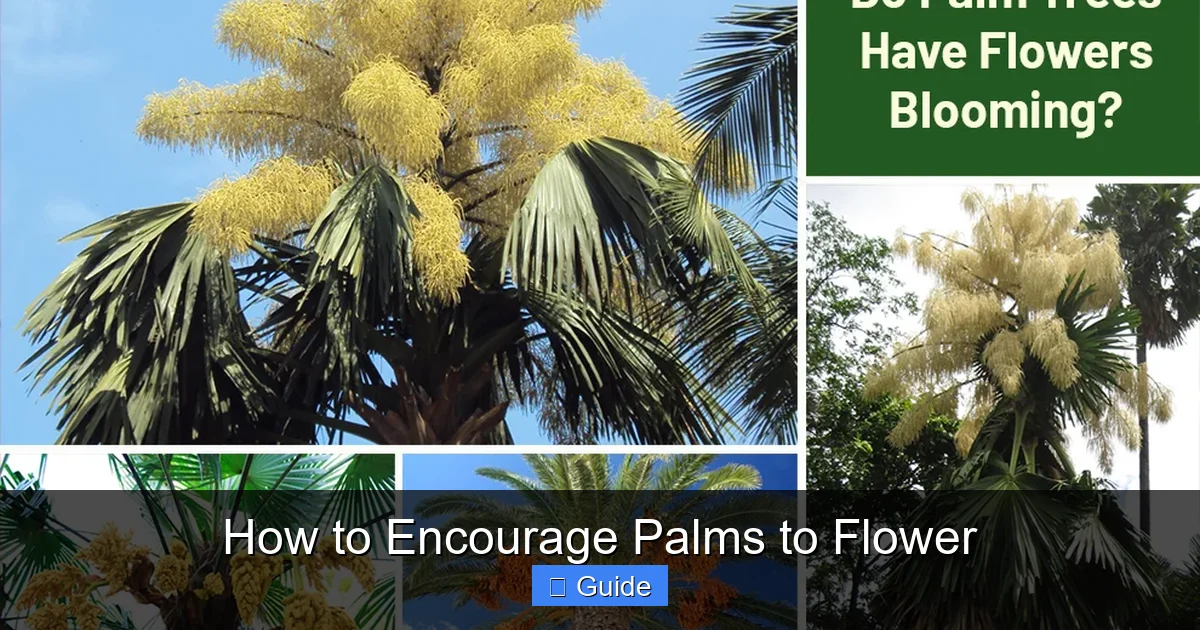
Visual guide about How to Encourage Palms to Flower
Image source: i.ytimg.com
Assessing Your Site
Take a honest look at your planting location. Does a nearby building cast afternoon shade? Has a neighbor’s oak tree grown taller over the years? Even dappled shade from high pine canopies reduces the light intensity enough to suppress flowering. If your palm is in too much shade, you have two options. You can limb up surrounding trees to let in more light. Or, if the palm is small enough and young enough, you can transplant it to a sunnier spot in late winter or early spring before new growth starts.
Indoor and Container Palms
For palms grown indoors or on patios, light is the number one reason they fail to flower. A sunny window rarely provides enough intensity. You need a south-facing exposure with zero obstructions, or better yet, supplemental grow lights. High-output LED grow lights running 12-14 hours daily can make the difference between a foliage plant and a flowering specimen. Rotate the pot weekly so all sides receive equal light, preventing lopsided growth.
Seasonal Light Changes
In cooler climates, palms may experience a dramatic drop in light during winter. This is actually beneficial for some species. A period of lower light and cooler temperatures can act as a vernalization cue, signaling the palm to prepare for spring flowering. Do not worry about winter light levels. Focus on maximizing spring through fall exposure.
Nutrition: Feeding for Flowers
Palms are heavy feeders, and flowering demands even more resources. The standard landscape fertilizer you use on your lawn will not cut it. Palms have very specific nutritional needs, particularly for potassium and magnesium. Deficiencies in these elements are the most common reason mature, well-sited palms fail to flower.
The Palm Special Fertilizer Formula
Look for a fertilizer labeled specifically for palms. The ideal analysis is roughly 8-2-12-4Mg. That means 8% nitrogen, 2% phosphorus, 12% potassium, and 4% magnesium. The high potassium is critical. Potassium regulates water movement, enzyme activation, and carbohydrate translocation—all essential for flower bud formation. Magnesium is the central atom in chlorophyll. Without it, the palm cannot photosynthesize efficiently to build the energy reserves needed for blooming.
Micronutrients Matter Too
Manganese, iron, boron, and zinc play supporting roles. Manganese deficiency, often called “frizzle top,” kills the growing point and stops flowering entirely. Boron deficiency causes deformed new growth and aborted flower buds. A quality palm fertilizer includes these micros in sulfate form, which is more available in alkaline soils than oxide forms. Apply fertilizer three to four times per year: early spring, late spring, summer, and early fall. Skip winter applications in cool climates.
Application Techniques
Broadcast the fertilizer evenly under the canopy, extending out to the drip line. Do not pile it against the trunk. Water deeply after application to move nutrients into the root zone. For established landscape palms, use 1.5 pounds of 8-2-12 per 100 square feet of canopy area per application. Container palms need less—follow label rates for pot size. Slow-release formulations are superior to water-soluble ones because they provide steady nutrition without the feast-famine cycle that stresses palms.
Correcting Existing Deficiencies
If your palm shows yellowing on older fronds (potassium deficiency) or yellow bands on older leaves with green centers (magnesium deficiency), you have a backlog to fix. These deficiencies take 1-2 years to correct fully. Apply a targeted supplement like potassium sulfate or kieserite (magnesium sulfate) in addition to your regular palm fertilizer. Be patient. The palm must rebuild its nutrient reserves before it can allocate energy to flowering.
Water Management for Flower Initiation
Water stress—both too little and too much—shuts down flowering. Palms need consistent soil moisture during the active growing season. The goal is evenly moist, not soggy, not bone dry. Think of a wrung-out sponge. That is your target moisture level in the root zone.
Deep Watering vs Frequent Sprinkling
Deep, infrequent watering encourages deep root growth. Shallow, frequent watering keeps roots near the surface where they dry out fast and overheat. Water established landscape palms once a week during dry periods, applying enough to wet the soil 2-3 feet deep. Use a soil probe or long screwdriver to check penetration. It should slide easily through moist soil and stop at dry soil.
Irrigation Systems
Drip irrigation or soaker hoses are ideal. They deliver water slowly, allowing full absorption without runoff. Avoid overhead sprinklers that wet the crown. Constant moisture in the crown leads to bud rot, which kills the growing point and ends any chance of flowering. If you must use sprinklers, run them early morning so the crown dries quickly.
Container Watering
Potted palms dry out much faster. Check daily in summer. Water until it drains freely from the bottom holes. Never let pots sit in standing water. Use a well-draining palm mix—typically bark, peat, perlite, and sand. Repot every 2-3 years as the mix breaks down and compacts, restricting root oxygen.
Seasonal Adjustments
Reduce watering in late fall as growth slows. In winter, water only during extended dry spells. This slight drought stress mimics the natural dry season many palms experience in their native habitats and can actually help trigger flowering come spring. Resume regular deep watering at the first sign of new growth in spring.
Temperature and Climate Considerations
Temperature plays a dual role. Palms need heat to grow and build reserves, but many also need a cool period to initiate flower buds. This is why some palms flower prolifically in Mediterranean climates but refuse to bloom in truly tropical ones, or vice versa.
Heat Accumulation
Most flowering palms need a long, warm growing season. They use heat units (growing degree days) to mature their tissues and store carbohydrates. In cooler summer climates, palms may grow slowly and never accumulate enough energy to flower. If you live in a cool-summer area like coastal San Francisco or the Pacific Northwest, choose palms adapted to those conditions—Windmill Palm, Mediterranean Fan Palm, or Chilean Wine Palm. Do not fight your climate.
Chilling Requirements
Some palms, particularly those from subtropical regions with distinct seasons, require a certain number of chill hours (hours below 50°F but above freezing) to break dormancy and initiate flower buds. Date Palms are a prime example. They need 100-300 chill hours for good flowering. In frost-free tropical zones, they may grow beautifully but flower sparsely or not at all. Conversely, truly tropical palms like Coconut can be damaged by even a light frost, destroying that year’s flower crop.
Protecting Buds from Cold
If a late frost threatens after flower buds have emerged, protect the crown. Wrap the top of the trunk and crown with frost cloth, old blankets, or even incandescent Christmas lights (the old kind that emit heat) for a few degrees of protection. A single freeze event can abort an entire season’s flowers. This is especially important for early bloomers like Pindo Palm that may push flowers in late winter.
Microclimate Manipulation
You can create a warmer microclimate by planting palms against south-facing walls, near heat-absorbing hardscape, or in courtyards that trap heat. This extends the growing season and increases heat accumulation. Just ensure the reflected heat does not scorch the fronds. A 10-15 degree buffer from a wall is ideal.
Pruning Practices That Promote Flowering
This is where many well-meaning gardeners go wrong. Over-pruning is one of the fastest ways to stop a palm from flowering. Every green frond is a solar panel. Removing it reduces the palm’s ability to photosynthesize and store energy for flowers.
The “Hurricane Cut” Myth
You have seen it—palms trimmed down to a few fronds at the top, looking like a feather duster. This is often called a “hurricane cut” and is supposedly for storm resistance. It is actually harmful. It weakens the palm, reduces cold hardiness, invites pests, and drastically cuts energy production. A palm with a full, round crown of green fronds will always out-flower a hurricane-cut palm.
What to Remove
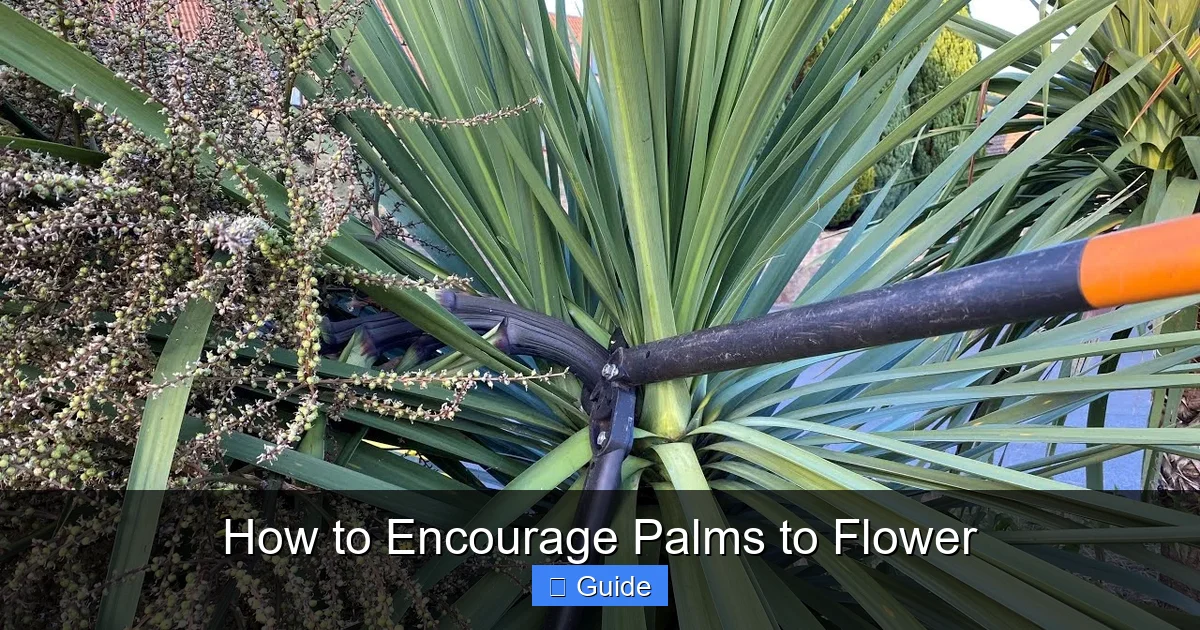
Only remove fronds that are completely dead—brown all the way to the trunk. Also remove flower stalks after they finish blooming and fruiting if you want to prevent messy fruit drop. That is it. Do not remove yellowing fronds. They are still translocating nutrients back to the trunk. Wait until they are fully brown. Do not remove green fronds for aesthetic reasons. Each one removed sets the palm back.
Timing Matters
Prune in late winter or early spring before new growth emerges. This minimizes stress and avoids cutting off emerging flower spikes. Never prune in fall. The palm needs every frond going into winter for cold protection and energy storage. If you must prune a green frond for safety (blocking a walkway, hitting a roof), cut only the minimum necessary and expect a temporary reduction in vigor.
Tool Sanitation
Always sterilize pruning tools between palms. Use 70% isopropyl alcohol or a 10% bleach solution. Palms are susceptible to lethal diseases like Fusarium wilt and Ganoderma butt rot that spread on contaminated tools. A single infected cut can kill a decades-old palm.
Species Selection: Choosing Palms That Flower in Your Zone
Sometimes the problem is not your care. It is the palm itself. Some species simply will not flower in certain climates, no matter what you do. Matching the palm to your climate is the ultimate “hack” for reliable flowering.
Reliable Flowerers for Warm Climates (Zones 9-11)
If you live in Florida, South Texas, Coastal California, or Hawaii, you have the widest options. Queen Palm (Syagrus romanzoffiana) flowers reliably at a young age. Pindo Palm (Butia capitata) produces spectacular yellow-orange flower spikes. Christmas Palm (Adonidia merrillii) blooms multiple times a year. Coconut Palm (Cocos nucifera) flowers continuously once mature. Royal Palm (Roystonea regia) puts on a massive show. These are your best bets for guaranteed flowers.
Best Choices for Cooler Climates (Zones 7-8)
Windmill Palm (Trachycarpus fortunei) is the superstar here. It flowers reliably even in Zone 7, producing huge, dramatic yellow flower clusters. Mediterranean Fan Palm (Chamaerops humilis) is another tough, reliable bloomer. Needle Palm (Rhapidophyllum hystrix) flowers at a young age and handles Zone 6b. Pindo Palm also works well into Zone 8. These palms have the chilling requirement built into their genetics.
Indoor and Container Champions
For pots that come indoors, Lady Palm (Rhapis excelsa) flowers readily in bright light. Parlor Palm (Chamaedorea elegans) blooms young and often. Bamboo Palm (Chamaedorea seifrizii) is another good choice. European Fan Palm (Chamaerops humilis ‘Cerifera’) works in large pots. Give them maximum light, consistent fertilizer, and a summer vacation outdoors for best results.
Dioecious Considerations
If you want fruit as well as flowers, and you choose a dioecious species like Date Palm (Phoenix dactylifera) or Willdate Palm (Phoenix theophrasti), you need both sexes. One male can pollinate several females. Males often flower more prolifically. If you only have room for one tree, choose a monoecious species or accept that you will get flowers but no viable fruit.
Troubleshooting: Why Your Palm Still Won’t Flower
You have the right palm in the right spot. You feed it, water it, and don’t over-prune. It is mature. But still no flowers. Let’s troubleshoot the most common hidden culprits.
Root Constraints
Palms planted near foundations, driveways, pools, or in narrow beds often have restricted root zones. Roots cannot expand to gather enough water and nutrients to support flowering. The palm survives but stays in a maintenance mode, not a reproductive mode. If possible, expand the planting area. Remove pavers. Install root barriers to direct roots away from hardscape. For container palms, root binding has the same effect. Repot into a larger container.
Competition from Turf
Grass growing right up to the trunk is a major problem. Turf roots are dense and shallow. They outcompete palm roots for water and fertilizer. Plus, lawn fertilizers are high nitrogen, low potassium—the opposite of what palms need. Create a mulched bed extending at least 3-5 feet from the trunk. No grass. No weeds. Just 3 inches of organic mulch. This eliminates competition and mimics the forest floor environment palms evolved in.
Hidden Nutrient Imbalances
High soil pH (above 7.0) locks up manganese, iron, and boron. Even if you fertilize correctly, the palm cannot absorb what it needs. Test your soil. If pH is high, apply elemental sulfur to lower it gradually. Use foliar sprays of manganese sulfate and chelated iron as a temporary bypass while soil chemistry improves. This is extremely common in coastal areas with limestone-based soils.
Pest and Disease Pressure
Palm weevils, scale insects, spider mites, and fungal diseases like Graphiola leaf spot (false smut) drain the palm’s reserves. A stressed palm aborts flower buds to survive. Inspect the crown regularly with binoculars. Look for chewed emerging fronds (weevils), white crusty bumps (scale), fine webbing (mites), or black spots with yellow halos (Graphiola). Treat promptly with appropriate horticultural oils, systemic insecticides, or fungicides labeled for palms.
Transplant Shock
If you moved the palm within the last 2-3 years, it may still be recovering. Transplanted palms focus entirely on root regeneration. Flowering is a luxury they cannot afford until the root system is fully re-established. Be patient. Maintain optimal care. Flowers will come when the palm is ready.
Advanced Techniques for Stubborn Palms
For the dedicated enthusiast who has tried everything and still waits for blooms, there are a few advanced strategies worth considering.
Paclobutrazol Application
Paclobutrazol is a plant growth regulator that inhibits gibberellin synthesis, reducing vegetative growth and promoting reproductive growth. It is used commercially to induce early flowering in palms like Date Palm and Oil Palm. Applied as a soil drench at very low rates (1-2 grams active ingredient per inch of trunk diameter), it can trigger flowering in mature but reluctant palms. This is not a homeowner product in many regions. Check local regulations. Use only on mature, healthy palms. Overdose causes severe stunting.
Ethephon Treatment
Ethephon releases ethylene, a plant hormone that can promote flowering in some species. It is sometimes used on Oil Palm and Coconut to synchronize flowering. Like paclobutrazol, this is primarily a commercial tool with strict label requirements. Not recommended for casual use.
Girdling (Not Recommended)
Some old-school growers girdle palm trunks (remove a ring of bark) to block carbohydrate flow downward, forcing accumulation in the crown to trigger flowering. This is extremely risky. Palms do not compartmentalize wounds like dicots. A girdling wound invites Ganoderma, Thielaviopsis, and other fatal fungi. Do not do this.
Stress Induction
Controlled drought stress in late winter, followed by heavy watering and fertilization in spring, mimics the natural dry-wet cycle that triggers flowering in many tropical trees. Withhold water for 3-4 weeks in late winter (if no rain), then resume deep watering with a bloom-boost fertilizer application. This can sometimes “wake up” a mature palm that has everything else but lacks the seasonal cue.
Conclusion
Learning how to encourage palms to flower is ultimately a lesson in patience and observation. There is no magic spray, no secret fertilizer blend, no single trick that overrides a palm’s biology. The formula is straightforward: choose the right species for your climate, give it full sun, feed it a proper palm fertilizer high in potassium and magnesium, water deeply and consistently, never over-prune, and wait for maturity. That is it. That is the whole secret.
But within that simple formula lies a world of nuance. Every palm is an individual. Every site has its quirks. The gardener who succeeds is the one who pays attention—who notices the slight yellowing on older fronds and corrects the magnesium before it becomes severe. Who sees the grass creeping back toward the trunk and expands the mulch ring. Who watches the crown in spring for the first sign of a flower spike emerging, and feels that rush of satisfaction knowing their care made it possible.
Your palm wants to flower. It is programmed to reproduce. Your job is simply to remove the obstacles. Remove the shade. Remove the nutrient deficiencies. Remove the water stress. Remove the competition. Remove the excessive pruning. Do that, and the flowers will come. Maybe not this year. Maybe not next. But they will come. And when they do—those incredible branching inflorescences bursting from the crown, buzzing with bees, heavy with the promise of fruit—you will know every minute of waiting was worth it.
Start today. Assess your palm. Check your soil. Adjust your fertilizer. Expand that mulch ring. And then do the hardest part of all: wait. The bloom is coming.
Frequently Asked Questions
What is the best fertilizer for palm flowering?
The best fertilizer for palm flowering is a slow-release palm special with an 8-2-12-4Mg analysis. This provides high potassium for flower bud development, magnesium for chlorophyll production, and essential micronutrients like manganese and boron in available forms. Apply three to four times per year during the growing season.
Can indoor palms flower?
Yes, indoor palms can flower but it is challenging. They need very bright light (south window or grow lights), consistent warmth, high humidity, and proper palm fertilizer. Species like Parlor Palm, Lady Palm, and Bamboo Palm are most likely to flower indoors. Summer placement outdoors dramatically increases flowering chances.
Should I cut off palm flower stalks?
Remove flower stalks only after flowering and fruiting are complete if you want to prevent messy fruit drop or seedling volunteers. Do not remove emerging flower stalks—this prevents the palm from flowering entirely. The stalk itself does not harm the palm.
Why do palm flowers turn yellow and fall off?
Flower abortion is usually caused by water stress (too dry or too wet), nutrient deficiency (especially boron or potassium), extreme heat, or pest damage. Ensure consistent deep watering, proper fertilization, and check for pests like thrips or mites in the crown.
Do male and female palms look different when flowering?
Yes, on dioecious species like Date Palms, male flowers are typically more numerous, whiter, and pollen-heavy, while female flowers are fewer, greener, and develop into fruit clusters if pollinated. On monoecious palms, both sexes appear on the same inflorescence but at different times or positions.
Can a palm flower after being transplanted?
A transplanted palm will not flower until it fully re-establishes its root system, typically 2-3 years. The palm prioritizes root regeneration over reproduction. Maintain optimal watering, fertilization, and avoid pruning during this recovery period for the earliest return to flowering.