Best Macrame Grow Lights for Palms
Finding the right lighting for indoor palms can be tricky. This guide covers everything you need to know about the best macrame grow lights for palms, from selection to troubleshooting common issues. Get your palms thriving with the perfect light setup today.
Hey there plant friend. If you’re reading this, you probably have a beautiful palm that’s looking a little sad indoors. Maybe the fronds are yellowing. Maybe the plant is stretching toward the window. Or maybe you just brought home a majesty palm and want to give it the best start possible. Whatever brought you here, you’re in the right place.
I’ve spent years helping plant parents troubleshoot lighting issues with their indoor palms. The struggle is real. Palms are picky. They want bright light but not direct sun. They need consistency but hate sudden changes. And finding a grow light that works with your decor? That’s a whole other challenge. That’s where the best macrame grow lights for palms come in. They solve the aesthetic problem and the plant health problem at the same time.
In this guide, we’re going to walk through everything you need to know. We’ll cover why palms struggle indoors, what makes macrame grow lights special, how to pick the right one, and how to fix the most common problems that pop up. By the end, you’ll feel confident setting up a lighting system that keeps your palms happy for years.
Key Takeaways
- Palms need specific light spectrums: Full-spectrum LED lights with 4000K-6500K color temperature work best for healthy palm growth.
- Macrame hangers solve spacing issues: They allow adjustable height positioning so lights stay at the optimal distance from palm fronds.
- Heat management is critical: Choose LED grow lights with built-in heat sinks to prevent leaf burn on sensitive palm foliage.
- Timer automation prevents problems: Consistent 12-14 hour light cycles mimic natural conditions and reduce stress on your palms.
- Watch for stretching or yellowing: These are early warning signs that your macrame grow light setup needs adjustment.
- Regular cleaning maintains efficiency: Dust on light panels reduces output by up to 20%, directly impacting palm health.
- Invest in quality over quantity: One well-placed premium grow light outperforms multiple cheap fixtures for palm care.
Quick Answers to Common Questions
How far should a macrame grow light be from my palm?
Start at 24-30 inches for panel lights and 18-24 inches for COB lights. Adjust based on species and response. Watch for stretching (too far) or tip burn (too close).
Can I use a regular LED bulb in a macrame pendant for my palm?
Regular LED bulbs lack the intensity and spectrum palms need. They work for very low-light palms like parlor palms at close range, but most palms need dedicated grow lights with higher PPFD output.
How many hours of grow light do palms need daily?
Most palms need 12-14 hours of quality light daily. Use a timer for consistency. Majesty and areca palms prefer 14 hours. Kentia and parlor palms tolerate 12 hours.
Why is my palm getting brown tips under the grow light?
Brown tips usually mean light burn or heat stress. Raise the light 6 inches, reduce intensity by 20%, and ensure good airflow around the light fixture. Check leaf temperature stays below 85°F.
Do I need to rotate my palm under a macrame grow light?
Yes. Rotate 90 degrees weekly for even growth. Even wide-beam lights create brighter centers. Rotation prevents lopsided development and ensures all fronds get equal light exposure.
📑 Table of Contents
- Understanding Why Palms Need Special Lighting
- What Makes Macrame Grow Lights Unique for Palms
- Top Features to Look for in Macrame Grow Lights
- Common Problems and How to Fix Them
- Setting Up Your Macrame Grow Light System
- Maintenance Tips for Long-Lasting Performance
- Choosing the Right Light for Your Specific Palm
- Budget vs Premium: Where to Spend and Where to Save
- Advanced Tips for Palm Enthusiasts
- Conclusion
Understanding Why Palms Need Special Lighting
Let’s start with the basics. Palms evolved under forest canopies or in open tropical areas with intense, filtered light. Your living room? Not so much. Even a bright south-facing window often delivers only a fraction of the light intensity palms expect.
The Light Gap Problem
Here’s what happens. A palm in its natural habitat gets 10,000 to 50,000 foot-candles of light. A bright indoor spot might give you 500 to 1,000 foot-candles on a good day. That’s a massive gap. Your palm survives but it doesn’t thrive. You’ll see slower growth, smaller fronds, and eventually yellowing or browning tips.
The best macrame grow lights for palms bridge this gap. They deliver concentrated light right where your palm needs it. But not all grow lights are created equal. Palms have specific needs that differ from succulents or leafy tropicals.
Palm-Specific Light Requirements
Palms need a balanced spectrum. Too much blue light and you get compact, stiff growth. Too much red and you get weak, stretching fronds. The sweet spot is a full-spectrum white light around 4000K to 6500K. This mimics midday sun through a canopy.
Intensity matters too. Most indoor palms want 2000 to 5000 foot-candles at the canopy level. That translates to roughly 30 to 50 watts per square foot of quality LED coverage. The best macrame grow lights for palms let you adjust height to dial in that perfect intensity.
Photoperiod Sensitivity
Here’s something many people miss. Palms are photoperiod sensitive. They track day length. In nature, they get 12 to 14 hours of quality light year-round near the equator. Indoor lights that run 8 hours or 16 hours randomly confuse the plant. This triggers stress responses like leaf drop or stalled growth.
A timer is non-negotiable. Set it and forget it. 12 hours on, 12 hours off works for most palms. Some species like kentia or parlor palms tolerate slightly less. Majesty and areca palms want the full 14 hours.
What Makes Macrame Grow Lights Unique for Palms
Okay, so why macrame specifically? Why not a clip light or a floor lamp? The answer comes down to three things: adjustability, aesthetics, and airflow.
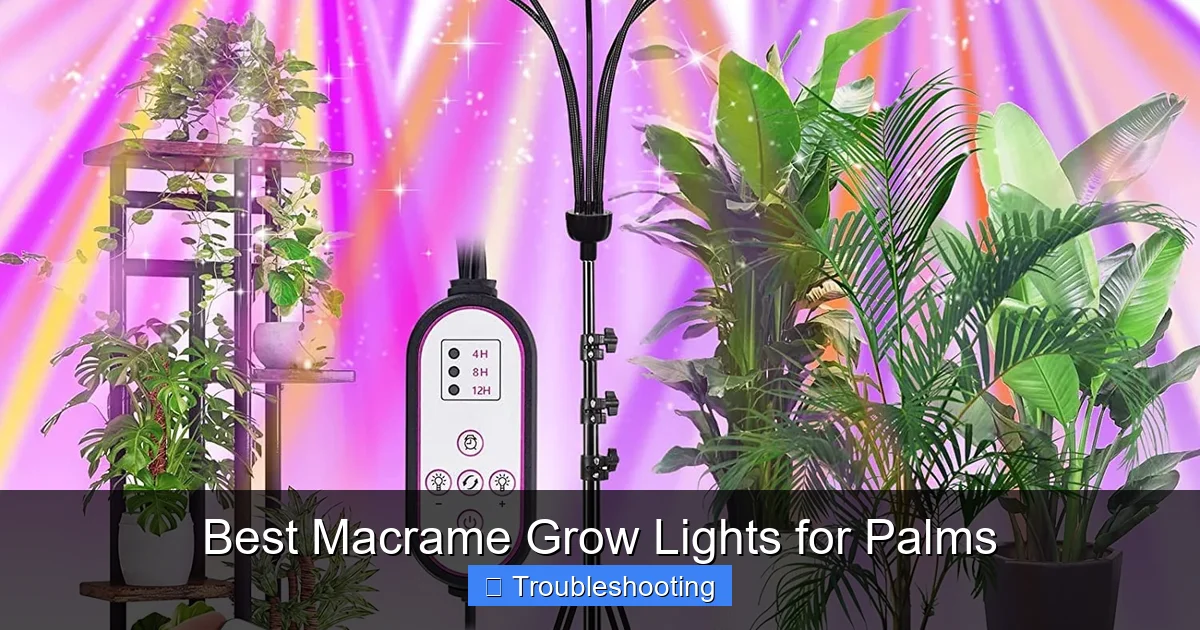
Visual guide about Best Macrame Grow Lights for Palms
Image source: m.media-amazon.com
Adjustable Height Changes Everything
Palms grow. Sometimes fast. A fixed light that’s perfect in March is burning fronds by June. Macrame hangers let you raise the light as your palm grows. No tools. No drilling new holes. Just pull the cord and tie a new knot.
This adjustability is huge for the best macrame grow lights for palms because different species need different distances. A parlor palm might want the light 18 inches away. A majesty palm might need 24 to 30 inches. With macrame, you customize for each plant.
360-Degree Light Distribution
Clip lights and gooseneck lamps shine in one direction. Palms are radial plants. They need light from multiple angles for even growth. A macrame-hung panel light or COB LED spreads light in a wide cone. Rotate your palm weekly and every frond gets its turn in the spotlight.
Some setups use two or three smaller lights on a macrame ring. This creates overlapping coverage that eliminates shadow zones. The result? Symmetrical, lush growth all around.
Decor That Doesn’t Scream “Grow Op”
Let’s be honest. Most grow lights look industrial. Purple panels. Aluminum heat sinks. Dangling cords. They kill the vibe of a carefully curated plant corner. Macrame softens everything. The natural fibers blend with your plant aesthetic. The light becomes a design element, not an eyesore.
You can match your macrame to your decor. Cream cotton for boho. Black nylon for modern. Jute for rustic. The best macrame grow lights for palms disappear into your style while doing heavy lifting for plant health.
Airflow and Heat Dissipation
This is the hidden benefit. Macrame creates space between the light and the ceiling. Heat rises and escapes. Clip lights pressed against shelves trap heat. That heat radiates down onto palm fronds, causing tip burn even if the light intensity is perfect.
The open structure of macrame hangers promotes convection cooling. Your LEDs run cooler, last longer, and your palms stay safer. It’s a win-win that most people overlook.
Top Features to Look for in Macrame Grow Lights
Shopping for grow lights gets overwhelming fast. Watts. PPFD. CRI. Spectrum charts. Let’s cut through the noise. Here are the features that actually matter for palms.
Full-Spectrum White Light (4000K-6500K)
Skip the purple blurple lights. They make it hard to spot pests, assess leaf color, or enjoy your plants. Full-spectrum white LEDs give you accurate color rendering (CRI 90+) and the balanced spectrum palms need. Look for 4000K for a warmer, more natural look or 5000K-6500K for maximum growth power.
The best macrame grow lights for palms use Samsung LM301H or similar high-efficiency diodes. These deliver more usable light per watt. You get better results with less electricity and less heat.
Dimmable Output
Dimming is essential. New palms need gentle light. Established palms want full power. Seasonal changes mean you dial back in winter, ramp up in spring. A 0-100% dimmer (not just 3 settings) gives you precise control.
Some premium lights include app control with sunrise/sunset simulation. This gradual transition reduces shock. It’s a nice-to-have, not a must-have, but your palms will appreciate it.
Passive Cooling Design
Fans fail. They get noisy. They collect dust. The best macrame grow lights for palms use aluminum heat sinks with fins or pin arrays. No moving parts. Silent operation. 50,000+ hour lifespan.
Check the weight. Heavier usually means more thermal mass. A 3-pound panel beats a 1-pound panel for heat management every time.
Coverage Area Matching Your Palm
Measure your palm’s canopy spread. Add 6 inches on each side. That’s your minimum coverage diameter. A 12-inch panel covers a 24-inch canopy. A 24-inch panel covers a 48-inch canopy.
Don’t undersize. Light intensity drops fast at the edges. The best macrame grow lights for palms list their coverage at specific hanging heights. Read the specs. Match them to your plant.
Water Resistance Rating
Misting happens. Humidity trays splash. Look for IP65 or at least IP54 rating on the light housing. Sealed drivers. Conformal coated boards. This isn’t paranoia. It’s protecting a $100+ investment from the inevitable accident.
Quality Macrame Construction
The hanger matters as much as the light. Look for:
- Weight-rated cord (minimum 15 lbs for panel lights)
- Secure knots (double figure-eight or scaffold knots)
- Metal ceiling hook with anchor, not just a screw eye
- Adjustable sliding knot or bead lock system
- Natural fiber that won’t degrade under UV/heat
Cheap macrame stretches. Knots slip. Your light slowly lowers onto your palm. Spend the extra $10 on quality hanging hardware.
Common Problems and How to Fix Them
Even with the best macrame grow lights for palms, things go wrong. Here’s your troubleshooting playbook for the most common issues.
Problem: Frond Tips Turning Brown and Crispy
Diagnosis: Usually light burn or heat stress. The light is too close or running too hot.
Fix: Raise the light 6 inches. Check leaf surface temperature with an infrared thermometer. Should stay below 85°F. If heat is the issue, add a small USB fan blowing across the light’s heat sink. Drop intensity by 20% via dimmer. Brown tips won’t heal but new growth will be clean.
Problem: Palm Stretching Toward Light / Leggy Growth
Diagnosis: Insufficient intensity or wrong spectrum. The palm is desperate for more photons.
Fix: Lower the light 3-6 inches. Increase intensity to 100%. Verify you’re running 12-14 hours. Check that your light actually delivers full spectrum. Some budget lights claim full spectrum but are heavy on blue, light on red. The best macrame grow lights for palms publish their spectral distribution chart. If yours doesn’t, consider upgrading.
Problem: Yellowing Lower Fronds
Diagnosis: Could be light starvation at the bottom, natural aging, or nutrient issue. If only the lowest, oldest fronds yellow, it’s often normal. If mid-canopy fronds yellow, light isn’t penetrating.
Fix: Add a second light at a lower angle. Or use a light with wider beam angle (120° vs 90°). Rotate plant more frequently. Thin dense canopies by removing fully brown fronds to let light through.
Problem: Light Flickering or Turning Off Randomly
Diagnosis: Driver overheating, loose connection, or timer malfunction.
Fix: Check all connections. Ensure heat sink has clearance. Test light plugged directly into wall (bypass timer). If it stabilizes, replace timer. If still flickering, contact manufacturer. Most quality lights have 3-5 year warranties.
Problem: Macrame Stretching / Light Slowly Lowering
Diagnosis: Cord creep. Knots tightening under sustained weight. Natural fiber elongation.
Fix: Retie knots monthly. Use a sliding bead lock instead of friction knots. Switch to polyester or nylon cord for zero stretch. Mark your ideal height on the cord with a permanent marker for quick reference.
Problem: Uneven Growth / One Side Sparse
Diagnosis: Light only hitting one side. Plant not rotated.
Fix: Rotate 90 degrees weekly. Set a phone reminder. Add a small supplemental light on the dark side. The best macrame grow lights for palms with wide beam angles minimize this, but rotation is still best practice.
Problem: Algae or Mold on Soil Surface
Diagnosis: Excess moisture + light hitting soil. The grow light creates a mini greenhouse effect.
Fix: Top dress with decorative gravel or horticultural charcoal. Improve airflow with a clip fan. Ensure light isn’t angled straight down at soil. Angle it slightly toward canopy instead.
Setting Up Your Macrame Grow Light System
You’ve got the light. You’ve got the macrame. Now let’s put it together right the first time.
Choosing the Right Location
Pick a spot with:
- Ceiling joist or solid anchor point (use a stud finder)
- Access to outlet (or plan for cord management)
- Room for palm to grow upward and outward
- Good airflow (not in a stagnant corner)
- Visible for daily enjoyment and accessible for watering and rotating
Avoid spots near HVAC vents, drafty windows, or exterior doors. Temperature swings stress palms more than slightly imperfect light.
Installing the Ceiling Anchor
This is where people cut corners. Don’t. A falling grow light destroys your palm and your floor.
- Locate joist with stud finder. Mark center.
- Drill pilot hole (1/8″ for 3/8″ lag hook).
- Screw in heavy-duty lag hook by hand until flush.
- Test with 25 lbs pull. Should not budge.
- If no joist, use toggle bolt rated 50+ lbs.
Pro tip: Install a swivel hook. It lets the macrame hang straight even if your joist is slightly off-center from your ideal plant position.
Hanging and Leveling the Light
Attach macrame to light first. Most panels have hanging loops or grommets. Use carabiners for easy removal. Hang on ceiling hook. Step back. Check level.
If crooked, adjust individual cords at the macrame gathering knot. Small tweaks. Get it perfect before positioning plant.
Positioning Your Palm
Place palm directly under light center. Measure distance from light to highest frond. Start at manufacturer’s recommended max distance. Usually 24-30 inches for panels, 18-24 inches for COB lights.
Run at 50% intensity for first week. Watch for stress. Increase 10% every 2 days until full power. This hardening-off period prevents shock.
Setting Up Automation
Plug light into smart plug or digital timer. Program:
- On: 6:00 AM (or your wake time)
- Off: 8:00 PM (14 hours) or 6:00 PM (12 hours)
- Dim to 25% for 30 min at start/end if your light supports it
Label the timer. “Palm Light – DO NOT UNPLUG.” House cleaners and guests love to “help” by turning off weird plugs.
Cable Management
Loose cords look messy and create trip hazards. Use adhesive cable clips along ceiling and wall. Run cord to nearest outlet. Leave a small service loop at the light for height adjustments. Velcro ties keep excess neat.
Maintenance Tips for Long-Lasting Performance
A little care keeps your system running strong for years. The best macrame grow lights for palms are an investment. Protect it.
Monthly Light Cleaning
Dust cuts output. Wipe panels monthly with microfiber cloth slightly damp with distilled water. Never spray directly on light. Never use chemicals. Clean when light is off and cool.
Check lens for water spots from misting. These create hot spots. Buff gently.
Quarterly Hardware Check
Every 3 months:
- Tug test macrame knots
- Verify ceiling hook tight
- Inspect cord for wear/fraying
- Check carabiners for gate function
- Confirm light still level
Set a calendar reminder. It takes 2 minutes.
Seasonal Adjustments
Winter: Lower light 3-4 inches. Days are shorter, sun angle lower. Palms appreciate the boost. Run 14 hours if possible.
Summer: Raise light 3-4 inches. Ambient light increases. Heat builds faster. Back off intensity 10-20% if temps climb.
Spring/Fall: Transition gradually over 2 weeks. Plants hate sudden changes.
Annual Deep Maintenance
Once a year:
- Remove light. Deep clean heat sink fins with compressed air.
- Inspect driver connections. Reseat if accessible.
- Test output with PAR meter if you have one. 10%+ drop means diode degradation.
- Replace macrame if any fiber degradation visible.
- Re-verify timer accuracy.
Troubleshooting Log
Keep a simple note on your phone. Date. Observation. Action taken. Result. This builds your personal knowledge base. Next time something weird happens, you’ll have data, not guesses.
Choosing the Right Light for Your Specific Palm
Not all palms are created equal. Let’s match light to species.
Low Light Tolerant: Parlor Palm, Kentia Palm, Lady Palm
These survive in lower light but thrive with moderate supplemental light. A 20-30 watt panel at 24 inches works beautifully. 12-hour photoperiod. The best macrame grow lights for palms in this category don’t need to be monsters. Quality over power.
Medium Light: Areca Palm, Bamboo Palm, Cat Palm
Want brighter conditions. 40-60 watt panel at 18-24 inches. 13-14 hour photoperiod. Watch for stretching. These show light deficiency fast.
High Light: Majesty Palm, Ponytail Palm, Chinese Fan Palm
Light hungry. 60-100 watt coverage. May need two panels for larger specimens. 14 hour photoperiod non-negotiable. Close monitoring for heat stress at higher intensities.
Special Case: Ponytail Palm (Not a True Palm)
Succulent-like. Wants intense light. Can handle closer positioning (12-18 inches). But watch the caudex. Direct intense light can scorch the swollen base. Angle light toward fronds, not trunk.
Grouping Multiple Palms
One large light over a cluster works if canopies are similar height. Staggered heights? Use multiple smaller lights on a macrame ring at different levels. The best macrame grow lights for palms in group settings are modular systems you can expand.
Budget vs Premium: Where to Spend and Where to Save
Let’s talk money. You can spend $50 or $500. Here’s the honest breakdown.
Where to Invest
- LED Diodes: Samsung, Osram, Cree chips. They last longer, run cooler, deliver better spectrum. This is the heart of the light.
- Driver: Mean Well or Inventronics. Cheap drivers fail first. They take the light with them.
- Ceiling Hardware: One lag hook. $3. Don’t use a $1 screw eye.
- Timer: $15 digital timer beats $5 mechanical every time. Reliability matters.
Where to Save
- Macrame: DIY with $10 cord and YouTube tutorial. Or buy handmade on Etsy for $25-40. Skip $80 designer hangers.
- Housing: Aluminum extrusion frame is fine. Don’t pay for fancy anodized colors.
- Smart Features: App control is nice. A $15 timer does 90% of the job.
- Brand Name: Many “premium” brands use identical components as mid-tier. Compare specs, not logos.
The Sweet Spot
For most palm parents, a $120-180 panel light with quality diodes, Mean Well driver, passive cooling, and dimmer hits the value peak. Pair with $30 macrame and $15 timer. Total $165-225. This system lasts 5-7 years and grows spectacular palms.
The best macrame grow lights for palms aren’t the most expensive. They’re the ones that match your palm’s needs and your commitment level.
Advanced Tips for Palm Enthusiasts
Ready to level up? These pro moves separate good results from great results.
Supplemental Side Lighting
Add two 10-watt LED bars on adjustable arms at mid-canopy height. Angled inward. This fills the “underside gap” where top light doesn’t reach. Fronds stay green to the base. No more naked trunks.
PAR Meter Rental
Borrow or rent a quantum PAR meter ($30/day). Measure actual PPFD at multiple canopy points. Adjust height and intensity to hit 200-400 µmol/m²/s across the canopy. Data beats guesswork every time.
CO2 Enrichment (For the Dedicated)
If you’re running high light (500+ PPFD), CO2 becomes limiting. A small CO2 bag or generator pushes growth 20-30%. Only worth it if you’ve maxed light, nutrients, and environment first.
Spectral Tuning by Season
Some advanced lights let you shift spectrum. More blue in vegetative spring/summer. More red in fall/winter. Mimics natural seasonal shift. Subtle but measurable difference in frond quality.
Integrated Pest Management Lighting
UV-A supplemental bars (365-395nm) for 2 hours daily suppress spider mites and fungal spores. Common palm pests hate UV. Your palms love the extra spectrum. Win-win.
Conclusion
We covered a lot of ground. From understanding why your palm struggles indoors to picking, installing, and maintaining the best macrame grow lights for palms. The key takeaways are simple.
Palms need consistent, quality light. Macrame hangers give you the adjustability to deliver it perfectly. Full-spectrum white LEDs in the 4000K-6500K range with passive cooling are your best bet. Automation via timer removes human error. Regular maintenance keeps the system performing.
Start with one quality light. Master the basics. Watch your palm respond. New fronds emerging larger and greener. No more brown tips. Symmetrical, lush growth. That’s the payoff.
Your palm has been waiting for this. Give it the light it deserves. The macrame looks beautiful. The light works invisibly. And you get to enjoy a thriving tropical centerpiece in your home, no matter the season or window situation.
Happy growing, friend. Your palms are about to thank you.
Frequently Asked Questions
What color temperature is best for palm grow lights?
Full-spectrum white light between 4000K and 6500K is ideal for palms. 4000K provides a warmer, more natural appearance while 5000K-6500K maximizes photosynthetic efficiency. Avoid purple/blurple lights as they make health assessment difficult.
Can macrame grow lights cause fire hazards?
Quality LED grow lights with passive cooling run cool and pose minimal fire risk. Ensure your macrame cord is rated for the light’s weight, use proper ceiling anchors, and keep flammable materials away from the driver unit. Never use damaged cords or frayed macrame.
How do I know if my palm is getting enough light?
Healthy signs include new fronds emerging at normal size, deep green color, compact growth without stretching, and no excessive yellowing of lower fronds. If new growth is small, pale, or the plant leans dramatically toward the light, increase intensity or duration.
Should I run my macrame grow light at night instead of day?
Run lights during natural daylight hours (e.g., 6 AM to 8 PM) to align with your palm’s circadian rhythm. Night-only lighting disrupts photoperiod sensitivity and can cause stress. Consistent daily timing matters more than specific hours.
How often should I replace my macrame grow light?
Quality LED grow lights last 50,000+ hours (5-7 years at 14 hours daily). Replace when output drops 15%+ (measure with PAR meter) or if diodes fail. Macrame hangers should be inspected annually and replaced if fibers show degradation or knots slip.
Can I hang multiple macrame grow lights from one ceiling hook?
Only if the hook and ceiling anchor are rated for the combined weight. Most residential hooks support 50-100 lbs. Two 3-lb lights plus macrame is fine. For heavier setups, install separate anchors into individual joists. Never exceed the hardware’s rated capacity.