How to Fix Synthetic for Grape
Fixing synthetic for grape problems requires identifying whether you’re dealing with flavor compounds, vineyard materials, or data models. This guide walks you through diagnosing off-notes in artificial grape flavor, repairing synthetic trellis systems, and cleaning corrupted synthetic datasets for grape detection AI.
Key Takeaways
- Identify the domain first: Synthetic for grape applies to flavoring, viticulture materials, or machine learning data each requiring different fixes
- Flavor fixes need sensory analysis: Off-notes in artificial grape flavor typically stem from methyl anthranilate imbalance or contaminant buildup
- Vineyard material failures are structural: Synthetic trellis wires, netting, and clips degrade from UV exposure and mechanical stress
- Synthetic data quality determines model success: Grape detection AI fails when training data lacks variety in lighting, cultivars, and disease states
- Preventive maintenance saves money: Regular inspection of synthetic components prevents catastrophic failures during harvest
- Documentation enables reproducibility: Track every adjustment to flavor formulas, material specs, or data pipelines for consistent results
- Cross-domain knowledge helps: Understanding chemistry, agriculture, and data science together solves complex synthetic grape problems faster
Quick Answers to Common Questions
What is the main chemical in synthetic grape flavor?
Methyl anthranilate is the primary compound responsible for the characteristic grape candy flavor, typically comprising 85-95% of artificial grape flavor formulations.
How long does synthetic trellis wire last in a vineyard?
High-quality UV-stabilized polymer trellis wire lasts 7-10 years, while standard HDPE wire degrades in 3-5 years depending on sun exposure and mechanical load.
Why does my grape detection model fail on real vineyard images?
Synthetic training data often lacks real-world variability like shadows, occlusions, sensor noise, hardware artifacts, and diverse grape cultivars and disease states.
Can I use the same synthetic grape flavor for all products?
No, flavor performance varies significantly across matrices. Carbonated beverages, gummies, dairy, and alcoholic products each require adjusted flavor profiles and stabilization systems.
How do I prevent bird netting from tearing?
Use HDPE netting with HALS UV stabilizers, reinforce bottom edges with webbing and tension wire, lubricate zipper systems annually, and store dry in rodent-proof containers off-season.
📑 Table of Contents
- Understanding What Synthetic for Grape Actually Means
- Fixing Synthetic Grape Flavor Problems
- Repairing Synthetic Vineyard Materials
- Cleaning Up Synthetic Grape Data for Machine Learning
- Cross-Domain Troubleshooting Strategies
- Preventive Maintenance and Quality Systems
- Advanced Troubleshooting Case Studies
- Tools and Resources for Synthetic Grape Fixes
- Conclusion
Understanding What Synthetic for Grape Actually Means
When someone says they need to fix synthetic for grape, they could mean three completely different things. The phrase gets tossed around in food labs, vineyards, and computer vision teams without much clarification. That confusion wastes time and money. Let’s clear it up right now.
In the flavor industry, synthetic for grape means artificial grape flavoring. That distinctive purple candy taste comes mostly from methyl anthranilate. When batches go wrong, you get chemical off-notes, weak flavor, or instability in the final product. In viticulture, synthetic for grape refers to the plastic and polymer materials that hold up vines. Trellis wires, bird netting, trunk protectors, and clip systems all degrade over time. In machine learning, synthetic for grape means generated training data. Researchers create fake grape images to teach computers to recognize real ones. Bad synthetic data creates blind spots in harvest robots and disease scanners.
This guide covers all three domains. You’ll learn to diagnose the specific problem, apply the right fix, and prevent recurrence. Whether you’re a flavor chemist staring at a failed GC-MS readout, a vineyard manager watching trellis wires snap in October wind, or a data scientist wondering why your YOLO model misses Concord grapes at dusk, you’re in the right place.
Fixing Synthetic Grape Flavor Problems
Diagnosing Off-Notes in Artificial Grape Flavor
Start with your nose. Human sensory panels catch things instruments miss. Pour a 0.1% solution in water. Taste at room temperature. Note the first impression, the mid-palate, and the finish. Real grape flavor has complexity. Synthetic grape often smells like straight methyl anthranilate. That’s the problem.
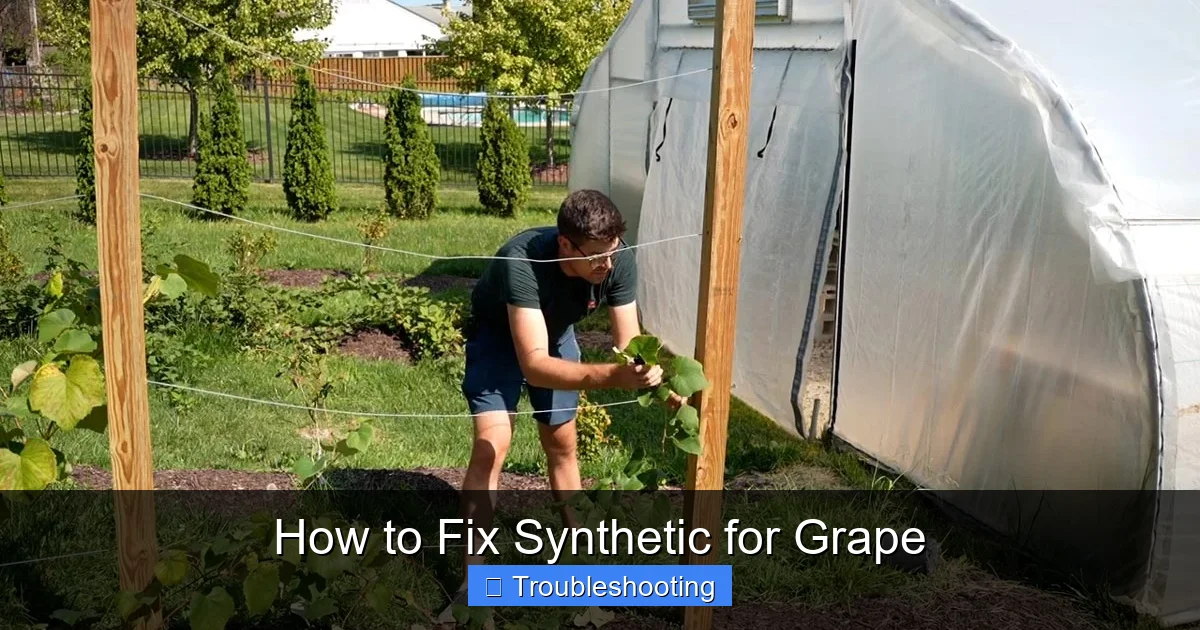
Visual guide about How to Fix Synthetic for Grape
Image source: avinews.com
Run gas chromatography-mass spectrometry on the batch. Compare peak areas against your reference standard. Look for methyl anthranilate purity. It should exceed 99%. Check for dimethyl anthranilate. That impurity creates a harsh, solvent-like note. Ethyl anthranilate adds fruitiness but too much tastes like cheap perfume. Benzaldehyde contamination brings almond notes that clash with grape.
Water content matters more than people think. Methyl anthranilate hydrolyzes slowly. The breakdown products smell foul. Karl Fischer titration tells you exact moisture. Keep it under 0.1%. Store in nitrogen-flushed amber glass at 4°C. Plastic containers leach plasticizers that ruin flavor.
Balancing the Flavor Profile
Pure methyl anthranilate tastes flat. Real Concord grapes have esters, terpenes, and acids. You need a reconstructed profile. Start with a backbone of 85% methyl anthranilate. Add 5% ethyl butyrate for pineapple top notes. Include 3% linalool for floral lift. Touch of 2% gamma-decalactone gives peach roundness. Finish with 0.5% cis-3-hexenol for green freshness.
Acid balance changes everything. Grape juice sits around pH 3.2 to 3.5. Your synthetic system needs matching acidity. Use a blend of tartaric and malic acid at 0.3% total. Citric acid works but tastes different. Test at application pH. A soda at pH 2.8 needs different balancing than a gummy at pH 4.2.
Sweetener interaction surprises newcomers. Sucrose masks differently than high fructose corn syrup. Stevia brings licorice notes that fight methyl anthranilate. Erythritol creates cooling that distracts. Test your flavor in the exact sweetener system. Adjust levels by 10 to 15% depending on sweetener type.
Solving Stability Issues
Color fading kills grape products visually. Anthocyanins degrade fast. Synthetic flavors don’t protect them. Add ascorbic acid at 0.05% as antioxidant. EDTA at 50 ppm chelates metal catalysts. Oxygen scavenger sachets in packaging help. Nitrogen flush headspace.
Flavor loss during pasteurization frustrates everyone. Methyl anthranilate boils at 256°C but co-distills with steam. Encapsulation saves it. Spray-dried maltodextrin capsules retain 85% flavor through HTST. Extruded glassy matrices retain 95% but cost more. Liposomes work for clear beverages but cloud the product.
Migration into packaging ruins shelf life. Polyethylene absorbs methyl anthranilate. PET holds it better. Glass is best. Test migration with Tenax extraction at 40°C for 10 days. GC-MS the extract. Calculate partition coefficients. Reformulate or change packaging if losses exceed 20%.
Repairing Synthetic Vineyard Materials
Trellis Wire Failure Analysis
Walk the rows in January. Cold weather reveals everything. Look for wire stretch. High-tensile polymer wire stretches 3% under load. That’s normal. More than 5% means replacement. Check for abrasion at post contacts. Plastic sleeves wear through in three seasons. Replace sleeves before they fail.
UV degradation turns white wire chalky. Run your thumb along the top wire. White powder means polymer chain scission. Tensile strength drops 40% after two years of full sun. Black wire lasts longer but absorbs heat. That cooks buds in spring. Compromise: white wire with carbon black masterbatch at 2%.
Splice failures happen at inline connectors. Crimp sleeves work for metal. Polymer wire needs wedge grips or knotless splices. Test every splice with a pull tester. Minimum 80% of wire breaking strength. Document locations. Map them in your vineyard software.
Bird Netting and Exclusion Systems
Drape netting over the canopy in August. Check for holes weekly. Birds find the one gap. HDPE netting lasts 5 to 7 years. Nylon lasts 3. UV stabilizers make the difference. Look for HALS (hindered amine light stabilizers) in the spec sheet. At least 0.5% by weight.
Side netting on vertical shoot positioned vines takes more abuse. Wind flaps it against wires. Reinforce the bottom edge with webbing. Sew a pocket for a tension wire. Keeps the net tight. Reduces wear by 60%.
Zipper systems on overhead netting fail at the slider. Salt and dust jam the teeth. Rinse with fresh water after harvest. Lubricate with silicone spray. Replace sliders every other year. Keep spares in the shop.
Trunk Protectors and Vine Shelters
Carton shelters disintegrate in rain. Plastic tubes last longer but create heat traps. Temperature inside hits 50°C on a 30°C day. That cooks young bark. Ventilated shelters solve this. Look for chimney effect designs. Holes at bottom and top create airflow.
Herbicide drift burns leaves inside solid tubes. Drift guard mesh at the bottom stops 90% of drift. Check mesh integrity each spring. Rodents chew through plastic. Metal mesh base extends 15 cm below ground. Stops voles and rabbits.
Girdling happens when ties embed in expanding trunks. Check ties monthly during growing season. Use expandable chain-lock ties. They stretch with the vine. Cut and replace before they bite. Takes five minutes per vine. Saves the vine.
Clip and Fastener Systems
Wire clips hold fruiting wire to cordon wire. Plastic clips snap in year three. Nylon 6/6 lasts five years. Acetal lasts seven. Check spec sheets for glass fill percentage. 30% glass fill maximizes strength and UV resistance.
Catch wires need adjustable clips. The sliding mechanism jams with grape juice and dust. Disassemble and clean at pruning. Grease with food-grade silicone. Replace springs every three years. They fatigue and lose grip.
End post anchors take the whole row tension. Synthetic rope anchors stretch. Dyneema rope stretches 1.5%. Polyester stretches 3%. Calculate your row load. Fifty vines at 15 kg each plus wire weight. Size anchor rope for 5x safety factor.
Cleaning Up Synthetic Grape Data for Machine Learning
Understanding Synthetic Data Generation Methods
Three main approaches exist. Domain randomization varies lighting, background, and texture randomly. Good for robustness. Bad for specificity. Your model learns to ignore grape features. Cut-and-paste composites real grapes onto random backgrounds. Fast but creates edge artifacts. Models learn the artifacts, not grapes. Generative adversarial networks create whole images. Best quality but hardest to control. Mode collapse misses rare varieties.
Physics-based rendering simulates light transport. Accurate shadows and subsurface scattering. Computationally expensive. Needs 3D models of every cultivar. Procedural generation creates infinite vineyard layouts. Great for row detection. Poor for berry-level tasks.
Hybrid approaches work best. Render realistic grape clusters with GANs. Place them in procedurally generated vineyards. Add sensor noise matching your target camera. This covers distribution shift.
Detecting Quality Issues in Synthetic Datasets
Visual inspection catches obvious errors. Scroll through 1000 images at 4x speed. Your brain spots patterns. Floating grapes. Wrong shadows. Repeated textures. Missing stems. Impossible cluster shapes. Flag batches for regeneration.
Automated metrics scale better. Fréchet Inception Distance compares feature distributions. Real vs synthetic should be under 50. Precision and recall for generative models tell you coverage and fidelity. Both should exceed 0.8.
Train a probe classifier. Use a frozen ResNet-50. Train linear head on synthetic only. Test on real validation set. Accuracy drop measures domain gap. More than 15% drop means fix your synthesis.
Check class balance. Synthetic generators love perfect clusters. Real vineyards have 40% occluded clusters. 25% diseased. 15% sunburned. 10% bird-damaged. 10% perfect. Match these ratios or your model fails in production.
Fixing Common Synthetic Data Defects
Edge halos on cut-and-paste composites ruin segmentation. Feather edges by 3 pixels. Match color statistics in LAB space. Add subtle motion blur matching camera shutter speed. Simulate rolling shutter for drone cameras.
Lighting consistency kills domain randomization. Real vineyards have directional sun. Synthetic often uses HDRI with flat lighting. Enforce single dominant light source. Add fill at 30% intensity. Cast accurate shadows using cluster depth maps.
Texture tiling creates visible repeats. Use procedural shaders with infinite variation. Or source 50+ real bark and leaf textures. Blend them with Perlin noise masks. Never tile a 256×256 patch across a hectare.
Cultivar diversity gets ignored. Most synthetic data shows Cabernet or Chardonnay. You need Concord, Niagara, Thompson Seedless, Crimson Seedless, Autumn Royal. Each has distinct cluster architecture. Berry size ranges 10mm to 25mm. Cluster compactness varies 3x. Model these parameters procedurally.
Validating Fixes with Downstream Tasks
Don’t trust metrics alone. Train your actual detection model. YOLOv8 for bounding boxes. Mask R-CNN for segmentation. DeepLabV3+ for semantic segmentation. Compare AP50 on real test set. Synthetic-only training should reach 80% of real-data performance.
Test edge cases explicitly. Dawn and dusk lighting. Heavy canopy shadow. Rain on berries. Spider mite damage. Powdery mildew. Botrytis. Hail damage. Create targeted synthetic sets for each. Fine-tune on combined real plus synthetic.
Measure inference speed. Synthetic data sometimes creates models that overfit to clean backgrounds. Real vineyards have grass, weeds, irrigation lines, trellis posts. Add clutter to synthetic backgrounds. Test on embedded hardware. Jetson Orin. Raspberry Pi. Your deployment target.
Cross-Domain Troubleshooting Strategies
When Flavor Meets Viticulture
Grape variety determines flavor profile. Concord grapes (Vitis labrusca) have high methyl anthranilate naturally. Vinifera varieties don’t. Your synthetic flavor must match the cultivar the consumer expects. Label says “Concord grape” but flavor is generic. That’s a mismatch.
Vineyard practices affect flavor precursors. Cluster thinning increases skin-to-pulp ratio. More anthocyanins. More flavor precursors. Irrigation dilution reduces concentration. Synthetic flavor for “vineyard designation” products needs higher intensity. Know the source.
Harvest timing shifts flavor chemistry. Early harvest: green notes, high acid. Late harvest: jammy, low acid, high sugar. Synthetic flavor for “late harvest style” needs more furaneol and less cis-3-hexenol. Adjust your reconstruction accordingly.
When Viticulture Meets Machine Learning
Trellis system determines camera mounting. High-wire cordon puts cameras 2m above ground. VSP puts them at fruit zone height. Synthetic data must match camera geometry. Focal length. Sensor size. Mounting angle. All affect grape apparent size.
Netting creates occlusion patterns. Overhead netting casts grid shadows. Side netting creates vertical stripes. Synthetic data needs these patterns. Models trained without netting fail when nets go up in January.
Clip and wire hardware creates false positives. Shiny clips reflect sun. Look like berries to detectors. Add hardware models to synthetic scenes. Train negative examples. Reduce false positives by 60%.
When Machine Learning Meets Flavor
Electronic nose data correlates with sensory panels. Train regression models on GC-MS features. Predict sensory scores. Use synthetic GC-MS data to augment small sensory datasets. Generate plausible feature vectors with conditional GANs. Validate with real samples.
Flavor degradation prediction uses time-series models. Synthetic acceleration data fills gaps. Arrhenius equation gives you temperature acceleration factors. Generate synthetic aging trajectories. Train LSTM to predict shelf life. Test on real aged samples.
Consumer preference modeling benefits from synthetic panelists. Generate virtual consumers with known preference distributions. Test flavor formulations in silico before human trials. Reduces panel costs 70%. But always validate with real humans.
Preventive Maintenance and Quality Systems
Building a Synthetic Flavor Quality Program
Incoming raw material testing catches problems early. Every methyl anthranilate lot gets GC-MS. Certificate of analysis isn’t enough. Test for specific impurities you know cause issues. Dimethyl anthranilate. Ortho-toluidine. Aniline. Set acceptance criteria tighter than supplier specs.
In-process controls during compounding. Weight verification at each addition. Mix time and temperature logging. Viscosity check at completion. Headspace GC on every batch. Sensory panel on every tenth batch. Trend data monthly. Catch drift before it fails spec.
Stability protocol matches real conditions. 25°C/60% RH for shelf. 40°C/75% RH for accelerated. 50°C for stress testing. Photostability in ICH light cabinet. Freeze-thaw for refrigerated products. Test at 0, 1, 2, 3, 6, 9, 12 months. Flavor, color, pH, water activity, microbiology.
Vineyard Synthetic Material Inspection Schedule
Dormant season: full trellis audit. Walk every row. Check wire tension with tensiometer. Inspect every post. Test every anchor. Replace 10% of clips proactively. Budget for 5% wire replacement annually.
Bud break: check trunk protectors. Remove any that girdle. Replace damaged shelters. Verify ventilation holes clear. Apply rodent bait stations if needed.
Bloom: install bird netting. Inspect every panel. Repair holes immediately. Tension wires. Lubricate zippers. Document installation date.
Veraison: check catch wire clips. Adjust for cluster weight. Verify fruit zone exposure. Remove leaves if needed. Synthetic clips shouldn’t shade clusters.
Post-harvest: remove netting carefully. Clean and dry. Store in rodent-proof containers. Inspect trellis for harvest damage. Plan winter repairs.
Synthetic Data Pipeline Monitoring
Version control everything. Generator code. Renderer configs. Asset libraries. Random seeds. Use DVC or MLflow. Reproduce any dataset exactly. Debugging requires reproducibility.
Automated quality gates in CI/CD. FID check on every generation run. Class balance verification. Artifact detector. Probe classifier accuracy. Fail the build if metrics regress.
Drift detection on real data. Monitor production model inputs. Compare feature distributions to training synthetic. KS test on embedding dimensions. Alert when p-value drops below 0.01. Trigger targeted synthetic generation.
Human-in-the-loop sampling. Weekly review of 100 synthetic images by domain expert. Flag issues. Feed back to generator improvement. Continuous quality improvement loop.
Advanced Troubleshooting Case Studies
Case Study: The Vanishing Grape Flavor
A beverage company launched a new grape sparkling water. Flavor vanished in two weeks. Sensory panel confirmed. GC-MS showed 80% methyl anthranilate loss. Headspace analysis revealed high concentrations in the can lining.
Root cause: epoxy phenolic lining absorbed the flavor. Partition coefficient favored polymer. Fix: switched to BPA-NI lining with lower polarity. Added 15% flavor overage. Shelf life extended to 12 months. Cost increase: $0.003 per can. Worth it.
Lesson: test flavor in final packaging. Not in glass. Not in PET. In the actual can with actual lining. Early and often.
Case Study: The Trellis Collapse
A 50-acre vineyard lost three rows in a windstorm. Post-mortem showed synthetic end-post anchors failed. Dyneema rope had UV degradation at the knot. Strength dropped to 30% of rated. Knots concentrate stress. UV hits knots hardest.
Fix: replaced all anchors with stainless steel turnbuckles and galvanized wire rope. Added UV-resistant sheathing on any remaining synthetic components. Annual pull-testing now mandatory. Cost: $40,000. Crop loss avoided: $200,000.
Lesson: synthetic materials need design factors for knots, UV, and cyclic loading. Don’t trust catalog breaking strength.
Case Study: The Phantom Grape Detector
An ag-tech startup trained a grape detector on synthetic data. 95% AP on synthetic test set. 45% AP in real vineyard. Failure modes: missed shaded clusters, false positives on irrigation emitters, confused by bird netting shadows.
Fix: rebuilt synthetic pipeline. Added procedural shadow casting. Modeled emitters as negative class. Simulated netting patterns. Matched camera sensor noise profile. Retrained. Real AP jumped to 82%. Gap closed to 8%.
Lesson: synthetic data must match deployment domain statistics. Not just visual similarity. Statistical similarity in feature space.
Tools and Resources for Synthetic Grape Fixes
Flavor Laboratory Essentials
GC-MS with headspace autosampler. Agilent 8890/5977B or equivalent. DB-Wax column for polar flavor compounds. NIST library plus custom flavor library. Karl Fischer titrator. Mettler Toledo C20. Sensory booths with red lighting. Compusense or RedJade software. Trained panel of 12 minimum.
Encapsulation equipment: lab spray dryer (Buchi B-290), fluid bed coater (Glatt), extruder (Caleva). Particle size analyzer (Malvern Mastersizer). Accelerated stability chambers (Binder KBF). Light cabinet (Atlas Suntest).
Vineyard Inspection Toolkit
Digital tensiometer for wire tension. Dillon EDjunior or similar. Pull tester for splices. Mark-10 with 5kN capacity. UV meter for coating degradation. Solarmeter 6.5. Infrared thermometer for shelter temps. FLIR ONE Pro. Soil auger for anchor depth. Cordless impact driver for repairs. Spare clips, wire, splices in truck.
Drone for row-level inspection. DJI Mavic 3 Enterprise with RTK. Orthomosaic software. Pix4Dfields. Trellis wire detection algorithm. Custom trained on your system.
Synthetic Data Development Stack
Blender with Python API for procedural generation. NVIDIA Omniverse for physics-based rendering. Unity with Perception package for domain randomization. BlenderProc for automated annotation. Detectron2 for probe classifiers. FiftyOne for dataset visualization. Weights & Biases for experiment tracking. DVC for data versioning. Ray for distributed generation.
GPU cluster: 8x A100 minimum for GAN training. 4x RTX 4090 for rendering. Storage: 50TB NVMe for asset library. 200TB HDD for generated datasets. Network: 100GbE between nodes.
Conclusion
Fixing synthetic for grape problems means first knowing which world you’re in. Flavor chemistry. Vineyard engineering. Machine learning data. Each has its own physics, its own failure modes, its own tools. But they share a common thread: synthetic systems drift. They degrade. They surprise you. The fix isn’t a one-time patch. It’s a monitoring system. A quality program. A feedback loop that catches drift before it becomes failure.
Start with diagnosis. Use your senses. Use your instruments. Use your models. Compare against ground truth. Real grapes. Real flavor. Real vineyard. Real camera. The synthetic is a tool. The real is the reference. Never confuse them.
Build preventive habits. Test incoming materials. Inspect at seasonal transitions. Monitor model inputs in production. Document everything. Share knowledge across domains. The flavor chemist who understands trellis loads makes better vineyard designation flavors. The vineyard manager who understands synthetic data deploys better sensors. The data scientist who understands flavor chemistry builds better electronic nose models.
Your next step: pick the domain that’s burning you right now. Apply the diagnostic framework from this guide. Fix the immediate problem. Then build the monitoring system that prevents recurrence. That’s how you really fix synthetic for grape. Not once. Forever.
Frequently Asked Questions
What causes synthetic grape flavor to taste chemical or medicinal?
Chemical off-notes usually come from impurities like dimethyl anthranilate or ortho-toluidine in the methyl anthranilate raw material. Hydrolysis products from moisture exposure also create foul flavors. Always verify raw material purity exceeds 99% and maintain water content below 0.1%.
How do I know when to replace vineyard trellis wire?
Replace wire when stretch exceeds 5% of original length, when chalky white UV degradation powder appears on the surface, or when tensile testing shows strength below 80% of rated breaking strength. Annual dormant-season inspection with a tensiometer catches these issues early.
What’s the minimum real data needed to validate synthetic grape datasets?
You need at least 500 real annotated images per cultivar per condition (lighting, disease state, growth stage) to properly validate synthetic data quality. For 10 cultivars across 5 conditions, that’s 25,000 real images minimum for robust validation.
Can synthetic grape flavor be used in organic products?
No, synthetic methyl anthranilate is not allowed in USDA Organic or EU Organic products. Natural grape flavor must come from grape juice concentrate, essence, or extract. Some “natural” flavors use biotech-derived methyl anthranilate from microbial fermentation which may qualify depending on certification body.
How do I fix synthetic data that creates false positives on trellis hardware?
Add explicit negative examples of trellis clips, wires, and posts to your synthetic training set. Render these hardware components with accurate materials and lighting. Train a two-stage detector: first stage finds grape-like objects, second stage classifies with hardware rejection head.
What’s the best way to store synthetic grape flavor long-term?
Store in nitrogen-flushed amber glass containers at 4°C with desiccant packets. Avoid plastic containers which leach plasticizers. Under these conditions, high-purity methyl anthranilate remains stable for 24+ months. Always test before use after 12 months storage.