Complete Guide How to Choose Best Full Spectrum for Mint
Choosing the right full spectrum for mint ensures healthy growth and strong flavor. This guide walks you through light intensity, spectrum balance, and practical buying tips.
Quick Answers to Common Questions
What PPFD should I target for mint seedlings?
Aim for 150‑200 µmol·m⁻²·s⁻¹ to encourage strong root and leaf development without stress.
How do I verify a light’s spectrum?
Request the manufacturer’s spectral power distribution chart or look for third‑party lab reports that list photon flux per nanometer.
Can I use a regular household LED bulb for mint?
Household LEDs lack the necessary blue‑red balance and UV/far‑red output; they will not provide a true full spectrum for mint.
What is the ideal blue‑to‑red ratio for mint?
A ratio between 1:2 and 1:3 (blue:red photons) supports compact growth and high oil production.
How often should I replace my grow light?
Quality LEDs maintain >90 % output for 50,000 hours; plan replacement after 5‑7 years of continuous use.
Introduction
Welcome to the complete guide on how to choose the best full spectrum for mint. In this article you will learn why mint needs a specific light recipe, what a true full spectrum for mint looks like, and how to compare products so you can buy with confidence. We break the process into clear steps, add practical tips, and finish with a troubleshooting section to help you solve common problems.
Step 1: Understand Mint Light Requirements
Mint is a fast‑growing herb that loves bright light. Without enough photons the plants become leggy, lose essential oils, and produce weak flavor. The first step is to quantify the light your mint will receive each day.

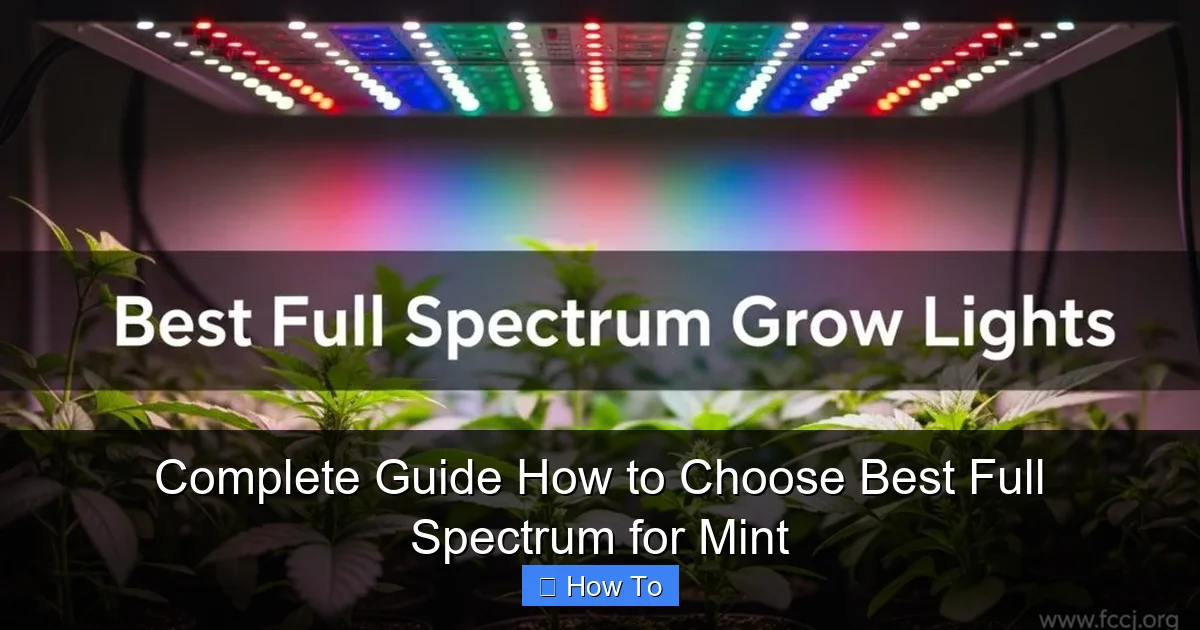
Visual guide about Complete Guide How to Choose Best Full Spectrum for Mint
Image source: cdn.shopify.com
1.1 Daily Light Integral (DLI)
Daily Light Integral measures the total photosynthetically active photons delivered in a 24‑hour period. Mint typically thrives at a DLI of 12‑16 mol·m⁻²·day⁻¹. If you grow indoors, you must supply this amount with your full spectrum for mint. Calculate DLI by multiplying the average PPFD by the photoperiod in hours and dividing by 1,000,000.
1.2 Photoperiod
Mint performs well with 14‑16 hours of light followed by 8‑10 hours of darkness. A consistent schedule encourages compact growth and strong essential‑oil production. Use a timer to keep the photoperiod stable; fluctuations can stress the plants and reduce yield.
Step 2: Learn About Full Spectrum Light Basics
Not every light labeled “full spectrum” meets the needs of mint. A true full spectrum for mint covers the entire photosynthetic range (400‑700 nm) and adds useful UV and far‑red wavelengths.
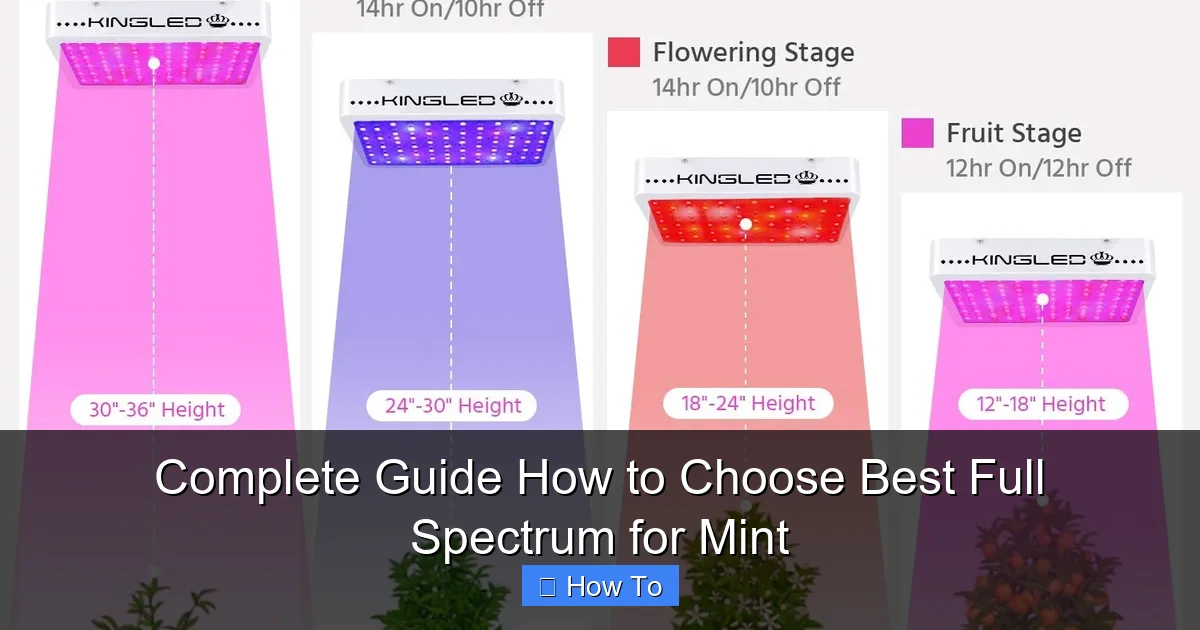
Visual guide about Complete Guide How to Choose Best Full Spectrum for Mint
Image source: backyardboss.net
2.1 What Is Full Spectrum
Full spectrum lights mimic natural sunlight by providing a continuous distribution of wavelengths. For mint, the most critical bands are blue (400‑500 nm) for vegetative structure and red (600‑700 nm) for flowering and oil synthesis. A quality full spectrum for mint also includes a small amount of UV‑B (280‑315 nm) to boost secondary metabolites.
2.2 Key Wavelengths for Mint
Research shows that a blue‑to‑red photon ratio of roughly 1:2 to 1:3 works best for mint. Too much blue creates compact but slow growth; too much red leads to stretching. Adding 5‑10 % far‑red (700‑750 nm) can improve leaf expansion without excessive elongation. When you shop, check the spectral power distribution chart for these peaks.
Step 3: Compare Light Sources
Three main technologies dominate the market. Each has pros and cons for a full spectrum for mint.
3.1 LED Grow Lights
LEDs are the most popular choice. They offer high efficacy (2.5‑3.5 µmol·J⁻¹), low heat, and customizable spectra. Look for fixtures that list a full spectrum for mint with a verified spectral chart. Modular panels let you expand coverage as your garden grows.
3.2 Fluorescent Tubes
T5 high‑output fluorescents provide a decent full spectrum for mint at a lower upfront cost. However, their efficacy (~1.5 µmol·J⁻¹) is lower, and they degrade faster, shifting spectrum over time. They work for small hobby setups but are less ideal for larger productions.
3.3 HID Lamps
Metal halide (MH) and high‑pressure sodium (HPS) lamps deliver intense light but generate significant heat and consume more electricity. MH leans blue, HPS leans red. Combining both can approximate a full spectrum for mint, yet the heat management and bulb replacement costs make them less attractive for most indoor growers.
Step 4: Evaluate Spectrum Ratios
Once you narrow the technology, examine the exact ratio of blue, red, UV, and far‑red photons.
4.1 Blue to Red Ratio
Target a blue‑to‑red photon ratio between 1:2 and 1:3. Many manufacturers publish this ratio. If the data is missing, request a spectral report. A balanced ratio ensures sturdy stems and high essential‑oil content in mint.
4.2 Adding UV and Far‑Red
UV‑B (280‑315 nm) at 1‑2 % of total photons can increase menthol concentration. Far‑red (700‑750 nm) at 5‑10 % improves leaf area. Some advanced LEDs include dedicated UV and far‑red chips; verify they are not just marketing claims by checking third‑party measurements.
Step 5: Check Intensity and Coverage
Even a perfect spectrum fails if the light intensity is too low or uneven.
5.1 PPFD Targets for Mint
Photosynthetic Photon Flux Density (PPFD) tells you how many photons hit a square meter each second. For seedlings aim for 150‑200 µmol·m⁻²·s⁻¹. For vegetative mint, 300‑400 µmol·m⁻²·s⁻¹ is ideal. Use a quantum sensor to map PPFD across the canopy after you hang the fixture.
5.2 Uniformity Across Canopy
Uniformity ratio (minimum PPFD ÷ average PPFD) should be above 0.7. Hot spots cause light burn; dark zones cause stretching. Choose fixtures with wide beam angles or add secondary reflectors to improve spread. A well‑designed full spectrum for mint delivers even light from edge to edge.
Step 6: Consider Energy Efficiency and Heat
Operating costs and temperature control are practical concerns.
6.1 Wattage vs Output
Higher wattage does not guarantee higher PPFD. Look at efficacy (µmol·J⁻¹). A 200 W LED with 2.8 µmol·J⁻¹ outperforms a 300 W HID at 1.5 µmol·J⁻¹. Calculate daily electricity cost: (Watts × hours ÷ 1000) × local kWh rate.
6.2 Cooling Needs
LEDs run cooler, but high‑output panels still need airflow. Ensure your grow space has adequate ventilation or built‑in fans. Excess heat raises leaf temperature, reducing photosynthetic efficiency and potentially damaging mint’s delicate oils.
Step 7: Read Reviews and Test Results
Real‑world data separates marketing from performance.
7.1 Independent Lab Data
Reputable brands publish third‑party spectral reports and PPFD maps. Download these PDFs and compare the numbers to the targets in Steps 4 and 5. A genuine full spectrum for mint will show a smooth curve across 400‑700 nm with the UV and far‑red peaks you need.
7.2 Grower Feedback
Search forums, YouTube channels, and product review sites for mint‑specific experiences. Look for comments on flavor intensity, internode length, and any light‑burn incidents. Consistent positive feedback from herb growers is a strong endorsement.
Step 8: Make a Purchase Decision
Combine all the data to select the best fixture for your situation.
8.1 Budget Planning
Set a realistic budget that includes the light, hanging hardware, timer, and possible supplemental fans. Remember that a higher upfront cost for an efficient LED often pays back within 12‑18 months through lower electricity bills.
8.2 Warranty and Support
Choose a manufacturer offering at least a 3‑year warranty on the LED chips and driver. Responsive customer service helps if you need spectrum adjustments or replacement parts. A solid warranty protects your investment in a quality full spectrum for mint.
Troubleshooting Common Issues
Even with the right light, problems can arise. Here are quick fixes.
Light Burn
Symptoms: bleached leaf tips, crispy edges. Reduce PPFD by raising the fixture 6‑12 inches or dimming the driver. Verify that the spectral output has not shifted toward excessive UV.
Stretching (Etiolation)
Symptoms: long internodes, pale leaves. Increase blue photon proportion or raise overall PPFD to the target range. Ensure the photoperiod is not too short.
Poor Flavor Development
Symptoms: weak mint aroma, low menthol. Add a modest UV‑B supplement (1‑2 % of total photons) for the last two weeks before harvest. Confirm the full spectrum for mint includes far‑red to support oil biosynthesis.
Conclusion
Choosing the best full spectrum for mint is a systematic process. Start by defining the DLI and photoperiod your mint needs. Then evaluate light technologies, spectrum ratios, intensity, uniformity, efficiency, and real‑world data. Balance these factors against your budget and warranty preferences. Follow the troubleshooting tips to keep your mint healthy and flavorful. With the right full spectrum for mint, you will enjoy vigorous growth, high essential‑oil content, and a bountiful harvest year‑round.