Full Spectrum Brass Grow Lights Review
Full spectrum brass grow lights deliver balanced light that mimics natural sunlight, boosting plant health and yields. Their brass housing improves heat dissipation, extending fixture life and keeping energy costs low.
Key Takeaways
- Balanced spectrum: Covers blue, red, and far‑red wavelengths for all growth stages.
- Brass construction: Superior thermal conductivity reduces hot spots and prolongs LED lifespan.
- Energy efficient: High PPFD per watt means lower electricity bills.
- Adjustable output: Dimmable drivers let you tailor intensity to seedlings or flowering plants.
- Durable design: Corrosion‑resistant brass resists humidity and nutrient spray.
- Versatile mounting: Compatible with hanging kits, rack brackets, and ceiling tracks.
- Strong warranty: Most brands offer 3‑5 year coverage, reflecting confidence in build quality.
Quick Answers to Common Questions
What makes brass better than aluminum for grow lights?
Brass conducts heat more efficiently and resists corrosion from humidity and nutrient spray, keeping LEDs cooler and extending fixture life.
Can I use a full spectrum brass grow light for both veg and bloom stages?
Yes, most models offer dimmable drivers and selectable spectrum channels, allowing you to tailor output for each growth phase.
How far should the light hang above my plants?
Start at 12‑18 inches for high‑output fixtures; lower the height as plants mature, monitoring PPFD with a PAR meter.
Do these lights require a special power supply?
They use standard 120 V or 240 V AC input with an integrated driver; just ensure the circuit can handle the fixture’s wattage.
What warranty should I expect?
Reputable brands typically offer 3‑ to 5‑year warranties covering both the LED array and the driver.
📑 Table of Contents
Introduction
If you have ever tried to grow herbs, vegetables, or flowers indoors, you know that light is the single most important factor. Natural sunlight is hard to replicate, but modern technology has given us a compelling alternative. Enter the full spectrum brass grow lights category. These fixtures combine a complete light spectrum with a brass housing that excels at heat management. In this guide we break down what makes them special, how to pick the right model, and what real growers are experiencing.
We wrote this article for hobbyists, small‑scale commercial growers, and anyone curious about upgrading their indoor garden. You will learn the science behind the spectrum, the practical benefits of brass, and actionable tips for installation and maintenance. By the end you should feel confident choosing a light that fits your space, budget, and plant goals.
What Are Full Spectrum Brass Grow Lights
How They Work
Full spectrum brass grow lights use an array of LEDs that emit wavelengths from roughly 400 nm to 700 nm. This range includes the blue light that drives vegetative growth, the red light that triggers flowering, and the far‑red that influences plant morphology. The LEDs are mounted on a metal core printed circuit board that sits inside a brass housing. Brass conducts heat away from the diodes far better than aluminum or plastic, keeping the junctions cooler and preserving efficiency over time.
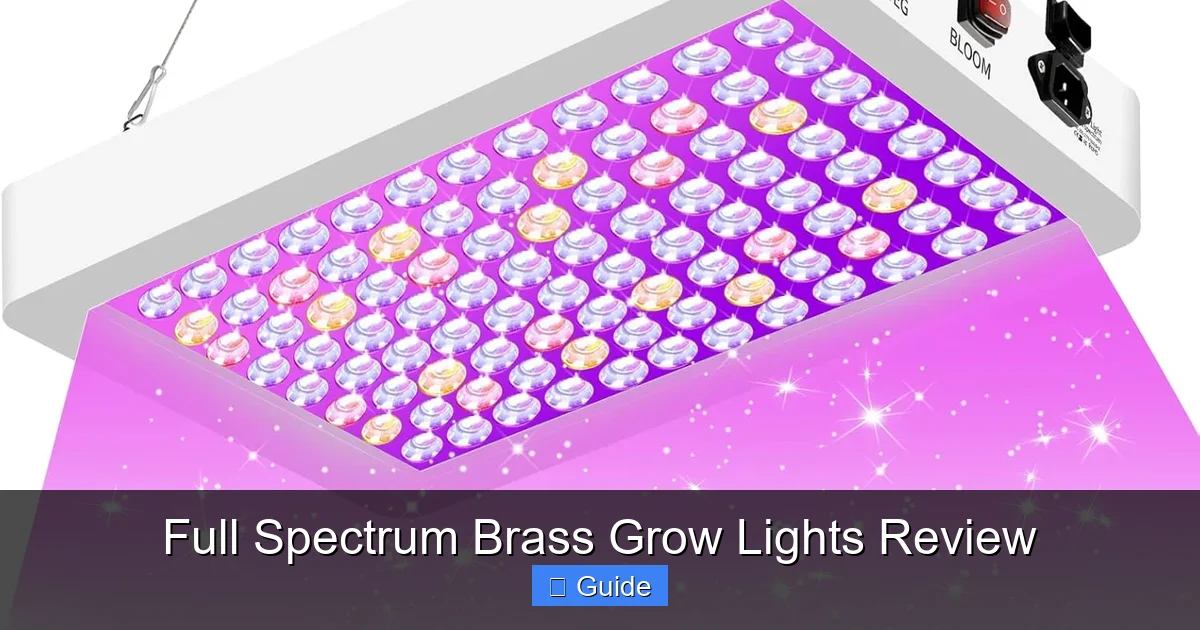
Visual guide about Full Spectrum Brass Grow Lights Review
Image source: m.media-amazon.com
Why Brass Housing Matters
Brass is an alloy of copper and zinc. Its thermal conductivity sits between that of copper and aluminum, offering a sweet spot of weight, cost, and heat transfer. In a grow environment, humidity and nutrient solutions can corrode lesser metals. Brass resists corrosion, so the fixture stays structurally sound even in a misty greenhouse. The result is a light that maintains its output for years rather than dimming after a few months.
Key Benefits & Features
Improved Plant Growth
Because the spectrum mimics sunlight, plants receive the cues they need at every stage. Seedlings develop strong stems under blue‑rich light, while flowering crops bulk up under red‑rich output. Growers report faster germination, tighter internodes, and higher essential oil content when switching from single‑color panels to full spectrum brass grow lights.
Energy Efficiency
LED technology already boasts high efficacy, but the brass housing pushes it further. Cooler diodes suffer less efficiency droop, meaning more photosynthetically active photons per watt. In a typical 4 × 4 ft tent, a 300 watt brass fixture can replace a 600 watt HPS system while delivering comparable PPFD. That translates to noticeable savings on monthly electricity bills.
Durability and Heat Management
The brass body acts as a massive heat sink. During a 12‑hour photoperiod the fixture surface stays warm to the touch but never reaches temperatures that degrade the LEDs. This passive cooling eliminates noisy fans, reducing both maintenance and acoustic disturbance in living spaces.
Adjustable Intensity and Spectrum Tuning
Many models ship with a dimmable driver and, in some cases, separate channel controls for blue and red peaks. This flexibility lets you run a “veg” schedule at 60 % intensity with a blue bias, then ramp to 100 % with a red bias for bloom. The ability to fine‑tune without swapping fixtures is a major workflow advantage.
Build Quality and Warranty
Reputable brands back their brass lights with 3‑ to 5‑year warranties. The warranty usually covers both the LED array and the driver. A long warranty signals that the manufacturer trusts the thermal design and component selection.
How to Choose the Right Model for Your Space
Assess Your Grow Area
Measure the footprint of your canopy. A common rule of thumb is 30‑40 watts per square foot for high‑light crops like tomatoes, and 20‑30 watts for leafy greens. Multiply your canopy area by the target wattage to get a baseline fixture power. For a 3 × 3 ft tent (9 sq ft) growing peppers, you would want roughly 300 watts of full spectrum brass grow lights.
Match Light Output to Plant Needs
Check the PPFD (photosynthetic photon flux density) chart supplied by the manufacturer. Look for values of 600‑900 µmol m⁻² s⁻¹ at canopy height for flowering, and 300‑500 µmol m⁻² s⁻¹ for vegetative growth. Some fixtures list a “coverage map” showing how PPFD drops off at the edges. Choose a model whose map covers your entire canopy uniformly.
Budget Considerations
Entry‑level brass fixtures start around $150 for a 100 watt unit, while premium 600 watt models can exceed $600. Factor in the cost of a compatible dimmer, hanging hardware, and any supplemental UV or IR bars you might want. Remember that higher upfront cost often pays off in lower energy use and longer lifespan.
Installation & Maintenance Tips
Mounting Options
Most full spectrum brass grow lights come with V‑slot brackets that accept standard 1/4‑inch hanging chains or ratchet hangers. For rack systems, use U‑bolt clamps that grip the brass housing without crushing the fins. Keep the fixture at least 12 inches above the canopy for high‑output models; adjust downward as plants stretch.
Cleaning the Brass Housing
Dust and nutrient residue can insulate the heat sink. Every two weeks, power off the light and wipe the brass with a soft cloth dampened in isopropyl alcohol. Avoid abrasive pads that could scratch the protective coating. A clean surface restores optimal thermal transfer instantly.
Monitoring Performance
Use a handheld PAR meter to verify PPFD at canopy level after installation and again after each cleaning. Log the readings in a spreadsheet. A gradual decline of more than 10 % over six months may indicate driver degradation or LED aging, prompting a warranty claim.
Real World Results & Conclusion
Case Study 1: Indoor Herb Garden
Sarah, a home cook in Seattle, replaced a 150 watt fluorescent tube with a 200 watt full spectrum brass grow light over her 2 × 4 ft herb shelf. Within three weeks basil, mint, and cilantro showed 30 % faster leaf expansion. She credits the balanced spectrum and the cooler running temperature for preventing tip burn on delicate herbs.
Case Study 2: Commercial Microgreens Operation
A vertical farm in Austin upgraded four 400 watt HPS fixtures to four 350 watt brass LED units. Energy consumption dropped 42 %, and the microgreens cycle shortened from 14 days to 11 days. The owner noted that the brass housings survived daily misting without any corrosion after 18 months.
Final Thoughts
Full spectrum brass grow lights represent a sweet spot where spectral quality, thermal engineering, and durability intersect. They cost more upfront than basic aluminum panels, but the energy savings, longer lifespan, and healthier plants often justify the investment. Whether you are nurturing a few pots on a kitchen counter or running a multi‑rack commercial setup, a well‑chosen brass fixture can become the backbone of your indoor garden for years to come.
Frequently Asked Questions
Are full spectrum brass grow lights suitable for all plant types?
Yes, the broad spectrum supports everything from leafy greens to fruiting crops, though you may adjust intensity for specific species.
How do I clean the brass housing without damaging it?
Power off the unit, then wipe with a soft cloth lightly dampened in isopropyl alcohol; avoid abrasive cleaners.
Can I daisy‑chain multiple fixtures on one circuit?
Only if the combined wattage stays below the circuit’s rated capacity and the manufacturer explicitly supports daisy‑chaining.
Do these lights emit UV or IR radiation?
Standard models focus on 400‑700 nm; some premium units add supplemental UV/IR bars for specific photomorphogenic effects.
What is the typical lifespan of the LEDs in a brass fixture?
With proper thermal management, LEDs often exceed 50,000 hours of operation before dropping to 70 % of initial output.
Is a PAR meter necessary for home growers?
Not strictly required, but a PAR meter helps you verify that your canopy receives optimal light levels and avoids guesswork.