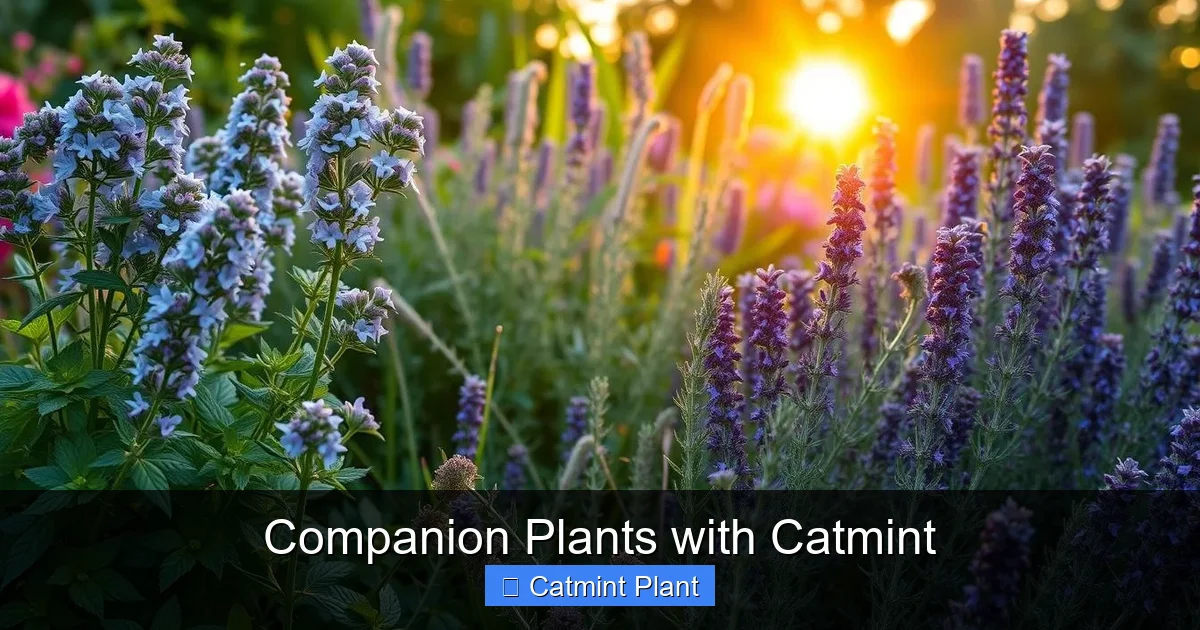
Companion Plants with Catmint
Catmint (Nepeta) is a versatile, drought-tolerant perennial that thrives alongside roses, salvias, lavender, and ornamental grasses. These companions share similar growing needs while enhancing visual appeal and ecological benefits. Smart pairings reduce pests, attract beneficial insects, and create season-long garden interest with minimal maintenance.
Walk through any well-designed perennial border in June, and you will likely spot catmint holding court. Its lavender-blue flower spikes sway above mounds of aromatic gray-green foliage. Bees dance from bloom to bloom. Butterflies pause for a sip. The plant asks for little—just sun, decent drainage, and a haircut after its first flush—and gives months of color in return.
But catmint does not have to go it alone. In fact, it shines brightest when paired with the right neighbors. Good companions share its cultural needs. They fill gaps when catmint takes a mid-summer breather. They contrast or harmonize with its soft texture. Some even help each other fight pests or attract more beneficial insects. This guide walks through the best companion plants for catmint, explains why they work, and shows you how to design combinations that look great from spring through fall.
Key Takeaways
- Shared growing conditions matter most: Choose companions that love full sun, well-drained soil, and low water once established.
- Roses and catmint are classic partners: Catmint hides bare rose canes while deterring aphids and attracting pollinators.
- Mediterranean herbs thrive together: Lavender, rosemary, thyme, and sage share catmint’s preference for lean soil and hot sun.
- Ornamental grasses add structure: Grasses like feather reed grass and blue fescue provide winter interest when catmint dies back.
- Pollinator magnets multiply: Pair catmint with salvia, coneflower, and bee balm to create a non-stop nectar buffet.
- Succession planting extends blooms: Combine early, mid, and late-season bloomers for continuous color from spring to frost.
- Avoid heavy feeders and moisture lovers: Plants needing rich soil or constant water will struggle beside catmint.
Quick Answers to Common Questions
What is the best companion plant for catmint?
Roses are widely considered the best companion for catmint. Catmint hides bare rose canes, deters aphids, attracts beneficial insects, and shares the same sun and drainage needs.
Can I plant catmint with lavender?
Yes, catmint and lavender are excellent companions. Both thrive in full sun, lean soil, and sharp drainage. They share Mediterranean origins and similar care requirements.
What should I not plant near catmint?
Avoid moisture-loving plants like astilbe, hostas, and ferns. Also avoid aggressive spreaders like mint, and acid-soil plants like blueberries and azaleas.
Does catmint come back every year?
Yes, catmint is a hardy perennial in USDA zones 3-8. It dies back in winter and returns from the crown in spring. Some cultivars are hardy to zone 9 with afternoon shade.
How far apart should I plant catmint from other perennials?
Space catmint 18-24 inches from companion plants, depending on the mature size of both. Allow enough room for air circulation and future growth without overcrowding.
📑 Table of Contents
- Understanding Catmint’s Growing Preferences
- Classic Perennial Partners
- Ornamental Grasses for Structure and Season Extension
- Herbs and Edibles That Play Nice
- Design Strategies for Stunning Combinations
- Plants to Avoid Near Catmint
- Seasonal Care for Companion Plantings
- Container Combinations Featuring Catmint
- Regional Considerations
- Creating a Catmint-Centered Garden Plan
- Troubleshooting Common Issues
- Conclusion
Understanding Catmint’s Growing Preferences
Before picking partners, you need to know what catmint likes. The most common garden catmint is Nepeta x faassenii and its cultivars like ‘Walker’s Low’, ‘Junior Walker’, and ‘Cat’s Meow’. There are also taller species like Nepeta sibirica and Nepeta grandiflora. All share the same basic requirements.
Sun and Soil Essentials
Catmint demands full sun. Six hours is the bare minimum. Eight to ten hours produces the sturdiest stems and heaviest bloom. Soil must drain sharply. Wet feet—especially in winter—will rot the crown. Lean soil is fine. Rich soil makes floppy stems and fewer flowers. Once established, catmint laughs at drought. It has a deep taproot that finds moisture far below the surface.
Hardiness and Habit
Most catmints are hardy in USDA zones 3 through 8. Some cultivars push into zone 9 with afternoon shade. The habit is a low, spreading mound. ‘Walker’s Low’ reaches 24 to 30 inches tall and wide. ‘Junior Walker’ stays a compact 15 to 18 inches. ‘Cat’s Meow’ forms a tidy 18 to 20-inch dome. All benefit from a hard shear after the first bloom. This triggers a second flush and keeps the mound dense.
What Catmint Brings to the Table
Catmint earns its keep in several ways. The flowers feed bees, butterflies, and hummingbirds from late spring to frost with deadheading. The foliage releases a minty aroma when brushed, deterring deer and rabbits. The dense growth suppresses weeds. And the soft blue color bridges warm and cool tones, making it a designer’s dream for blending tricky color combinations.
Classic Perennial Partners
These perennials share catmint’s love of sun, lean soil, and low water. They bloom at overlapping or sequential times. Their forms contrast nicely with catmint’s billowy mound.
Roses: The Timeless Duo
If you grow roses, plant catmint at their feet. It is one of the most practical and beautiful pairings in the garden. Roses often have bare, thorny canes at the base. Catmint’s mounding habit covers those “knees” with a froth of blue. The colors work with any rose—pink, red, white, yellow, apricot. But the benefits go deeper.
Catmint attracts hoverflies and parasitic wasps. These beneficial insects lay eggs in aphids, a common rose pest. The strong scent of catmint foliage may also confuse pests searching for roses. And both plants want the same thing: full sun, good drainage, moderate water. Avoid planting catmint so close that it smothers the rose crown. Leave 18 inches between the rose base and the catmint center.
Salvias: Color Echoes and Extended Bloom
Salvia and catmint are cousins in the mint family. They speak the same cultural language. Salvia nemorosa cultivars like ‘Caradonna’, ‘May Night’, and ‘East Friesland’ send up vertical spikes of deep purple, violet, or blue. Catmint provides a horizontal cloud. The contrast in form—spires versus mounds—creates rhythm in the border.
Bloom times align perfectly. Both start in late spring. Both respond to shearing with a second flush. Plant them in drifts of three to five, alternating or mingled. The bees will thank you. For a hotter palette, try Salvia greggii or Salvia microphylla in reds and pinks. These shrubby salvias bloom longer in heat but need sharper drainage.
Lavender: Mediterranean Soul Mates
Lavender and catmint hail from the same rocky, sun-baked regions. They want identical conditions: full sun, alkaline-leaning soil, sharp drainage, little fertilizer. English lavender (Lavandula angustifolia) cultivars like ‘Hidcote’, ‘Munstead’, and ‘Phenomenal’ form tight silver-green mounds topped with purple wands. Catmint is looser, greener, and blooms longer.
Plant them together in a gravel garden, along a sunny path, or on a slope. The silver foliage of lavender intensifies the gray-green of catmint. Both release fragrance when brushed. Both deter deer. Shear lavender lightly after bloom; never cut into old wood. Catmint takes a harder cut. The maintenance rhythms differ slightly, but the cultural match is perfect.
Coneflowers: Bold Cones Meet Soft Clouds
Echinacea purpurea and its many hybrids bring large, daisy-like flowers with prominent cones. Colors range from purple-pink to white, yellow, orange, and red. The sturdy stems stand 2 to 4 feet tall. Catmint fills the space at their feet.
Coneflowers bloom mid-summer to fall. Catmint bridges the gap from late spring. The combination feeds pollinators for months. Goldfinches eat coneflower seeds in winter. Catmint provides cover for beneficial insects overwintering in leaf litter. Choose compact coneflower varieties like ‘PowWow Wild Berry’ or ‘Kim’s Knee High’ for smaller beds. Taller types work behind catmint in deeper borders.
Bee Balm: Hummingbird Heaven
Monarda didyma and Monarda fistulosa explode with shaggy, tubular flowers in red, pink, purple, and lavender. Hummingbirds fight over them. Bee balm likes a bit more moisture than catmint, but established plants tolerate dry spells. Give it a slightly richer pocket of soil, or plant it where runoff collects.
The vertical habit of bee balm (3 to 4 feet) rises above catmint. The bloom time overlaps in mid-summer. Both attract a staggering diversity of native bees. Watch for powdery mildew on bee balm in humid climates. Good air circulation helps. Plant catmint in front to hide any bare lower stems.
Yarrow: Flat Heads and Ferny Foliage
Achillea millefolium cultivars offer flat-topped flower clusters in yellow, gold, pink, red, white, and terracotta. The ferny foliage contrasts with catmint’s simple leaves. Yarrow is tough as nails—heat, drought, poor soil, it takes it all.
‘Moonshine’ with its soft yellow heads looks stunning beside blue catmint. ‘Paprika’ and ‘Terra Cotta’ add warm tones. ‘New Vintage Violet’ keeps a compact 12 to 14 inches. Yarrow spreads by rhizomes. Give it room or choose clumping types. Deadhead for repeat bloom. The dried seed heads add winter structure if left standing.
Ornamental Grasses for Structure and Season Extension
Grasses bring movement, texture, and winter presence. Catmint dies back to the ground in cold climates. Grasses stand tall through snow. Their forms—upright, arching, fountain-like—contrast with catmint’s mound.
Feather Reed Grass: Vertical Exclamation Points
Calamagrostis x acutiflora ‘Karl Foerster’ is the gold standard. It shoots up 4 to 5 feet in early summer with wheat-colored plumes that persist into winter. The strict upright habit punctuates a sea of catmint. Plant three or five grasses in a line or cluster. Let catmint billow around their bases.
‘Overdam’ offers variegated foliage for brighter spots. ‘Avalanche’ has a white center stripe. All are sterile, so no unwanted seedlings. Cut back in late winter before new growth emerges. The grasses emerge early, providing green structure while catmint is still dormant.
Blue Fescue: Cool-Tone Harmony
Festuca glauca ‘Elijah Blue’ and ‘Beyond Blue’ form tight, porcupine-like mounds of intense silver-blue foliage. They stay 8 to 12 inches tall. The color echoes catmint’s gray-green leaves but in a finer texture.
Use blue fescue as edging along a path with catmint behind. Or dot them through a catmint drift for rhythm. They are semi-evergreen in mild winters. Divide every few years to keep centers from dying out. They want the same sharp drainage as catmint.
Switchgrass: Native Cloud Forms
Panicum virgatum cultivars like ‘Northwind’, ‘Heavy Metal’, and ‘Shenandoah’ form vase-shaped clumps 3 to 6 feet tall. Airy flower panicles appear in late summer, turning beige for winter. ‘Northwind’ is strictly upright. ‘Shenandoah’ develops red tips by fall.
These are warm-season grasses. They emerge late in spring. Catmint covers the ground while they wake up. By summer, the grass rises above. The combination works in meadow-style plantings, rain garden edges, or large borders. Switchgrass tolerates clay better than most grasses.
Little Bluestem: Prairie Partner
Schizachyrium scoparium ‘The Blues’, ‘Standing Ovation’, and ‘Carousel’ bring fine-textured blue-green foliage that turns copper, orange, and red in fall. Fluffy white seed heads catch the light. Height ranges from 2 to 4 feet.
This native grass thrives in the same lean, dry soil as catmint. It hosts skipper butterfly caterpillars. Birds eat the seeds. The fall color extends the season long after catmint fades. Plant in drifts for a naturalistic look. It self-sows modestly; edit seedlings as needed.
Herbs and Edibles That Play Nice
Catmint belongs to the mint family. Many culinary herbs share its preferences. Interplanting herbs with ornamentals blurs the line between vegetable garden and flower border. The result is beautiful and productive.
Rosemary: Woody Shrub Contrast
Salvia rosmarinus (formerly Rosmarinus officinalis) grows into a woody shrub 2 to 4 feet tall in warm climates. In colder zones, grow ‘Arp’ or ‘Hill Hardy’ in pots or protected spots. The needle-like foliage is deep green, resinous, and intensely fragrant.
Rosemary wants the same baking sun and sharp drainage. It hates wet feet more than catmint. Plant it on a mound or slope. The upright, architectural form contrasts with catmint’s softness. Blue flowers appear in winter in mild climates, early spring elsewhere. Bees love them when little else blooms.
Thyme: Living Mulch
Creeping thymes (Thymus serpyllum, Thymus praecox) form flat mats 2 to 4 inches tall. Woolly thyme has fuzzy gray leaves. ‘Elfin’ is tiny and tight. ‘Red Creeping’ covers ground fast. All bloom in pink or lavender in early summer.
Plant thyme at the front edge of a catmint bed. It suppresses weeds, tolerates foot traffic, and releases scent when stepped on. The flowers feed tiny native bees. Thyme wants the same lean, dry conditions. It will rot in heavy clay. Amend with grit or plant in raised beds.
Oregano and Marjoram: Pollinator Magnets
Origanum vulgare and Origanum majorana form spreading clumps 12 to 18 inches tall. ‘Aureum’ has gold leaves. ‘Hot & Spicy’ packs flavor. Ornamental oreganos like ‘Kent Beauty’ and ‘Drops of Jupiter’ are grown for hop-like bracts in pink and green.
The flowers are bee magnets. The foliage is aromatic and deer-resistant. Oregano spreads more aggressively than catmint. Give it a boundary or plant in a pot sunk in the ground. Harvest leaves for cooking throughout the season. Cut back hard after bloom to refresh foliage.
Sage: Textural Foliage Star
Common sage (Salvia officinalis) offers pebbly, gray-green leaves on a woody base. ‘Berggarten’ has large, rounded leaves. ‘Purpurascens’ shows purple new growth. ‘Tricolor’ mixes green, white, and pink. All bloom in lavender-blue spikes in early summer.
Sage wants the same conditions as catmint. The foliage contrast is superb—sage’s thick, textured leaves against catmint’s finer foliage. Sage gets woody and sparse after a few years. Replace or layer stems to renew. Plant catmint in front to hide bare legs.
Design Strategies for Stunning Combinations
Knowing which plants work together is half the battle. Arranging them for maximum impact is the other half. These design principles apply whether you are planting a new bed or editing an existing one.
Repeat for Rhythm
Don’t plant one of everything. Repeat key plants in groups of three, five, or seven. A drift of five ‘Walker’s Low’ catmints interrupted by three ‘Karl Foerster’ grasses and three ‘Caradonna’ salvias reads as a cohesive scene. A single plant of each looks like a botanical collection.
Repeat the combination along a border. Catmint, salvia, grass. Catmint, salvia, grass. The eye moves happily along the rhythm. Vary the spacing slightly so it doesn’t look like a marching band. Nature is loose. Your planting should feel loose too.
Layer by Height
Think in three layers. Ground layer: creeping thyme, sedum, blue fescue. Mid layer: catmint, salvia, yarrow, compact coneflowers. Tall layer: feather reed grass, switchgrass, bee balm, tall coneflowers, roses.
Place tall plants at the back of a border viewed from one side. In an island bed viewed from all sides, put tall plants in the center. Mid-layer plants surround them. Ground layer edges the perimeter. This ensures every plant is visible and gets its share of sun.
Play with Color Temperature
Catmint’s blue flowers are cool. They harmonize with other cools: lavender, purple salvia, blue fescue, violet coneflowers. They contrast with warms: yellow yarrow, orange butterfly weed, red bee balm, pink roses.
Decide on a mood. A cool palette feels serene and spacious. A warm palette feels energetic and intimate. A mixed palette feels dynamic. Use foliage color too. Silver lavender and blue fescue cool things down. Gold oregano and red-tinged switchgrass warm them up.
Plan for Succession of Bloom
Catmint peaks in late spring to early summer. It takes a break in July heat. It rallies in late summer if sheared. Fill the gaps. Early: alliums, baptisia, peonies. Mid: coneflowers, bee balm, yarrow, ornamental oregano. Late: sedum ‘Autumn Joy’, asters, goldenrod, Japanese anemone.
Grasses provide summer structure and fall color. Seed heads persist into winter. Evergreen herbs (thyme, sage, lavender) hold the ground in cold months. A well-designed bed has something interesting every week of the year.
Edge and Path Plantings
Catmint softens hard edges. Plant it along a stone path where it can spill over. The fragrance releases when brushed. Pair with creeping thyme in the joints. Add lavender at intervals for stronger scent.
Along a driveway or sidewalk, use compact catmint like ‘Junior Walker’ or ‘Cat’s Meow’. They won’t flop onto pavement. Back them with a row of feather reed grass for a clean, modern look. Or mix with sedum ‘Autumn Joy’ for late-season color at knee height.
Plants to Avoid Near Catmint
Not every sun-loving perennial makes a good neighbor. Some have conflicting needs. Others outcompete catmint. Knowing who to keep away saves frustration.
Heavy Feeders and Water Lovers
Astilbe, ligularia, Japanese iris, and cardinal flower want rich, moist soil. They will languish in catmint’s lean, dry conditions. Conversely, catmint will rot if watered to keep these happy. Keep them in separate beds with irrigation zones matched to their needs.
Aggressive Spreaders
Mint (Mentha species), bee balm (some cultivars), obedient plant (Physostegia), and gooseneck loosestrife (Lysimachia clethroides) run by rhizomes. They will swallow a catmint clump in two seasons. If you want these, contain them in pots or dedicated areas with barriers.
Shade Tolerant Plants
Hostas, ferns, heucheras, and bleeding hearts want shade. Catmint wants blasting sun. Planting them together means one will be miserable. Use catmint in the sunny transition zone between lawn and shade garden. Then shift to shade lovers where the canopy deepens.
Plants Needing Acidic Soil
Blueberries, azaleas, rhododendrons, and camellias need acid soil (pH 4.5 to 5.5). Catmint prefers neutral to alkaline (pH 6.5 to 7.5). Amending for one hurts the other. Keep acid lovers in their own beds with peat-based soil mixes.
Seasonal Care for Companion Plantings
A mixed planting needs a care routine that works for everyone. The good news: catmint and its best companions are low-maintenance. A few timely tasks keep the show going.
Spring Cleanup
Cut back grasses and perennials left standing for winter. Do this in late winter or early spring before new growth emerges. Rake out debris. Top-dress with a thin layer of compost—half an inch is plenty. Catmint and Mediterranean herbs don’t want rich mulch. Gravel or pine fines are better than wood chips.
The Chelsea Chop
In late May (around the Chelsea Flower Show in the UK), shear catmint, salvia, yarrow, and tall sedums by one-third to one-half. This delays bloom by a few weeks, reduces height, and prevents flopping. It also staggers bloom if you chop some plants and not others. Skip this for roses, lavender, and grasses.
Deadheading for Repeat Bloom
After the first flush, shear catmint back to 6 inches. Do the same for salvia, yarrow, and catmint. Coneflowers and bee balm benefit from deadheading individual spent flowers. Leave some coneflower heads for goldfinches. Grasses need no deadheading—their seed heads are the show.
Fall and Winter Care
Leave grasses and seed heads standing. They feed birds and shelter insects. Cut back catmint foliage after it turns brown if you prefer a tidy look. Or leave it as mulch. Do not cut lavender, rosemary, sage, or thyme hard in fall. Wait until spring to see where live wood ends.
Division and Renewal
Catmint centers can die out after 3 to 4 years. Dig the clump in early spring. Discard the woody center. Replant vigorous outer pieces. Do the same for yarrow, ornamental oregano, and thyme. Grasses rarely need division. Lavender and rosemary hate root disturbance. Replace them when they get woody.
Container Combinations Featuring Catmint
No garden bed? No problem. Catmint thrives in pots with the right partners. The key is a large container (18 inches minimum), fast-draining potting mix, and companions with matching needs.
Thriller, Filler, Spiller Formula
Use a tall grass or upright salvia as the thriller in the center or back. Catmint is the filler—mounding, floriferous, long-blooming. Creeping thyme, sedum, or calibrachoa spills over the edge. All want sun, lean soil, and infrequent water.
Try ‘Karl Foerster’ grass (thriller), ‘Junior Walker’ catmint (filler), and ‘Angelina’ sedum (spiller). Or ‘Hot Lips’ salvia, ‘Cat’s Meow’ catmint, and woolly thyme. Fertilize once in spring with slow-release organic. Water when the top two inches are dry. Overwinter pots in an unheated garage in zones 5 and colder.
Herb Pot Trio
Plant rosemary (upright), catmint (mounding), and thyme (trailing) in a 24-inch pot. Place by the kitchen door. Snip herbs all summer. The catmint feeds bees. The rosemary stays compact in a pot. The thyme cascades. Use cactus mix amended with a little compost. Elevate the pot on feet for perfect drainage.
Pollinator Pot
Combine compact catmint, dwarf butterfly bush (Buddleia ‘Lo & Behold’ series), dwarf coneflower (‘PowWow’ series), and annual verbena or lantana for non-stop nectar. This pot becomes a pollinator fueling station. Deadhead the annuals. Cut back the perennials in late winter. Refresh potting mix every two years.
Regional Considerations
Catmint grows across a huge range. But the best companions shift with climate. Heat, humidity, rainfall, and winter cold all affect plant choices.
Cool Northern Gardens (Zones 3-5)
Stick with the hardiest partners. ‘Walker’s Low’ catmint. ‘Karl Foerster’ grass. ‘May Night’ salvia. ‘Hidcote’ lavender (with winter protection). ‘Moonshine’ yarrow. ‘Magnus’ coneflower. Roses on hardy rootstock. Avoid rosemary, tender salvias, and ornamental oreganos. Mulch lightly with straw after ground freezes.
Midwest and Northeast (Zones 5-7)
The sweet spot. Almost everything on the list works. Watch for humidity-induced mildew on bee balm and phlox. Space plants for air flow. Choose mildew-resistant cultivars. Winter wet kills more lavender than cold. Plant on mounds or in gravel gardens.
Hot Southern Gardens (Zones 7-9)
Heat and humidity change the game. Catmint may melt out in July-August in zone 9. Choose heat-tolerant cultivars like ‘Cat’s Meow’ or ‘Blue Prelude’. Give afternoon shade. Partners: Salvia greggii, Salvia microphylla, lantana, black-eyed Susan, ornamental grasses, rosemary, thyme. Avoid English lavender—try Spanish lavender (Lavandula stoechas) or lavandin (Lavandula x intermedia ‘Phenomenal’).
Arid West (Zones 5-8)
Perfect catmint country. Low humidity, intense sun, alkaline soil. All Mediterranean herbs thrive. Native partners: penstemon, agastache, eriogonum, native grasses. Water deeply but infrequently. Mulch with gravel. This is where catmint looks its absolute best with the least effort.
Pacific Northwest (Zones 7-9)
Wet winters are the challenge. Drainage is everything. Plant on berms. Use gravel mulch. Choose winter-wet-tolerant grasses: Deschampsia, Molinia. Catmint may need replacing every few years. Partners: hardy salvias, yarrow, sedums, thyme, oregano. Avoid lavender unless drainage is perfect.
Creating a Catmint-Centered Garden Plan
Let’s put it all together. Here are three sample planting plans you can adapt. Each assumes a sunny, well-drained bed.
Plan 1: The Classic Border (10 ft x 4 ft)
Back row (against fence or hedge): Three ‘Karl Foerster’ feather reed grasses, spaced 24 inches. Middle row: Three ‘Walker’s Low’ catmints, spaced 24 inches, staggered with grasses. Front row: Five ‘Caradonna’ salvias, spaced 15 inches. Edging: Nine ‘Elijah Blue’ fescues, spaced 10 inches. Spring bulbs: 50 species tulips or alliums planted among the catmint and salvias.
This plan gives early bulbs, late spring catmint and salvia, summer grass plumes, fall grass color, winter grass structure. All plants are zone 4 hardy. Maintenance: spring cleanup, Chelsea chop on catmint and salvia, fall bulb planting.
Plan 2: The Rose Companion Bed (8 ft diameter circle)
Center: One ‘Munstead’ lavender. First ring (18 inches out): Three ‘Junior Walker’ catmints in a triangle. Second ring (36 inches out): Three shrub roses (pink, white, apricot), spaced equally. Outer ring: Six ‘Moonshine’ yarrows alternating with six ‘Hot & Spicy’ oreganos. Mulch with pea gravel.
The lavender anchors the center. Catmint hides rose knees. Yarrow and oregano fill gaps and feed insects. All want the same conditions. The circle can be viewed from all sides. Adjust rose count for bed size.
Plan 3: The Pollinator Meadow Strip (20 ft x 3 ft)
Along a sunny driveway or property line. Plant in loose drifts, not rows. Groups of 3 to 5: ‘Cat’s Meow’ catmint, ‘Blue Fortune’ agastache, ‘PowWow Wild Berry’ coneflower, ‘Little Moonshine’ yarrow, ‘Standing Ovation’ little bluestem, ‘Phenomenal’ lavender. Scatter seeds of California poppy and annual alyssum in gaps.
This mimics a natural meadow. It feeds pollinators from May to October. It needs one mowing in late winter. It self-sows and evolves. Edit aggressive seeders. Add more catmint plugs where gaps appear.
Troubleshooting Common Issues
Even well-planned pairings hit snags. Here are fixes for frequent problems.
Catmint Flopping Open in Center
Causes: Too much shade, too rich soil, too much water, or old age. Fix: Move to full sun. Stop fertilizing. Water less. Shear hard after first bloom. Divide in spring if center is dead. Replace with compact cultivar if site cannot change.
Companions Outgrowing Catmint
Tall grasses, bee balm, or coneflowers shading catmint. Fix: Move catmint to sunnier edge. Choose shorter companions. Cut back tall neighbors in June (Chelsea chop) to reduce height. Stake tall plants so they don’t lean.
Lavender or Rosemary Dying in Winter
Usually wet feet, not cold. Fix: Plant on 6-inch mound of gritty soil. Mulch with gravel, not wood chips. Ensure pot drainage. Choose hardiest cultivars. Accept some losses in marginal zones.
Powdery Mildew on Bee Balm or Phlox
Humidity and poor air flow. Fix: Thin stems in spring. Water at base, not overhead. Choose resistant varieties (‘Jacob Cline’, ‘Raspberry Wine’). Spray with milk solution (1 part milk to 9 parts water) weekly at first sign. Accept some mildew—it rarely kills.
Aggressive Spreading
Yarrow, oregano, or mint relatives taking over. Fix: Install root barriers (12-inch deep plastic edging). Dig out runners annually. Plant in bottomless pots sunk in ground. Choose clumping cultivars. Edit ruthlessly in spring.
Conclusion
Catmint is a garden workhorse. It asks little and gives months of bloom, fragrance, and pollinator support. But it becomes something more when paired thoughtfully. The right companions turn a pretty plant into a plant community. A community that covers ground, feeds wildlife, resists pests, and looks good in every season.
Start with the cultural match. Sun. Drainage. Lean soil. Low water. Build from there. Add roses for romance. Salvias for rhythm. Grasses for structure. Herbs for utility. Natives for ecology. Repeat for flow. Layer for depth. Edit for balance.
Your garden will not look like a magazine spread overnight. Plant communities evolve. Some plants thrive. Others fade. You edit, divide, move, and learn. That is the joy of it. Catmint and its friends are forgiving. They grow fast. They bounce back. They give you room to experiment.
So grab a pot of ‘Walker’s Low’. Tuck it beside a rose. Edge a path with ‘Junior Walker’ and thyme. Dot a meadow strip with ‘Cat’s Meow’ and coneflowers. Watch the bees arrive. Smell the minty air when you brush past. That is the garden you are growing. One pairing at a time.
Frequently Asked Questions
Can catmint grow in partial shade?
Catmint prefers full sun (6+ hours) for best flowering and compact growth. In partial shade, it becomes leggy, blooms sparsely, and is more prone to flopping. If you must plant in part sun, choose a bright spot with at least 4-5 hours of direct light and expect a looser habit.
When should I cut back catmint for a second bloom?
Shear catmint back by half to two-thirds immediately after the first flush of flowers fades, usually in early to mid-summer. This stimulates fresh growth and a heavy second bloom in late summer through fall. Use hedge shears or string trimmers for large plantings.
Is catmint invasive?
Catmint (Nepeta x faassenii and common cultivars) is not invasive. It forms a clump that slowly expands but does not run by rhizomes or seed aggressively. It may self-sow lightly, but seedlings are easy to remove. True mint (Mentha) is the invasive relative—keep them separate.
What fertilizer does catmint need?
Catmint needs little to no fertilizer. Rich soil causes floppy stems and reduced flowering. A light top-dressing of compost in spring (half an inch) is sufficient. Avoid high-nitrogen fertilizers. Lean conditions produce the strongest plants and best blooms.
Can I divide catmint in summer?
Early spring is the ideal time to divide catmint, just as new growth emerges. Fall division works in mild climates. Summer division is stressful due to heat and active growth. If you must divide in summer, cut foliage back hard, water deeply, and provide temporary shade for two weeks.
Why is my catmint turning brown in the center?
A dead or woody center indicates an aging clump (3-4+ years) or poor drainage. Dig the plant in early spring, discard the dead center, and replant vigorous outer sections. Improve drainage with grit if soil stays wet. Divide regularly every 3-4 years to prevent this.


