Best T5 for Staghorn Fern Care
Staghorn ferns thrive under T5 fluorescent lights that mimic their natural dappled forest canopy environment. This guide covers the top T5 fixtures, optimal color temperatures, mounting distances, and daily light schedules to help your epiphytes grow lush, healthy fronds year-round.
Staghorn ferns have a way of stealing the spotlight in any plant collection. Their antler-like fronds and shield-shaped bases make them living sculptures. But here is the thing: these epiphytes evolved in the dappled light of tropical forest canopies. Recreating that environment indoors means getting your lighting right. That is where T5 fluorescent fixtures shine. They run cool, offer excellent spectrum options, and deliver the kind of consistent, diffuse light staghorns love.
I have spent years testing different grow lights on my own wall-mounted Platycerium collection. Some fixtures produced gorgeous, deep green fronds. Others left me with crispy tips or leggy, reaching growth. The difference came down to understanding what these ferns actually need: not just brightness, but the right spectrum, the right duration, and the right distance. This guide walks through everything I have learned so you can skip the trial and error.
Key Takeaways
- Color temperature matters: Choose 6500K T5 bulbs for vegetative growth and 3000K for mature plants needing reproductive cues.
- Distance is critical: Mount fixtures 12 to 18 inches above mounted ferns to prevent frond burn while delivering adequate PAR.
- Photoperiod consistency: Provide 12 to 14 hours of light daily using a timer to replicate tropical day lengths.
- Multi-bulb fixtures win: Four-bulb T5 units offer better coverage and intensity control than two-bulb models for larger specimens.
- Supplement with humidity: T5 lights produce heat; pair with humidifiers or misting to maintain 60 to 80 percent humidity.
- Rotate for even growth: Turn mounted ferns weekly so all sides receive equal light exposure.
- Monitor for stress signals: Bleached fronds mean too much light; stretched, pale growth means too little.
Quick Answers to Common Questions
What is the best color temperature for staghorn ferns under T5 lights?
A mix of 6500K and 3000K bulbs in a 50/50 ratio provides the ideal spectrum for both vegetative growth and reproductive maturity.
How far should T5 lights be from staghorn ferns?
Mount fixtures 12 to 18 inches above the fronds. Start at 18 inches for new mounts and lower to 12 inches once established.
How many hours of light do staghorn ferns need daily?
Provide 12 to 14 hours of light per day using a timer. Consistency is more important than exact duration.
When should I replace my T5 bulbs?
Replace T5 bulbs annually or every 5,000 hours of use. Spectrum shifts and output drops significantly after this point.
Can I use T5 lights for staghorn ferns in a terrarium?
Yes, but use a 2-foot fixture with good ventilation. Monitor temperature and humidity closely since enclosed spaces trap heat.
📑 Table of Contents
- Why T5 Lights Work So Well for Staghorn Ferns
- Understanding Staghorn Fern Light Requirements
- Top T5 Fixtures for Staghorn Fern Setups
- Choosing the Right T5 Bulbs for Your Ferns
- Mounting Distance and Coverage Strategies
- Photoperiod and Seasonal Lighting Schedules
- Managing Heat and Humidity Around T5 Fixtures
- Common Mistakes and How to Avoid Them
- Advanced Tips for Spectacular Staghorns
- Conclusion
Why T5 Lights Work So Well for Staghorn Ferns
The Forest Canopy Connection
Staghorn ferns grow attached to tree trunks and branches in nature. They receive bright but filtered light. Direct sun scorches their fronds. Deep shade slows their growth to a crawl. T5 fluorescent tubes produce a broad, even light spread that mimics this filtered canopy effect beautifully. Unlike LED panels that can create harsh hotspots, T5 fixtures bathe the entire plant in consistent illumination.
Cool Operation Protects Delicate Fronds
Heat stress is a real concern for mounted ferns. Their shield fronds press flat against mounting boards or plaques. Hot lights placed too close can cook the tissue where it contacts the mount. T5 bulbs run significantly cooler than T8, T12, or high-output HID fixtures. You can position them closer without risking thermal damage. This matters especially for compact growing spaces like shelves or terrariums.
Spectrum Flexibility for Every Growth Stage
T5 bulbs come in a wide range of color temperatures. You can mix and match 6500K daylight tubes for vegetative growth with 3000K warm tubes when you want to encourage spore production or stronger root attachment. Some growers even swap bulbs seasonally. This level of spectral control is harder to achieve with fixed-spectrum LED boards.
Understanding Staghorn Fern Light Requirements
PAR and PPFD Targets for Epiphytes
Photosynthetically Active Radiation (PAR) measures the light plants actually use. For staghorn ferns, aim for 100 to 250 micromoles per square meter per second (PPFD) at frond level. This sits comfortably in the “bright indirect” range. A four-bulb T5 HO fixture at 12 inches typically delivers 200 to 300 PPFD. At 18 inches, you get 100 to 180 PPFD. Use a quantum meter if you want precision. Otherwise, trust the distance guidelines later in this article.
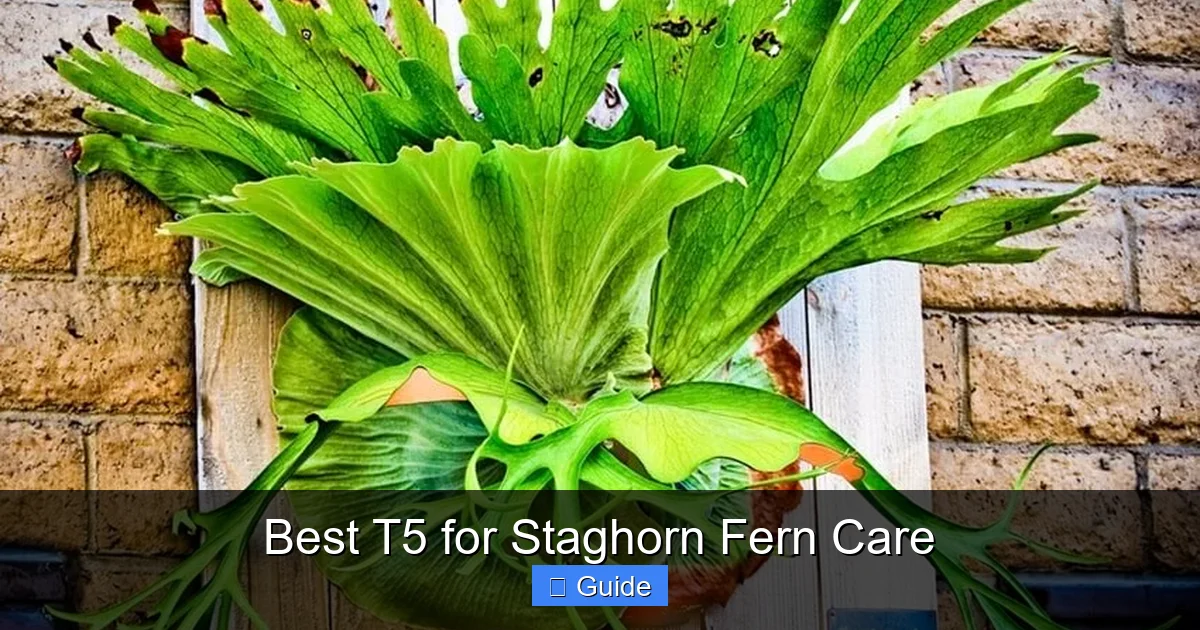
Visual guide about Best T5 for Staghorn Fern Care
Image source: besgrow.com
Daily Light Integral (DLI) Goals
DLI measures total photons delivered per day. Staghorn ferns thrive at 6 to 10 moles per square meter per day. At 200 PPFD for 12 hours, you hit about 8.6 DLI. At 150 PPFD for 14 hours, you reach 7.6 DLI. Both work well. The key is consistency. A timer is non-negotiable. Irregular light cycles confuse the plant and weaken growth.
Signs Your Light Is Too Strong or Too Weak
Watch your fern. It tells you everything. Bleached, white patches on frond tips mean the light is too intense or too close. Fronds curling inward signal heat or light stress. On the flip side, elongated, pale green fronds stretching toward the fixture mean insufficient light. Healthy growth shows firm, upright fronds with rich green color and visible venation. New shield fronds should emerge regularly during the growing season.
Top T5 Fixtures for Staghorn Fern Setups
Best Overall: SunBlaster T5HO 4-Foot 4-Lamp Fixture
This workhorse delivers 20,000 lumens across four 54-watt bulbs. The built-in reflector directs 90 percent of light downward. The ballast runs cool and silent. At 48 inches long, it covers a 4-by-2-foot mounting area perfectly. I run two 6500K and two 3000K bulbs for a balanced spectrum. The daisy-chain feature lets you link multiple units from one outlet. Price sits around $120, making it serious value for serious growers.
Best Compact: Hydrofarm Agrobrite T5 2-Foot 4-Lamp
Short on space? This 24-inch fixture packs four 24-watt bulbs into a slim profile. It fits under cabinet shelves or inside grow tents. The powder-coated steel housing resists humidity corrosion. Output reaches 10,000 lumens. At 12 inches, it covers a 2-by-2-foot zone. Great for a few mounted specimens or a single large bifurcatum. Runs about $80.
Best Budget: Durolux T5 2-Foot 2-Lamp Fixture
If you are just starting with one or two ferns, this two-bulb unit gets the job done for under $50. Each 24-watt tube delivers 2,000 lumens. Combined 4,000 lumens works for a 18-by-18-inch area at 12-inch height. The reflector is basic but functional. Ballast hum is noticeable in quiet rooms. Swap the included 6400K bulbs for 6500K replacements when they age.
Best Premium: Gavita Pro T5 4-Foot 4-Lamp
Commercial-grade construction with a sealed, waterproof ballast. The Miro 95 reflector achieves 95 percent reflectivity. Bulbs last 20,000 hours with minimal lumen depreciation. This fixture pays for itself over time through bulb longevity and energy efficiency. Expect to pay $200 plus. Worth it if you run lights 14 hours daily year-round.
Best for Shelves: Active Grow T5 2-Foot 4-Lamp Slim Profile
Designed specifically for vertical shelving units. At just 2.5 inches tall, it fits tight shelf spacing. The integrated hanging brackets adjust in 1-inch increments. Four 24-watt bulbs provide 10,000 lumens. The spectrum-tuned 6500K bulbs are optimized for foliage plants. No daisy-chain, but the low profile makes it ideal for multi-tier staghorn displays.
Choosing the Right T5 Bulbs for Your Ferns
Color Temperature Explained Simply
Color temperature, measured in Kelvin (K), describes the light’s visual warmth or coolness. Lower numbers (2700K to 3000K) appear warm, reddish. Higher numbers (5000K to 6500K) appear cool, bluish. Staghorn ferns use both ranges. Blue light drives compact, sturdy frond structure. Red light encourages reproductive maturity and strong rhizome attachment. A mix gives you the best of both worlds.
My Recommended Bulb Combinations
For a four-bulb fixture, I run two 6500K and two 3000K tubes. This 50/50 split mimics late morning forest light. If you only have a two-bulb fixture, choose 5000K to 5500K “full spectrum” bulbs. They sit in the middle and cover both needs adequately. Avoid pure 2700K bloom bulbs unless supplementing a primary 6500K source. Pure 6500K works fine for juveniles but may delay shield frond maturation in adults.
When to Replace T5 Bulbs
T5 bulbs lose 10 to 15 percent output in the first 2,000 hours. After 10,000 hours, spectrum shifts toward green-yellow, reducing usable PAR. Replace bulbs annually if running 14-hour days. That is about 5,000 hours per year. Mark the install date on the fixture with a silver Sharpie. Your ferns will thank you with consistent growth.
Mounting Distance and Coverage Strategies
The 12-to-18-Inch Sweet Spot
Distance determines intensity. At 6 inches, a four-bulb T5 HO delivers 400+ PPFD. Too strong. At 24 inches, you drop below 80 PPFD. Too weak. The 12-to-18-inch range hits the 100-to-250 PPFD target perfectly. Start at 18 inches for newly mounted ferns. Lower to 12 inches once they establish and show vigorous growth. Use a tape measure. Guessing leads to problems.
Calculating Coverage Area
A 4-foot, 4-bulb fixture evenly illuminates roughly 4 feet by 2 feet at 18-inch height. At 12 inches, the intense zone shrinks to 3 feet by 1.5 feet. A 2-foot, 4-bulb fixture covers 2 feet by 2 feet at 18 inches. Plan your mounting board layout accordingly. Overlapping light from adjacent fixtures eliminates dark edges. Space 4-foot fixtures 3 feet apart center-to-center for seamless coverage.
Adjustable Hanging Systems
Chain hangers work but lack precision. Ratchet light hangers let you adjust in 1/4-inch increments. They hold 150 pounds per pair. For shelf setups, use adjustable shelf brackets with the fixture screwed to the underside. PVC pipe frames with S-hooks offer a DIY solution. Whatever you choose, ensure you can raise the lights as fronds grow toward them. Staghorns can add 6 inches of frond length in a single season.
Photoperiod and Seasonal Lighting Schedules
The 12-to-14-Hour Standard
Tropical regions near the equator receive 12 hours of daylight year-round. Subtropical zones see 10 to 14 hours seasonally. Staghorn ferns adapt to both. A 12-hour baseline works everywhere. Increase to 14 hours in spring and summer to accelerate growth. Drop to 10 hours in winter if you want to simulate a rest period. Never go below 8 hours or above 16. Consistency trumps perfection.
Using Timers and Smart Plugs
A $10 mechanical timer works fine. Digital timers offer battery backup for power outages. Smart plugs let you adjust schedules from your phone and track runtime. I use a smart plug with a sunrise/sunset feature that shifts the schedule gradually through the seasons. It mimics natural photoperiod changes without me lifting a finger. Set it once, check it monthly.
Supplementing with Natural Light
If your ferns live near a bright window, you can reduce artificial hours. East-facing windows provide gentle morning sun. South or west windows need sheer curtains. Measure combined PPFD with a meter. Target the same 100-to-250 range. Reduce T5 runtime by 1 hour for every 50 PPFD the window contributes. This saves electricity and creates a more natural light rhythm.
Managing Heat and Humidity Around T5 Fixtures
Airflow Is Your Friend
T5 ballasts and bulbs generate warmth. In enclosed spaces, this raises ambient temperature and lowers relative humidity. Staghorns want 60 to 80 percent humidity. A small clip-on fan circulating air across the fronds prevents heat buildup and fungal issues. Position the fan to blow parallel to the mounting surface, not directly at the plant. Gentle air movement strengthens frond tissue too.
Humidifier Placement Strategies
Run a humidifier on a separate timer, offset by 30 minutes from the lights. This prevents condensation on hot bulbs. Aim the mist toward the root zone, not the fronds. Wet fronds under intense light can develop bacterial spots. A humidity controller maintains your target range automatically. Grouping ferns creates a microclimate. A pebble tray under mounted boards adds passive humidity.
Monitoring with Hygrometers
Place a digital hygrometer at frond level, not on the floor. Temperature and humidity stratify. You want data where the plant lives. Check min/max readings daily. If humidity drops below 50 percent with lights on, increase humidifier runtime or add a second unit. If it exceeds 90 percent, increase airflow. Both extremes invite problems.
Common Mistakes and How to Avoid Them
Mistake: Mounting Lights Too Close
Enthusiasm leads to crispy fronds. The “more light equals faster growth” instinct backfires. Staghorns are not succulents. They cannot handle high PPFD. Start high. Lower gradually. Watch for stress signals. If you see any bleaching, raise the fixture 2 inches immediately. Recovery takes weeks. Prevention takes seconds.
Mistake: Running Lights 24/7
Plants need dark periods for respiration and metabolic processes. Continuous light disrupts circadian rhythms. Growth actually slows. Fronds become thin and fragile. Always use a timer. Even a 2-hour dark period is better than none. Eight hours dark is ideal.
Mistake: Ignoring Bulb Aging
Old bulbs look fine to human-eye. They still glow. But spectrum shifts and output drops. Your ferns slowly starve while you wonder why growth stalled. Replace on schedule. Keep spare bulbs on hand. A four-bulb fixture needs four replacements. Budget $40 to $80 per year for bulbs. It is the cost of admission for thriving ferns.
Mistake: Uneven Light Distribution
Mounting a large fern under a small fixture leaves outer fronds in shade. They stretch. The center fronds get blasted. Match fixture length to plant width. For a 36-inch wide bifurcatum, use a 4-foot fixture. Center the plant. Rotate weekly. Even growth requires even light.
Advanced Tips for Spectacular Staghorns
Side Lighting for Vertical Mounts
Wall-mounted ferns receive light from one direction. The back fronds weaken. Add a vertical T5 strip on the wall beside the mount. A 2-foot, 2-bulb fixture mounted 6 inches from the plaque edge fills in the shadows. Run it on the same timer. This trick produces symmetrical, 360-degree specimens that look like they grew in the open.
Pulsing Light for Spore Production
Some growers report increased fertile frond production using a 2-week pulse of 16-hour days at 3000K spectrum, followed by 2 weeks of 10-hour days at 6500K. This mimics seasonal shifts that trigger reproduction in nature. I have not tested this rigorously, but the logic tracks. Try it on a mature specimen and document results.
Integrating T5 with LED Supplement
T5 excels at broad coverage. LED excels at intensity. For massive specimens, add a 30-watt LED spotlight aimed at the crown during peak hours. This boosts PPFD in the growth zone without overheating the shield fronds. Use a separate timer for the LED. Run it 4 hours mid-day. Monitor closely. This is advanced. Master basic T5 first.
Conclusion
Growing staghorn ferns under T5 lights is one of the most rewarding indoor gardening projects you can undertake. These prehistoric-looking plants respond dramatically to proper lighting. The fronds unfurl wider. The shields thicken and turn a rich, velvety green. New pups appear at the base. You feel like you have cracked a secret code.
The formula is straightforward. Choose a quality 4-bulb T5 HO fixture. Run two 6500K and two 3000K bulbs. Hang it 12 to 18 inches above your mounted ferns. Set a timer for 12 to 14 hours. Maintain 60 to 80 percent humidity with a fan and humidifier. Replace bulbs annually. Rotate plants weekly. That is it. No magic. Just consistency and attention.
Start with one fixture and one fern. Watch. Learn. Adjust. The feedback loop between you and your plant is the real teacher. T5 lights give you the control to respond to what your staghorn tells you. Before long, you will have a wall of antlered green that stops visitors in their tracks. And you will know exactly how you got there.
Frequently Asked Questions
Do staghorn ferns need a dark period?
Yes, staghorn ferns require at least 8 hours of darkness daily for proper respiration and metabolic function. Continuous light weakens growth and disrupts natural circadian rhythms.
Can I use regular shop light T5 bulbs for staghorn ferns?
Standard 4100K or 5000K shop light bulbs work adequately but lack the red spectrum that encourages shield frond maturation. Horticultural 6500K and 3000K bulbs produce better results.
Why are my staghorn fern fronds turning brown at the tips under T5 lights?
Brown tips usually indicate the light is too close or too intense. Raise the fixture 2 to 3 inches and ensure humidity stays above 60 percent. Check for heat buildup near the ballast.
How many T5 bulbs do I need for a large staghorn fern?
A 36-inch wide mature staghorn needs a 4-foot, 4-bulb T5 HO fixture for even coverage. Smaller plants do well under 2-foot, 4-bulb fixtures.
Should I mist my staghorn fern while the T5 lights are on?
Mist 30 minutes before lights turn on or after they turn off. Water droplets on fronds under intense light can act as magnifying lenses and cause burn spots.
Can T5 lights cause staghorn ferns to produce spores?
Mature staghorns under proper 3000K-spectrum light and a 12 to 14-hour photoperiod will naturally produce fertile fronds with spores. This typically occurs on plants 3+ years old.