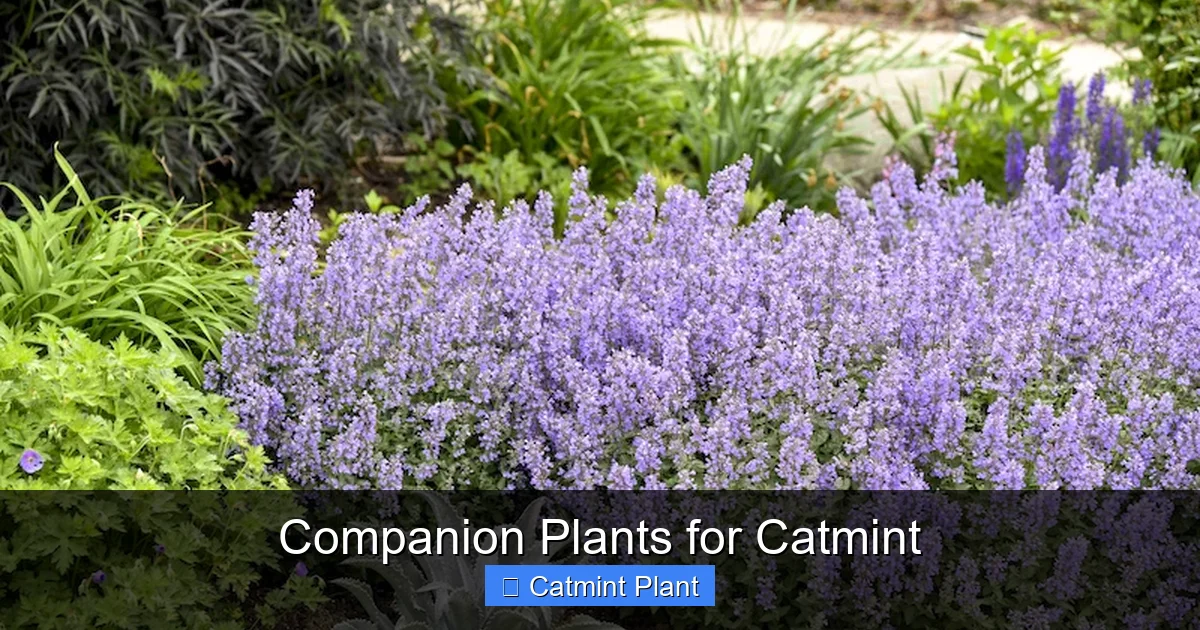
Companion Plants for Catmint
Catmint (Nepeta) thrives alongside drought-tolerant perennials like salvia, coneflowers, and ornamental grasses. These companions share similar sun and soil needs while attracting beneficial insects. Strategic pairings create continuous blooms, suppress weeds, and build a resilient, low-maintenance garden ecosystem.
Key Takeaways
- Match growing conditions: Choose companions that love full sun, well-drained soil, and low water once established.
- Extend bloom season: Pair early, mid, and late-season bloomers for continuous color from spring through frost.
- Attract pollinators: Combine catmint with salvia, coneflowers, and bee balm to create a pollinator magnet.
- Use height layers: Plant tall grasses behind catmint, mid-height perennials beside it, and low creepers in front.
- Repel pests naturally: Catmint’s aromatic foliage deters aphids, squash bugs, and deer while protecting neighbors.
- Divide and conquer: Split catmint every 2-3 years to maintain vigor and prevent center die-out.
- Avoid wet feet: Never pair catmint with moisture-loving plants like astilbe or ferns — they need opposite conditions.
Quick Answers to Common Questions
What are the best companion plants for catmint in hot climates?
In hot climates, pair catmint with heat-loving plants like Russian sage, lantana, salvia greggii, ornamental grasses (muhly grass, little bluestem), and agastache. These all thrive in full sun with minimal water once established.
Can I plant catmint next to vegetables?
Yes, catmint repels aphids, squash bugs, cucumber beetles, and flea beetles. Plant it near tomatoes, peppers, squash, and brassicas. Keep it at bed edges since it spreads. Avoid planting near peas or beans which may be inhibited by its aromatic oils.
How far apart should I space catmint and its companions?
Space catmint 18-24 inches apart. Give salvia 12-18 inches. Coneflowers need 18-24 inches. Grasses vary: 18 inches for small varieties, 3 feet for large. Always check mature width on plant tags and space accordingly.
Does catmint come back every year?
Yes, catmint is a hardy perennial in zones 3-8. It dies back in winter and returns from the crown in spring. Cut dead stems to the ground in early spring before new growth emerges. Divide every 2-3 years to maintain vigor.
What plants should NOT be planted with catmint?
Avoid moisture-loving plants like hostas, astilbes, ferns, ligularias, and Japanese iris. These need consistently damp soil while catmint requires sharp drainage. Also avoid aggressive spreaders like mint, bee balm, and gooseneck loosestrife that will overwhelm catmint.
📑 Table of Contents
- Why Companion Planting Matters for Catmint
- Understanding Catmint Growing Requirements
- Best Flowering Perennial Companions
- Ornamental Grasses for Structure and Movement
- Herbs and Edible Companions
- Design Strategies for Companion Planting
- Pest Management and Ecological Benefits
- Maintenance Tips for Companion Planting
- Common Mistakes to Avoid
- Regional Considerations
- Container Combinations with Catmint
- Conclusion
Why Companion Planting Matters for Catmint
Catmint earns its spot in any sunny border. The soft gray-green foliage looks good all season. The lavender-blue flowers bloom for months. Bees and butterflies cannot resist it. Deer and rabbits usually leave it alone. But catmint shines brightest when paired with the right neighbors.
Good companions share the same cultural needs. They want full sun. They want sharp drainage. They thrive on neglect once established. When you match plants with similar requirements, maintenance drops. Watering becomes simple. Fertilizing becomes unnecessary. The garden starts to take care of itself.
Beyond practical benefits, companions create visual magic. Catmint has a loose, billowy habit. It softens hard edges. It spills over paths. It knits separate plants into a cohesive tapestry. The right partners amplify this effect. They add vertical spikes, bold foliage, or contrasting textures. The result looks designed by nature, not forced by a gardener.
Understanding Catmint Growing Requirements
Sun Exposure Needs
Catmint demands full sun. Six hours minimum. Eight hours is better. In hot southern zones, a touch of afternoon shade prevents flower fade. But too much shade makes stems floppy. Flowers become sparse. Powdery mildew risk rises. Choose companions that also crave bright light.

Visual guide about Companion Plants for Catmint
Image source: as1.ftcdn.net
Soil Preferences
Lean soil suits catmint best. Rich soil produces lush foliage but fewer flowers. Stems grow weak and flop. Sandy or gravelly soil is ideal. Clay works if drainage is excellent. Amend heavy soil with coarse sand or fine gravel. Avoid compost-heavy beds. Your companions should tolerate these same lean conditions.
Water Requirements
New plants need regular water. Established catmint is remarkably drought-tolerant. Deep, infrequent watering encourages deep roots. Frequent shallow watering creates dependence. Overwatering causes root rot. Select companions with similar low-water needs. Mediterranean herbs, prairie natives, and xeriscape plants fit perfectly.
Hardiness and Climate Adaptability
Most catmint varieties thrive in USDA zones 3-8. Some handle zone 9 with afternoon shade. ‘Walker’s Low’ and ‘Six Hills Giant’ are especially cold-hardy. ‘Cat’s Meow’ and ‘Cat’s Pajamas’ offer compact forms for smaller spaces. Know your zone. Pick companions rated for the same range.
Best Flowering Perennial Companions
Salvia (Sage)
Salvia and catmint are classic partners. Both belong to the mint family. Both have aromatic foliage. Both bloom in blue-purple shades. But salvia adds vertical spikes. Catmint provides horizontal clouds. Together they create rhythm. ‘May Night’ salvia blooms early. ‘Caradonna’ follows. Catmint bridges the gap with nonstop flowers.
Plant them in drifts. Alternate groups of three or five. The repetition draws the eye through the border. Bees work both plants efficiently. Hummingbirds visit salvia. Butterflies cover catmint. The pollinator traffic is constant.
Echinacea (Coneflower)
Coneflowers bring bold daisy forms. Their raised centers catch light. Petals reflex downward. Colors range from purple to orange, yellow, and white. ‘Magnus’ offers classic pink-purple. ‘Cheyenne Spirit’ mixes warm tones. ‘Green Twister’ adds lime-green petals.
Coneflowers bloom mid-to-late summer. Catmint starts earlier. Deadhead catmint in July for a fresh flush. The two overlap beautifully. Goldfinches eat coneflower seeds in fall. Leave seed heads standing. They feed birds and add winter structure.
Rudbeckia (Black-Eyed Susan)
Rudbeckia brings golden sunshine. ‘Goldsturm’ is the reliable standard. ‘Little Goldstar’ stays compact. ‘Henry Eilers’ has quilled petals. All bloom late summer into fall. They extend the season when catmint slows down.
The yellow-orange flowers contrast catmint’s cool blues. This color combination never fails. Both plants self-sow moderately. You get volunteers. Thin them or share with friends. Deer avoid both.
Perovskia (Russian Sage)
Russian sage mirrors catmint’s airy habit. Lavender-blue spires rise from silver foliage. It blooms late summer to frost. ‘Blue Spire’ reaches four feet. ‘Little Spire’ stays two feet. ‘Denim ‘n Lace’ resists flopping.
Plant Russian sage behind catmint. The height difference creates layers. Silver foliage echoes catmint’s gray-green. The combined haze effect is dreamy in late afternoon light. Both thrive in poor, dry soil. Both laugh at heat.
Coreopsis (Tickseed)
Coreopsis offers cheerful yellow daisies. ‘Moonbeam’ has pale lemon flowers and threadleaf foliage. ‘Zagreb’ is compact and golden. ‘Red Satin’ brings deep red blooms. They flower early summer to fall with deadheading.
The fine texture of threadleaf coreopsis contrasts catmint’s broader leaves. Yellow and blue are complementary colors. They vibrate visually. Coreopsis tolerates heat, humidity, and poor soil. It asks for nothing but sun.
Achillea (Yarrow)
Yarrow contributes flat-topped flower clusters. Colors span white, yellow, pink, red, and terracotta. ‘Moonshine’ has soft yellow flowers and silver foliage. ‘Paprika’ holds rich red. ‘Terracotta’ shifts from orange to amber.
Yarrow’s ferny foliage adds texture. The flat flowers provide landing pads for beneficial insects. Ladybugs, lacewings, and hoverflies love yarrow. They patrol nearby catmint for aphids. Yarrow spreads by rhizomes. Give it room or choose clumping varieties.
Ornamental Grasses for Structure and Movement
Calamagrostis (Feather Reed Grass)
‘Karl Foerster’ is the gold standard. Vertical green blades rise early. Wheat-colored plumes appear in June. They stand tall all winter. The strict upright form anchors loose catmint. Plant three or five grasses in a row. Let catmint billow at their feet.
Pennisetum (Fountain Grass)
Fountain grass arches gracefully. Bottlebrush plumes catch light. ‘Hameln’ stays compact at two feet. ‘Little Bunny’ is miniature. ‘Karley Rose’ has pinkish plumes. The cascading form echoes catmint’s mounding habit. Both move beautifully in wind.
Schizachyrium (Little Bluestem)
This native prairie grass turns copper-orange in fall. ‘The Blues’ has intense blue summer foliage. ‘Standing Ovation’ stays strictly upright. Seed heads feed birds. The warm autumn tones complement catmint’s late blue flowers. Both are deeply drought-tolerant.
Sporobolus (Prairie Dropseed)
Fine-textured mounds emit a subtle cilantro fragrance in late summer. Airy seed heads hover above foliage. Fall color is golden-orange. Winter presence is strong. This grass stays put. It never self-sows aggressively. It frames catmint with refined elegance.
Muhlenbergia (Muhly Grass)
Pink muhly grass creates a pink cloud in fall. ‘Regal Mist’ and ‘Pink Flamingos’ are reliable. The effect is ethereal. Plant behind catmint. The pink haze floats above blue flowers. Spring foliage is neat green. Summer is quiet. Fall steals the show.
Herbs and Edible Companions
Lavender
Lavender and catmint are soulmates. Both Mediterranean natives. Both want sun, drainage, and lean soil. Both repel pests. Both attract pollinators. English lavender (Lavandula angustifolia) is hardiest. ‘Hidcote’ and ‘Munstead’ are classics. ‘Phenomenal’ handles humidity better.
Plant them together in a herb garden or sunny border. The silver foliage combination is sophisticated. Harvest lavender for sachets. Let catmint feed the bees. They bloom sequentially for extended interest.
Rosemary
Upright rosemary adds vertical structure. ‘Arp’ and ‘Hill Hardy’ survive zone 6. Prostrate rosemary spills over walls. Both have needle-like foliage. Blue flowers appear in spring. The piney scent mingles with catmint’s minty aroma. Both deter cabbage moths and bean beetles.
Thyme
Creeping thyme makes a living mulch. It suppresses weeds between catmint plants. ‘Elfin’ forms a tight mat. ‘Red Creeping’ has magenta flowers. ‘Lemon’ thyme adds citrus scent. All tolerate foot traffic. Harvest leaves anytime. Flowers feed tiny native bees.
Oregano and Marjoram
Greek oregano spreads steadily. Golden oregano brightens edges. Sweet marjoram stays tender. All produce pollinator-friendly flowers. The pungent oils confuse pests. Plant them near vegetable beds. Catmint, oregano, and thyme form a protective ring.
Sage (Culinary)
Common sage has velvety gray leaves. ‘Berggarten’ has large, rounded leaves. ‘Purpurascens’ shows purple new growth. ‘Tricolor’ splashes cream and pink. Blue flower spikes appear in early summer. Sage deters cabbage moths and carrot flies. It shares catmint’s cultural needs perfectly.
Design Strategies for Companion Planting
Creating Height Layers
Think in three tiers. Back layer: tall grasses, Russian sage, coneflowers. Middle layer: catmint, salvia, yarrow, coreopsis. Front layer: creeping thyme, sedum, low grasses. This creates depth. Every plant remains visible. Air flows freely. Disease pressure drops.
In island beds, place tallest plants in center. Step down toward edges. Catmint works beautifully in the middle zone. It bridges tall and short. Its mounding habit hides bare legs of taller plants. It softens the transition to groundcovers.
Color Theory in the Garden
Catmint’s blue-lavender flowers are cool tones. They pair naturally with warm opposites. Yellow, orange, and red create energy. Think rudbeckia, coreopsis, yarrow ‘Paprika’, and echinacea ‘Hot Papaya’. Cool harmonies use pink, purple, and white. Try echinacea ‘White Swan’, salvia ‘Snow Hill’, and white yarrow.
Silver foliage bridges everything. Catmint, lavender, Russian sage, artemisia, and lamb’s ears share this trait. Repeat silver plants throughout. They unify disparate colors. They glow at dusk. They cool hot color schemes.
Succession Blooming for Continuous Color
Plan for overlap. Early summer: salvia ‘May Night’, catmint, coreopsis ‘Moonbeam’. Mid-summer: coneflowers, yarrow, bee balm, catmint (rebloom). Late summer: Russian sage, rudbeckia, ornamental grasses, sedum. Fall: asters, muhly grass, prairie dropseed, coneflower seed heads.
Deadhead catmint hard after first flush. Shear to six inches. Water once. Fresh growth appears fast. Second bloom coincides with coneflowers. Third flush often happens in cool autumn. The plant works overtime.
Mass Planting vs. Specimen Placement
Mass planting creates impact. Drifts of five, seven, or nine catmint plants read as a single gesture. Intersperse companion drifts. The rhythm calms the eye. This works in large borders and meadow gardens.
Specimen placement suits small gardens. One catmint, one salvia, one grass. Repeat the trio three times. The repetition creates cohesion. Each plant shows its individual form. This approach fits courtyard gardens and narrow beds.
Pest Management and Ecological Benefits
How Catmint Repels Pests
Catmint contains nepetalactone. This compound repels aphids, squash bugs, cucumber beetles, and flea beetles. It confuses cabbage moths. Deer and rabbits avoid the strong scent. Plant catmint around vegetable beds. Edge rose gardens. Border fruit trees. The protective halo extends several feet.
Companions amplify this effect. Yarrow attracts predatory insects. Dill and fennel host beneficial wasps. Alliums deter borers. The combined arsenal protects the whole garden. Chemical sprays become unnecessary.
Attracting Beneficial Insects
Catmint flowers feed bees, butterflies, and hoverflies. Long bloom season means reliable nectar. Bumblebees work flowers early morning. Honeybees visit midday. Solitary bees forage late afternoon. Butterflies nectar throughout.
Add companions that host caterpillars. Milkweed for monarchs. Parsley and dill for swallowtails. Violets for fritillaries. Nectar plants feed adults. Host plants feed the next generation. A complete habitat supports full life cycles.
Supporting Pollinator Diversity
Different flower shapes serve different pollinators. Tubular salvia flowers suit hummingbirds and long-tongued bees. Flat yarrow clusters welcome short-tongued bees and beetles. Daisy-form coneflowers accommodate everyone. Catmint’s small tubes fit small native bees.
Plant in groups. Pollinators forage efficiently on massed flowers. Single plants waste their energy. Aim for three-foot minimum drifts. Include early and late bloomers. Spring bulbs, fall asters. Continuous forage builds strong populations.
Maintenance Tips for Companion Planting
Dividing and Renewing Catmint
Catmint centers die out after three years. Divide in early spring. Dig the clump. Cut into sections with a sharp spade. Replant vigorous outer pieces. Discard woody centers. Amend soil with grit if needed. Water well once. Done.
Divide companions on similar schedules. Salvia every 3-4 years. Coneflowers every 4 years. Yarrow every 2-3 years (it spreads fast). Grasses every 4-5 years. Stagger divisions. The border never looks bare.
Seasonal Cutback Strategies
Leave stems standing winter. Seed heads feed birds. Hollow stems house overwintering insects. Crowns catch insulating snow. Cut back in early spring. New growth emerges from base. Use hedge shears for speed. Rake debris. Compost if disease-free.
Grasses need annual cutback. Tie clumps with twine. Cut six inches high. Avoid cutting into crown. Catmint can be sheared after first bloom. This triggers rebloom. No need to deadhead individual flowers. The plant responds to hard pruning.
Watering and Fertilizing Companion Beds
Water deeply, infrequently. Soak the root zone. Wait until top two inches dry. This trains deep roots. Mulch with gravel or pine fines. Avoid wood chips — they hold moisture and rot crowns. Fertilize never. Lean soil produces stronger plants. More flowers. Less flopping.
If soil is extremely poor, top-dress with compost once in spring. Half-inch layer. Keep away from crowns. Most companions prefer the same treatment. Mediterranean herbs especially hate rich soil. They lose flavor and hardiness.
Common Mistakes to Avoid
Pairing with Moisture-Loving Plants
Hostas, astilbes, ferns, and ligularias need consistent moisture. Catmint rots in those conditions. Do not mix them. Create separate zones. Dry garden here. Woodland garden there. Each thrives in its preferred environment.
Overcrowding at Planting Time
Small pots deceive. Catmint reaches two feet wide. Salvia spreads. Grasses expand. Space for mature size. Read labels. Use a tape measure. Thin later if needed. Crowded plants compete. Airflow drops. Disease enters. Flowers diminish.
Ignoring Bloom Time Gaps
A border that peaks in June then sleeps disappoints. Plan for shoulder seasons. Early bulbs. Late grasses. Winter structure. Catmint covers a long stretch but not all year. Fill the gaps. The garden should offer interest twelve months.
Choosing Invasive Companions
Mint family members can run. Bee balm spreads fast. Obedient plant is not obedient. Gooseneck loosestrife travels. Research before planting. Choose clumping varieties. Install barriers if needed. Remove volunteers promptly.
Regional Considerations
Hot Humid Climates (Southeast, Gulf Coast)
Choose heat-tolerant varieties. ‘Cat’s Meow’ and ‘Cat’s Pajamas’ handle humidity. ‘Phenomenal’ lavender resists fungal issues. Mexican bush sage (Salvia leucantha) blooms fall. Lantana thrives. Ornamental grasses love heat. Ensure excellent drainage. Raise beds if needed.
Cold Northern Climates (Zones 3-4)
Select hardiest cultivars. ‘Walker’s Low’ catmint. ‘May Night’ salvia. ‘Magnus’ coneflower. ‘Karl Foerster’ grass. Little bluestem. Russian sage. Mulch crowns after ground freezes. Avoid fall planting. Spring establishment is safer.
Arid Western Climates
Catmint is a star here. Pair with desert natives. Penstemon. Agastache. Salvia greggii. Desert marigold. Globe mallow. Grasses: blue grama, sideoats grama. Mulch with gravel. Water deeply monthly in summer. Never fertilize.
Coastal Gardens
Salt spray challenges many plants. Catmint tolerates moderate salt. Lavender handles it well. Russian sage thrives. Grasses: switchgrass, little bluestem. Yarrow. Sedum. Rugosa rose. Rinse foliage after storms. Sandy soil drains perfectly.
Container Combinations with Catmint
Choosing the Right Pot
Big pots. Eighteen inches minimum. Twenty-four is better. Drainage holes essential. Terra cotta breathes. Glazed ceramic holds moisture longer. Lightweight composite works for rooftops. Elevate pots on feet. Prevents waterlogging.
Container Soil Mix
One part potting soil. One part coarse sand. One part fine gravel or perlite. Add handful of lime. Catmint likes alkaline conditions. Slow-release fertilizer at half rate. Top-dress with gravel mulch. Keeps crown dry. Looks finished.
Thriller, Filler, Spiller Formula
Thriller: dwarf grass or upright salvia. Filler: catmint. Spiller: creeping thyme or sedum. All want sun. All want drainage. Water when top inch dries. Shear catmint mid-season. Refresh thyme if woody. Replace annual spillers yearly.
Overwintering Containers
Zone 6 and colder: move pots to unheated garage. Water monthly. Zone 7-8: group pots against protected wall. Mulch heavily. Zone 9+: leave in place. Avoid freeze-thaw cycles. Terra cotta cracks. Use frost-proof pots.
Conclusion
Catmint gives so much. Long bloom. Aromatic foliage. Pollinator magnet. Pest repellent. Deer resistance. Drought tolerance. But it gives even more with thoughtful companions. The right partners amplify every strength. They cover weaknesses. They extend seasons. They create a garden that functions as a community.
Start with cultural matches. Sun lovers with sun lovers. Dry with dry. Lean with lean. Then layer for beauty. Height variation. Texture contrast. Color harmony. Succession bloom. Ecological function. Every plant earns its keep. Maintenance drops. Enjoyment rises.
Experiment. Observe. Adjust. Move plants that struggle. Divide those that thrive. Share divisions. The garden evolves. Catmint remains the reliable anchor. Its soft blue clouds tie everything together. Season after season. Year after year. That is the promise of good companions.
Frequently Asked Questions
What is the best companion plant for catmint?
Salvia is widely considered the best companion for catmint. Both share identical growing requirements — full sun, lean soil, and low water. Their bloom times overlap beautifully, and the vertical salvia spikes contrast perfectly with catmint’s billowy mounds.
Can catmint and lavender be planted together?
Absolutely. Catmint and lavender are ideal companions. Both are Mediterranean natives requiring full sun, excellent drainage, and lean soil. Their silver-gray foliage creates a sophisticated color echo, and they bloom sequentially for extended seasonal interest.
Will catmint choke out other plants?
Catmint spreads steadily but is not aggressively invasive. It forms a clump 18-24 inches wide. It may overwhelm very small, slow-growing alpines. Give companions adequate space at planting. Divide catmint every 2-3 years to control size and maintain vigor.
Should I deadhead catmint to encourage rebloom?
Yes. After the first heavy flush fades in early summer, shear the entire plant back to 6 inches. Water once deeply. Fresh foliage and flowers return in 2-3 weeks. This coincides perfectly with mid-summer companions like coneflowers and yarrow.
Is catmint the same as catnip?
No. Catmint (Nepeta x faassenii) and catnip (Nepeta cataria) are different species. Catmint is ornamental with showy flowers and tidy habit. Catnip is weedy, less attractive, and intensely attractive to cats. Catmint may interest cats mildly but is grown for garden performance.
Can catmint grow in partial shade?
Catmint tolerates light shade but performs best in full sun (6+ hours). In partial shade, stems become leggy, flowering decreases, and powdery mildew risk increases. In hot southern zones, afternoon shade is beneficial. Choose shade-tolerant companions like Japanese forest grass for shadier spots.