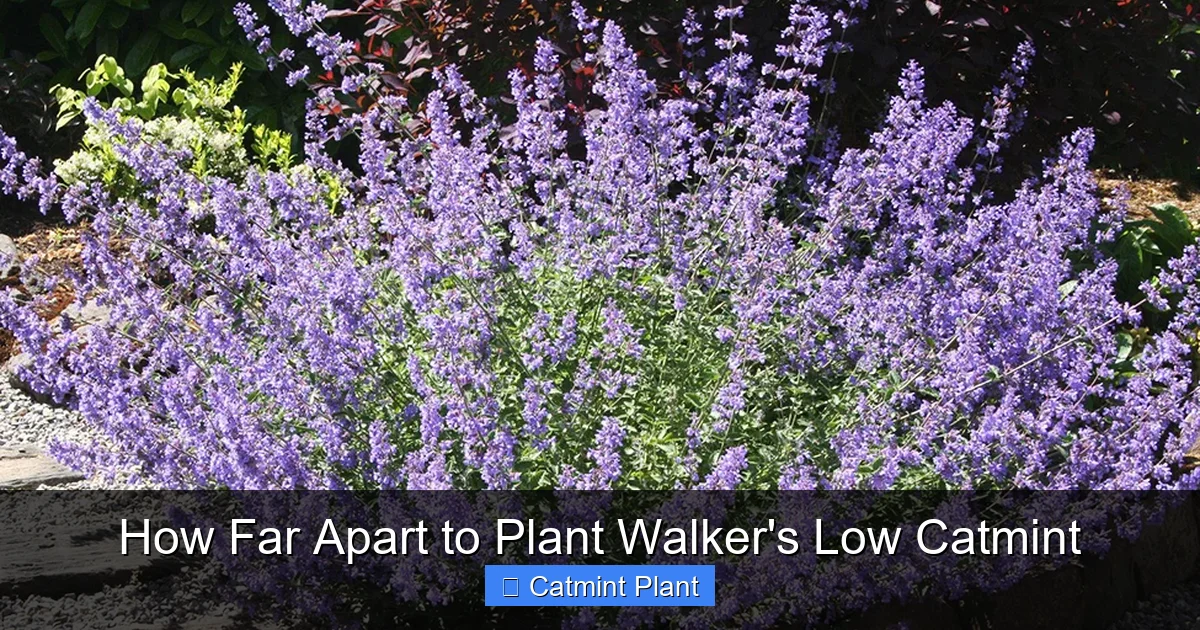
How Far Apart to Plant Walker’s Low Catmint
Walker’s Low catmint should be planted 18 to 24 inches apart to allow for its mature spread and ensure good air circulation. Proper spacing prevents disease, encourages fuller growth, and creates a stunning floral display in your garden beds.
If you have ever walked past a garden border buzzing with bees and draped in soft lavender-blue flowers, chances are you were admiring Walker’s Low catmint. This perennial superstar, known botanically as Nepeta x faassenii ‘Walker’s Low,’ earns its keep in sunny gardens across the country. It blooms for months. It laughs at drought. It feeds pollinators. And it asks for very little in return.
But there is one question that trips up both new and seasoned gardeners: how far apart to plant Walker’s Low catmint? Spacing might seem like a small detail. Get it wrong, though, and you end up with a crowded mess prone to mildew or a patchy border that takes years to fill in. Get it right, and you enjoy a lush, healthy drift of color that looks like it belongs in a magazine spread. Let us walk through everything you need to know about spacing this garden favorite.
Key Takeaways
- Ideal spacing is 18 to 24 inches: This distance accommodates the plant’s mature width of 24 to 30 inches while allowing air flow.
- Closer spacing creates a faster groundcover: Planting at 12 to 15 inches fills in quickly but requires earlier division.
- Wider spacing improves plant health: At 24 to 30 inches apart, plants develop better root systems and resist fungal issues.
- Consider companion plants when spacing: Leave extra room if pairing with roses, salvias, or ornamental grasses.
- Container planting needs different rules: Use one plant per 12-inch pot or three plants in a 24-inch container.
- Division timing affects spacing decisions: Plan to divide every 3 to 4 years to maintain vigor and prevent overcrowding.
- First-year growth looks sparse but fills in: Resist the urge to plant too close; patience rewards you with healthier plants.
Quick Answers to Common Questions
What is the exact spacing for Walker’s Low catmint?
Plant Walker’s Low catmint 18 to 24 inches apart on center for optimal growth and air circulation.
Can I plant Walker’s Low catmint closer together for faster coverage?
Yes, you can plant at 12 to 15 inches for quick groundcover, but plan to divide earlier to prevent overcrowding and disease.
Does spacing change if I am planting in containers?
Yes, use one plant per 12-inch pot or three plants spaced 8 inches apart in a 24-inch container.
How far from roses should I plant Walker’s Low catmint?
Space catmint 18 to 24 inches from the base of rose bushes to allow access for pruning and reduce disease risk.
When should I divide Walker’s Low catmint if it gets too crowded?
Divide every 3 to 4 years in early spring when the center becomes woody or flower production declines.
📑 Table of Contents
- Understanding Walker’s Low Catmint Growth Habit
- The Golden Rule: 18 to 24 Inches Apart
- Spacing Scenarios for Different Garden Designs
- Soil, Sun, and Climate Adjustments
- Companion Planting and Spacing Interactions
- Planting Techniques for Success
- Common Spacing Mistakes and How to Fix Them
- Long-Term Management: Division and Renovation
- Design Tips for Maximum Impact
- Walker’s Low vs. Other Catmints: Spacing Differences
- Troubleshooting Spacing-Related Problems
- Budget-Friendly Spacing Strategies
- Regional Case Studies
- Conclusion
Understanding Walker’s Low Catmint Growth Habit
Before we talk numbers, we need to understand the plant. Walker’s Low is not actually low. The name comes from the garden in Ireland where it was discovered, not its height. This catmint forms a mounding clump of aromatic, gray-green foliage. From late spring through fall, it sends up spikes of small, tubular flowers in a lovely shade of periwinkle blue.
Mature Size and Spread
A happy, established plant reaches 24 to 30 inches tall and spreads 24 to 36 inches wide. That spread is the key number. The plant grows outward from the center, creating a fountain shape. In rich soil with regular water, it leans toward the larger end. In lean, dry soil, it stays more compact. Knowing this range helps you visualize the final picture.
Growth Rate Timeline
Walker’s Low is a fast grower. In its first season, a small nursery plug or quart pot can reach near-full width by late summer. By year two, it hits its stride. Year three often brings the most impressive floral display. After year three or four, the center may get woody and flower production drops. That is your cue to divide. Understanding this timeline prevents the common mistake of planting too close because the young plants look small and lonely.
Root System Characteristics
This catmint develops a fibrous, spreading root system. It does not have a deep taproot. The roots occupy the top 12 to 18 inches of soil and extend slightly beyond the drip line of the foliage. This means plants compete most intensely in that upper soil zone. Adequate spacing ensures each plant has enough soil volume to access water and nutrients without stress.
The Golden Rule: 18 to 24 Inches Apart
For most garden situations, plant Walker’s Low catmint 18 to 24 inches apart on center. On center means measuring from the center of one plant to the center of the next. This spacing hits the sweet spot for several reasons.
Why This Range Works
At 18 inches, the foliage of adjacent plants will touch or slightly overlap by mid-summer of the first year. You get a continuous mass of color quickly. At 24 inches, there is a visible gap between plants for the first season. By year two, they merge into a seamless drift. Both distances allow enough air movement to keep foliage dry and discourage powdery mildew, the main disease threat.
Measuring On Center Correctly
Grab a tape measure. Place the first plant. Measure 18 or 24 inches from the center of its root ball. That is where the center of the next plant goes. Do not measure from the edge of the pot. Do not guess. A consistent rhythm creates a professional look. If you are planting a long border, mark your spacing on a stick or board to speed things up.
Adjusting for Your Goals
Choose the tighter 18-inch spacing if you want a quick groundcover effect, are planting on a slope for erosion control, or have a small space where you need immediate impact. Choose the wider 24-inch spacing if you garden in a humid climate where fungal diseases thrive, have rich soil that encourages rampant growth, or prefer a more open, architectural look where individual plant forms remain distinct.
Spacing Scenarios for Different Garden Designs
Gardens are not one-size-fits-all. Your spacing should serve your design intent. Here are common scenarios and how to adapt.
Mass Planting and Drifts
This is the classic use. Picture a river of blue flowing through a sunny border. For drifts, use a staggered grid pattern rather than straight rows. Space plants 20 inches apart in all directions. Offset every other row by 10 inches. This creates a natural, woven look with no visible lines. Plant in groups of odd numbers: three, five, seven, or nine. The staggered grid ensures even coverage without the “polka dot” effect of aligned rows.
Edging a Path or Border
When lining a walkway, you want a neat, defined edge. Space plants 18 inches apart in a single row. Set them back 12 inches from the hard edge. This allows the foliage to spill softly over the hardscape without engulfing the path. If the border is viewed from both sides, plant a double row with 18-inch spacing within rows and 12 inches between rows, staggered. This creates a full, lush hedge effect quickly.
Mixed Perennial Borders
In a mixed border, Walker’s Low plays a supporting role. It knits together taller plants like coneflowers, salvias, or ornamental grasses. Space catmint 24 inches apart when weaving between companions. This gives neighbors room to establish without being smothered. Remember, catmint spreads laterally. A 24-inch gap at planting becomes a 12-inch gap by July. Plan for that closure.
Rock Gardens and Slopes
On slopes or in rock gardens, drainage is sharp and soil is lean. Plants stay smaller. You can tighten spacing to 15 to 18 inches. The closer planting helps stabilize soil faster. On steep slopes, plant in horizontal bands across the contour, not vertical lines down the slope. This slows water runoff and catches debris.
Container Planting
Containers follow different math. One plant fills a 12-inch diameter pot nicely. For a 16-inch pot, use one plant centered. For a 24-inch pot or half-barrel, plant three in a triangle pattern, 8 inches apart on center. They will merge into a single mound. Use a gritty, well-draining mix. Water more often than in-ground plants. Fertilize lightly. Container plants need division or repotting every two years.
Soil, Sun, and Climate Adjustments
Your local conditions change how the plant grows. Smart gardeners adjust spacing to match their reality.
Rich Soil vs. Lean Soil
In amended, fertile garden loam, Walker’s Low turns into a beast. It can hit 36 inches wide and flop open in the center. In this case, plant at 24 to 30 inches. The extra room accommodates the exuberance. In lean, sandy, or rocky soil, the plant stays naturally compact at 18 to 24 inches wide. You can plant at 18 inches. The plant tells you what it needs by how it grows.
Humid Climates Need Breathing Room
If you garden in the Southeast, Midwest, or any place with sticky summers, fungal diseases are a real threat. Powdery mildew loves crowded, damp foliage. Increase spacing to 24 to 30 inches. Orient rows to catch prevailing breezes. Avoid overhead watering. The extra air space is your best insurance against a white, dusty coating on leaves in August.
Arid Climates Can Go Tighter
In the Intermountain West, Southwest, or other dry regions, humidity is low. Fungal pressure is minimal. Plants grow more slowly due to water limits. You can plant at 15 to 18 inches. The foliage stays drier naturally. Just ensure your irrigation delivers enough water to support the denser planting.
Full Sun vs. Part Shade
Walker’s Low wants full sun. That means six-plus hours of direct light. In full sun, it grows dense and floriferous. In part shade (four to six hours), it stretches toward light, gets leggy, and flowers less. In part shade, space at 24 inches. The open habit needs more room to look intentional rather than sparse. Honestly, if you have less than four hours of sun, choose a different plant.
Companion Planting and Spacing Interactions
Walker’s Low is a team player. Its partners influence spacing decisions.
Roses and Catmint: The Classic Duo
Catmint hides the bare knees of rose bushes. Plant catmint 18 to 24 inches from the base of the rose. This keeps the catmint foliage off the rose canes, reducing disease transfer. It also makes pruning and spraying the roses easier. The catmint’s long bloom covers the rose’s June gap beautifully.
Ornamental Grasses
Pairing with grasses like Calamagrostis ‘Karl Foerster’ or Panicum ‘Shenandoah’ creates texture contrast. Space catmint 24 inches from grass crowns. Grasses emerge later in spring. Catmint fills the early gap. By summer, the grass rises above. The catmint softens the grass base. Neither crowds the other.
Spring Bulbs
Plant catmint over daffodils, alliums, or tulips. The catmint foliage emerges as bulb foliage fades, hiding the yellowing leaves. Space catmint 18 inches apart over bulb clusters. The catmint roots occupy a different soil zone than most bulbs. They coexist happily.
Other Perennials: Salvia, Echinacea, Rudbeckia
These upright perennials share the same sun and soil needs. Space catmint 24 inches from their crowns. The catmint forms a living mulch at their feet, shading soil and suppressing weeds. The taller plants rise through the catmint haze. It is a low-maintenance community.
Planting Techniques for Success
Spacing is only half the equation. How you plant determines how fast they establish.
Timing: Spring vs. Fall
Spring planting (after frost) gives a full growing season to establish. Fall planting (six weeks before ground freeze) lets roots grow in cool soil without top-growth stress. Both work. Fall-planted catmint often explodes earlier the next spring. Space the same regardless of season.
Preparing the Planting Hole
Dig a hole twice as wide as the pot and just as deep. Loosen the bottom and sides. Do not amend the backfill soil heavily. You want roots to explore native soil, not circle in a pocket of luxury. If your soil is heavy clay, mix in a little compost and coarse sand. If it is pure sand, mix in compost for water retention.
Root Ball Handling
Remove the pot. If roots circle the bottom, tease them apart gently. If they are a solid mat, make four vertical slices 1/2 inch deep around the root ball with a knife. This sounds harsh. It stimulates new outward growth. Set the plant so the crown sits at soil level. Not deeper. Not shallower. Backfill. Firm gently. Water thoroughly to settle soil.
Mulching After Planting
Apply two inches of shredded bark, pine straw, or composted leaves. Keep mulch two inches away from the crown. Mulch conserves moisture, suppresses weeds, and looks finished. Do not use landscape fabric under catmint. The plant spreads by rooting where stems touch soil. Fabric blocks this natural layering.
First-Season Care
Water deeply once a week for the first month, then taper to every two weeks. Do not fertilize at planting. Wait until early spring of year two, then apply a light handful of balanced organic fertilizer. Deadhead spent flower spikes in July to trigger a fresh flush. Shear the whole plant back by half after the first bloom for a tidy mound and second show.
Common Spacing Mistakes and How to Fix Them
We all make them. Here is how to recognize and correct the usual errors.
Planting Too Close: The Instant Gratification Trap
You want it full now. You plant at 12 inches. By July, it is a solid mat. By year two, the centers die out. Air cannot penetrate. Mildew moves in. You have a brown, crispy mess in August. Fix: In early spring, dig up every other plant. Replant them elsewhere or give them away. The remaining plants will thank you with vigor and bloom.
Planting Too Far: The Polka Dot Effect
You read “spreads to 36 inches” and plant at 36 inches. Year one: lonely dots. Year two: still gaps. Year three: weeds colonize the bare soil. You lose the weed-suppressing benefit. Fix: Interplant with annuals like zinnias or cosmos for the first two years. Or buy more catmint and fill gaps in spring. Divide existing plants to get free fill-ins.
Ignoring Mature Width of Neighbors
You space catmint perfectly at 24 inches. But you planted a ‘Autumn Joy’ sedum 18 inches away. The sedum spreads to 24 inches. They merge into a tangled heap. Fix: Research every plant labels. Research mature widths of all plants in the bed. Draw a plan to scale. Use circles for mature spreads. Adjust before you dig.
Forgetting Maintenance Access
You plant a 20-foot drift with no access points. In July, you need to deadhead. You trample plants to reach the middle. Fix: Leave a 12-inch gap every 6 feet for a stepping stone or kneeling pad. Or plant in blocks no wider than 4 feet with paths between. Your knees will thank you.
Long-Term Management: Division and Renovation
Spacing is not a one-time decision. The plant changes. You must respond.
When to Divide
Divide every three to four years in early spring as new growth emerges. Signs it is time: the center is woody and bare, flower production has dropped, the plant has outgrown its allotted space, or it flops open in summer rain. A healthy clump has vigorous shoots all the way to the center.
How to Divide
Dig the whole clump. Shake off loose soil. Use a sharp spade or old knife to cut into pie-shaped wedges. Each division needs three to five healthy shoots and a good root mass. Discard the woody center. Replant divisions at your standard 18 to 24-inch spacing. Water well. They barely skip a beat.
Using Divisions to Fill Gaps
This is the beauty of perennials. Your original spacing investment pays dividends. Those divisions fill bare spots, start new drifts, or become gifts. One $12 plant becomes ten plants in six years. That is garden economics at its finest.
Renovating an Overgrown Planting
Inherited a crowded, mildewed mess? In early spring, cut everything to the ground. Dig the entire area. Amend soil with compost. Replant healthy divisions at proper spacing. It looks drastic. By June, you have a fresh, vigorous planting. Sometimes a reset is the kindest cut.
Design Tips for Maximum Impact
Good spacing serves design. Here are pro tricks to make your catmint sing.
Repeat for Rhythm
Don’t plant one clump here, one there. Repeat the same plant at intervals along a border. The eye moves smoothly. The garden feels cohesive. Space each repetition 6 to 10 feet apart depending on border length. The consistent 18 to 24-inch internal spacing within each clump creates a visual language.
Use the Haze Effect
Walker’s Low creates a soft blue haze. Plant it in front of dark foliage plants like Physocarpus ‘Diabolo’ or Cotinus ‘Grace.’ The contrast makes the blue pop. Space catmint 24 inches from the shrub base. Let it billow at the shrub’s feet. It hides bare legs beautifully.
Edge with Contrasting Texture
The soft, fine texture of catmint begs for a bold neighbor. Plant Stachys byzantina (lamb’s ears) or Bergenia at the front edge. The big, fuzzy or leathery leaves frame the catmint mist. Space the bold plants 18 inches apart, catmint 24 inches behind them.
Create a Pollinator Highway
Bees and butterflies forage in straight lines. Plant catmint in a continuous drift along a sunny path. Space at 20 inches for quick closure. Add Salvia ‘May Night,’ Echinacea ‘Magnus,’ and Asclepias tuberosa in the same line. You build a buffet they can’t resist.
Walker’s Low vs. Other Catmints: Spacing Differences
Not all catmints are created equal. Knowing the differences prevents mix-ups.
Walker’s Low vs. ‘Six Hills Giant’
‘Six Hills Giant’ is the old standard. It grows taller (36 inches) and wider (36 to 48 inches). It flops more. Space it 30 to 36 inches apart. It needs more room and more staking. Walker’s Low is the improved, better-behaved cousin.
Walker’s Low vs. ‘Cat’s Meow’ / ‘Cat’s Pajamas’
These newer Proven Winners varieties are more compact. ‘Cat’s Meow’ hits 18 to 20 inches tall and 24 to 30 inches wide. ‘Cat’s Pajamas’ is even smaller at 14 inches tall and 20 inches wide. Space ‘Cat’s Meow’ at 18 to 22 inches. Space ‘Cat’s Pajamas’ at 16 to 18 inches. They fill faster but cover less ground.
Walker’s Low vs. Nepeta racemosa ‘Walker’s Low’ (the species)
Sometimes the species Nepeta racemosa is sold as Walker’s Low. It is seed-grown, variable, and often larger and floppier. True ‘Walker’s Low’ is vegetatively propagated (cuttings), so every plant is identical. Buy from reputable nurseries. If you get the species, space at 24 to 30 inches to be safe.
Walker’s Low vs. Nepeta subsessilis (Japanese Catmint)
This species tolerates more moisture and part shade. It grows 24 to 36 inches tall and spreads slowly by rhizomes. Space at 18 to 24 inches. It makes a tighter clump. Good for damp spots where Walker’s Low would rot.
Troubleshooting Spacing-Related Problems
Even with perfect spacing, issues arise. Here is the diagnostic guide.
Flopping Open Centers
Mid-summer rain + heavy bloom = splayed plant with a bald center. Cause: Rich soil, too much water, or insufficient sun. Fix: Shear back by half after first bloom. Stake early with grow-through supports. Reduce irrigation. Next spring, divide and replant in leaner conditions.
Powdery Mildew
White dust on leaves. Cause: Humidity + poor air flow + dry roots. Fix: Thin stems in spring by cutting 1/3 of shoots to ground. Water at soil level only. Apply preventive neem oil or potassium bicarbonate spray in early summer. Ensure 24-inch minimum spacing.
Sparse Bloom
Lots of leaves, few flowers. Cause: Too much shade, too much nitrogen fertilizer, or overcrowded roots. Fix: Move to full sun. Stop fertilizing. Divide if clump is old and woody. Check spacing. If neighbors encroach, remove or relocate them.
Winter Dieback
Plants don’t return in spring. Cause: Wet winter soil, especially in clay. Crown rot. Fix: Improve drainage with grit and compost. Plant slightly high (crown 1 inch above grade). Mulch with gravel, not bark, in wet climates. Space wider (24 to 30 inches) to keep crowns drier.
Budget-Friendly Spacing Strategies
Perennials add up. Here is how to stretch your dollars.
Buy Small, Wait Longer
Quart pots or plugs cost 1/3 of gallon pots. Plant at 18 inches. They catch up by year two. You save 60% on a large drift. Patience pays.
Divide and Multiply
Buy three plants. In three years, divide each into three. You now have nine. In six years, 27. The math works. Plan your spacing knowing you will propagate.
Seed-Grown Alternatives
Nepeta mussinii or Nepeta racemosa from seed cost pennies. They are variable but lovely. Sow indoors 8 weeks before frost. Transplant at 12-inch spacing. Thin to 18 inches in year two. Not identical to Walker’s Low, but the same vibe.
End-of-Season Sales
Nurseries discount perennials in July and August. Root-bound pots? Score. Tease roots, plant, water. They establish in cool fall weather. Space normally. You just got a deal.
Regional Case Studies
Real gardens, real spacing decisions.
Pacific Northwest: Wet Winters, Dry Summers
A Seattle gardener plants on a berm of sandy loam. Space at 24 inches. Gravel mulch. No summer water after year one. Plants stay 24 inches wide. No mildew. Perfect.
Midwest: Humid Summers, Clay Soil
A Chicago gardener amends clay with compost and expanded shale. Plants at 28 inches. Drip irrigation. Good air flow. Mildew stays away. Plants hit 30 inches wide. Happy.
Southwest: Intense Sun, Alkaline Soil
A Denver gardener plants in lean, gravelly soil. Space at 18 inches. Afternoon shade from a fence. Weekly deep watering. Plants stay compact at 20 inches. Floriferous.
Southeast: Heat, Humidity, Heavy Rain
An Atlanta gardener plants in raised beds with pine bark fines. Space at 30 inches. Morning sun only. Fans in greenhouse? No, just wide spacing. Plants survive. Bloom is less but present.
Conclusion
How far apart to plant Walker’s Low catmint? The answer lives in that 18 to 24-inch sweet spot. But the real answer depends on your soil, your climate, your design, and your patience. Tighter for speed and groundcover. Wider for health and longevity. Always measure from center to center. Always imagine the plant at year three, not day one.
This plant wants to please you. Give it sun, drainage, and elbow room. It repays you with months of blue haze, clouds of pollinators, and the quiet satisfaction of a garden that works. Whether you plant three by your mailbox or three hundred along a winding path, the spacing principle holds. Respect the mature width. Honor the need for air. Trust the process.
Now grab your tape measure. Your catmint is waiting.
Frequently Asked Questions
What happens if I plant Walker’s Low catmint too close together?
Overcrowding leads to poor air circulation, increased powdery mildew risk, floppy growth, and premature center die-out. Plants compete for water and nutrients, reducing overall vigor and bloom quality.
Can Walker’s Low catmint be planted in partial shade?
It tolerates light shade (4-6 hours sun) but becomes leggy and flowers less. In partial shade, increase spacing to 24 inches and expect a looser, less floriferous habit.
How wide does Walker’s Low catmint actually get?
Mature plants spread 24 to 36 inches wide depending on soil fertility, moisture, and climate. In rich, moist soil, expect the larger dimension. In lean, dry conditions, plants stay more compact.
Should I fertilize Walker’s Low catmint at planting time?
No. Avoid fertilizer at planting. It encourages weak, floppy growth. Wait until early spring of the second year, then apply a light handful of balanced organic fertilizer if soil is poor.
Is Walker’s Low catmint invasive?
No, it is not invasive. It spreads by gentle clumping and occasional self-seeding, not by aggressive runners. It stays where planted and is easily controlled by division.
Can I walk on Walker’s Low catmint?
It tolerates occasional light foot traffic but is not a lawn substitute. Repeated crushing damages stems and crowns. For paths, plant it alongside stepping stones, not between them.