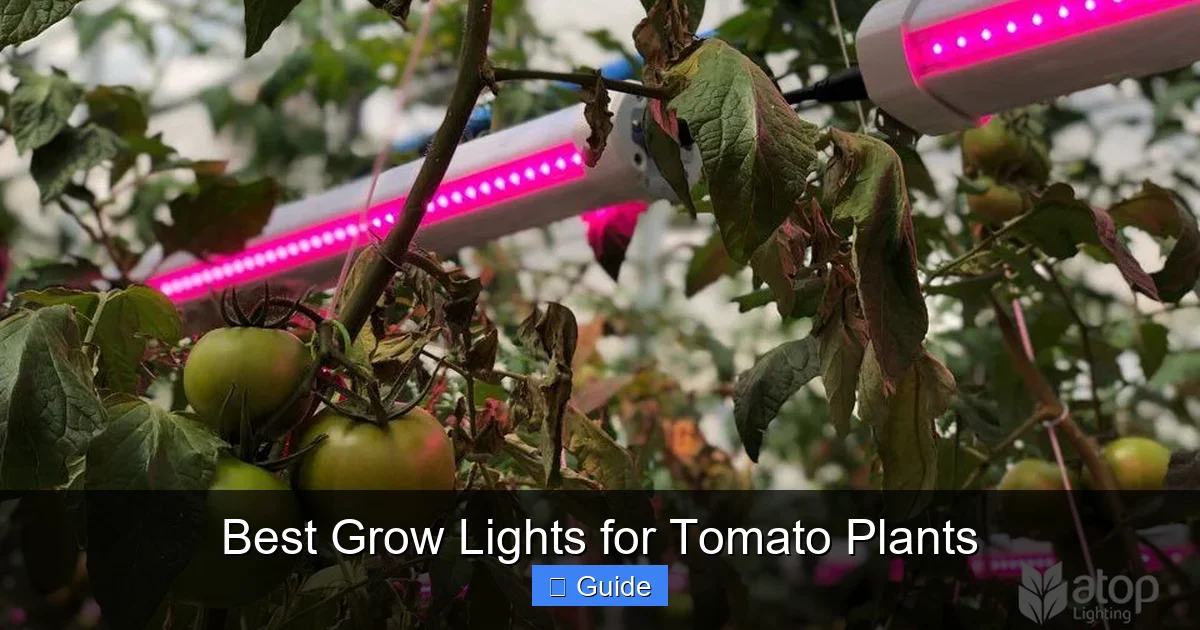
Best Grow Lights for Tomato Plants
Growing tomatoes indoors? The right grow light makes all the difference between leggy seedlings and heavy, vine-ripened fruit. This guide breaks down the best grow lights for tomato plants by type, budget, and growing space so you can harvest year-round.
There is nothing quite like the taste of a tomato plucked warm from the vine. But what if you don’t have a backyard? What if winter lasts six months where you live? That is where indoor growing comes in. And the single most important piece of gear you will buy is not the pot, not the soil, and not even the fertilizer. It is the light.
Choosing the best grow lights for tomato plants can feel overwhelming. You see terms like PAR, PPFD, Kelvin, and full-spectrum thrown around. You see panels, bars, bulbs, and fixtures ranging from twenty dollars to two thousand. I have been there. I have burned seedlings with cheap blurple lights. I have watched determinate varieties stretch into spindly messes because I underestimated their hunger for photons. This guide is the resource I wish I had when I started. We will cut through the jargon, look at real-world performance, and match the right light to your specific setup.
Key Takeaways
- Full-spectrum LED lights are the top choice: They mimic natural sunlight, run cool, and use less electricity than older technologies.
- Tomatoes need high light intensity: Aim for 400-600 µmol/m²/s during flowering and fruiting for the best yields.
- Light duration matters as much as intensity: Provide 14-18 hours of light daily for vegetative growth and 12-14 hours for fruiting.
- Distance from canopy is critical: Keep LEDs 12-24 inches above plants; adjust as tomatoes grow to prevent burning or stretching.
- Wattage alone doesn’t tell the whole story: Look at PPFD (photosynthetic photon flux density) and spectrum charts, not just watts.
- Heat management saves your crop: Even efficient LEDs produce some heat; good airflow prevents stress and disease.
- Budget-friendly options exist: Quality full-spectrum LED panels start under $100 and can handle a small tomato garden.
Quick Answers to Common Questions
How many hours of light do indoor tomato plants need?
Tomato plants need 16-18 hours of light during vegetative growth and 12-14 hours during flowering and fruiting. They require a dark period for proper hormone regulation and stress recovery.
What color spectrum is best for tomato plants?
A full-spectrum white light (3000K-4000K) with added 660nm deep red diodes is ideal. This provides the blue light for stocky growth and strong red/far-red for flowering and fruit development.
How far should LED grow lights be from tomato plants?
Keep LED grow lights 12-18 inches above the canopy during vegetative growth and 12-16 inches during flowering. Adjust based on plant response — raise if leaves curl or bleach, lower if stems stretch.
Can I grow tomatoes with regular LED shop lights?
Regular shop lights (4000K-5000K) work for seedlings and micro-dwarf varieties but lack the intensity and red spectrum needed for full-size fruiting tomatoes. Dedicated grow lights deliver 3-5x the usable PPFD.
Do tomato plants need a dark period?
Yes, tomatoes are day-neutral but require a dark period (6-12 hours) for proper respiration, hormone balance, and stress recovery. Continuous 24-hour light causes chlorosis and reduces yields.
📑 Table of Contents
- Why Tomatoes Are Uniquely Demanding
- Understanding Grow Light Metrics That Actually Matter
- Types of Grow Lights: Pros, Cons, and Best Uses
- Top Picks: Best Grow Lights for Tomato Plants by Category
- Matching Light to Your Growing Style
- Setup, Safety, and Daily Management
- Common Mistakes and How to Avoid Them
- Budget Breakdown: What to Expect
- Advanced Tips for Maximum Yield
- Frequently Overlooked: The Human Factor
- Conclusion
Why Tomatoes Are Uniquely Demanding
Tomatoes are not lettuce. They are not herbs. They are heavy-feeding, sun-worshipping fruit factories. In nature, they evolved in the high-light environments of western South America. Their genetics expect intense, direct sun for ten to fourteen hours a day. When you bring them indoors, you are asking a machine to replace a nuclear fusion reactor ninety-three million miles away. That is a tall order.
The Science of Light Hunger
Photosynthesis in tomatoes peaks at much higher light intensities than leafy greens. Lettuce saturates around 200-300 µmol/m²/s (micromoles per square meter per second). Tomatoes keep climbing. During the vegetative stage, they want 300-400 µmol/m²/s. Once they flower and set fruit, that demand jumps to 500-700 µmol/m²/s or even higher for indeterminate varieties pushing heavy yields. If your light cannot deliver those numbers at the canopy level, you get leggy stems, poor fruit set, blossom drop, and bland flavor.
Photoperiod Sensitivity
Tomatoes are day-neutral plants, meaning they do not require a specific night length to flower. However, they do need a rest period. Continuous twenty-four-hour light causes physiological stress, leading to chlorosis (yellowing) and reduced yields. The sweet spot is typically sixteen to eighteen hours on for vegetative growth, dropping to twelve to fourteen hours once fruiting begins. A good timer is not optional. It is essential.
Understanding Grow Light Metrics That Actually Matter
Marketing loves watts. Watts are easy to print on a box. But watts measure electricity consumption, not plant food. To shop smart, you need to speak the language of plant lighting.
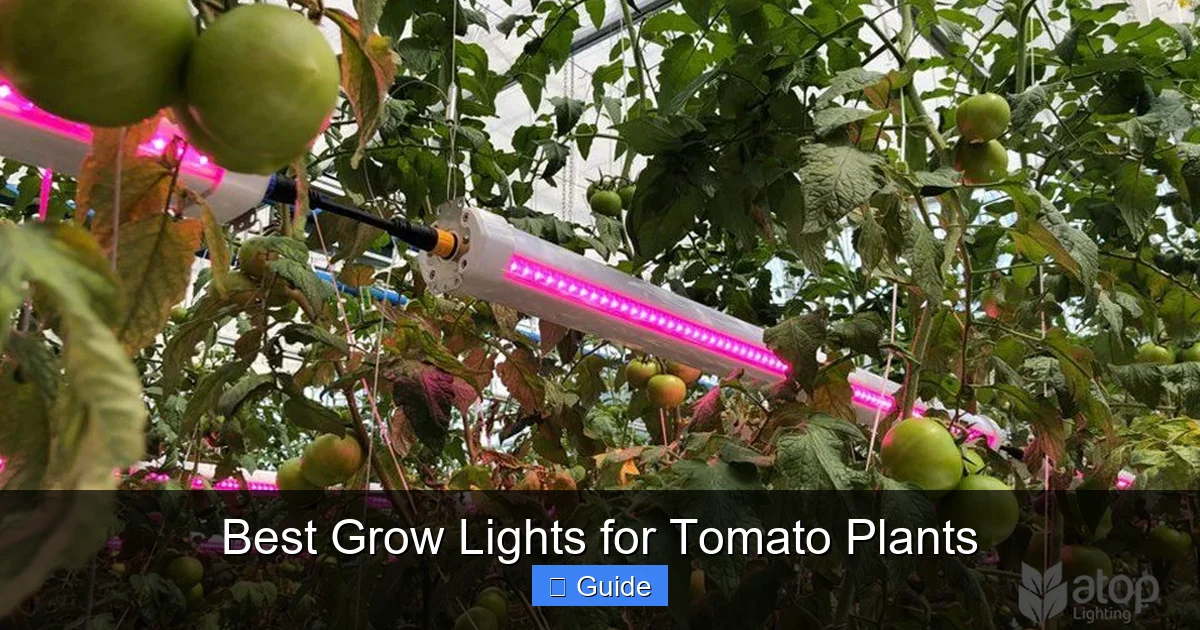
Visual guide about Best Grow Lights for Tomato Plants
Image source: atophort.com
PPFD: The Number to Watch
Photosynthetic Photon Flux Density (PPFD) measures how many photosynthetically active photons actually hit a square meter of your canopy every second. Unit: µmol/m²/s. This is the single most useful spec for comparing best grow lights for tomato plants. A light claiming “1000W equivalent” but delivering 150 µmol/m²/s at eighteen inches will grow you a salad, not a beefsteak. Look for manufacturers who publish PPFD maps — grids showing intensity at various distances and positions across the coverage area.
Spectrum: Beyond “Full Spectrum”
“Full spectrum” is a marketing term, not a standard. What you want is a spectrum heavy in red (600-700nm) for flowering and fruiting, with enough blue (400-500nm) to keep stems stocky and leaves thick. Green and far-red (700-750nm) penetrate deeper into the canopy, driving photosynthesis in lower leaves. Quality white LEDs (3000K-4000K) with added 660nm red diodes are currently the gold standard. Avoid “blurple” (heavy blue/red only) panels unless budget is extremely tight. They work, but canopy penetration and visual inspection are poor.
Efficacy: µmol/J
This tells you how efficiently the fixture turns electricity into usable light. Higher is better. Top-tier LEDs now exceed 2.7 µmol/J. Cheap panels hover around 1.0-1.5 µmol/J. Over a year of sixteen-hour days, that difference adds up to real money on your electric bill — and more heat to manage.
Coverage Area vs. Hanging Height
A light’s footprint shrinks as you raise it. Intensity drops by the inverse square law. A fixture covering 3×3 feet at twelve inches might only give you usable PPFD over 2×2 feet at twenty-four inches. Always check the PPFD map at your planned hanging height. For tomatoes, you will be raising the light as plants grow. Plan for the mature canopy height.
Types of Grow Lights: Pros, Cons, and Best Uses
Three main technologies dominate the market. Each has a place depending on your space, budget, and goals.
LED (Light Emitting Diode) — The Modern Standard
LEDs have won. They run cooler, last fifty thousand hours or more, offer tunable spectra, and have the highest efficacy. Within LEDs, you have two main form factors.
Quantum Boards & Spider Fixtures
These use hundreds of mid-power diodes (usually Samsung LM301H or similar) spread over a large aluminum heatsink. They deliver incredibly even coverage, run passively cooled (silent), and have top-tier efficacy (2.7-3.0 µmol/J). Brands like HLG, Spider Farmer, and Mars Hydro dominate this space. They are ideal for tents and dedicated grow rooms. A 300-480 watt quantum board covers a 3×3 or 4×4 foot area beautifully for tomatoes.
COB (Chip on Board) & High-Power Diode Fixtures
These concentrate light into intense points. They penetrate deep into dense canopies better than quantum boards but create hotspots and require active cooling (fans). They can be cheaper per watt but are louder and less even. Good for tall, single-plant setups or supplemental side lighting.
LED Bars & Strips
Long, narrow fixtures. Excellent for vertical racks, shelving units, or supplementing greenhouse edges. Less ideal as sole source for wide tomato canopies unless you use multiple bars.
Fluorescent (T5 HO, T8, CFL) — The Budget Entry
High-output T5 fixtures are the classic seed-starting workhorse. They are cheap upfront, run cool enough to keep inches from seedlings, and provide decent blue-heavy spectrum for vegetative growth. But their efficacy is low (~0.9-1.1 µmol/J), bulbs degrade fast (replace yearly), and they simply cannot deliver the 500+ µmol/m²/s tomatoes need for heavy fruiting without stacking four to six tubes inches from the canopy. Use them for starts. Graduate to LED for production.
HID (High-Intensity Discharge) — The Old Guard
Metal Halide (MH) for veg, High Pressure Sodium (HPS) for flower. These were the commercial standard for decades. They pump out massive intensity and deep canopy penetration. A 600W or 1000W HPS will out-yield almost any LED per watt if you can manage the heat. And that is the rub. They run hot. Very hot. You need serious ventilation, air-cooled hoods, and headroom. Ballasts hum. Bulbs need replacing every 1-2 grows. Electricity costs are double a comparable LED. Today, HID makes sense only for growers with existing infrastructure, high ceilings, and cheap electricity.
Top Picks: Best Grow Lights for Tomato Plants by Category
Enough theory. Here are specific recommendations based on real grower feedback, third-party testing, and value.
Best Overall: HLG 300L R-Spec (or 350R/600R for Larger Spaces)
Horticulture Lighting Group (HLG) built their reputation on quality components and honest specs. The 300L R-Spec uses Samsung LM301H diodes with 660nm deep red added. It pulls 270 watts at the wall, delivers 2.8 µmol/J, and covers a 3×3 foot veg area or 2.5×2.5 foot flower area with PPFD numbers that hit 600-800 µmol/m²/s at canopy. Passive cooling means zero noise. Five-year warranty. Made in USA. It is not the cheapest, but cost-per-harvest it wins. For a 4×4 tent, step up to the 600R (two boards on a larger heatsink).
Best Value Quantum Board: Spider Farmer SF-4000
Spider Farmer brought quantum board pricing down. The SF-4000 draws 450 watts, uses Samsung LM301B diodes (still excellent), adds 660nm and 730nm IR, and covers a solid 4×4 foot veg / 3×3 foot flower footprint. PPFD maps show 700+ µmol/m²/s center at twelve inches. It includes a dimmer and daisy-chain capability. Fanless. Three-year warranty. Often $150-200 less than comparable HLG. A tremendous value for serious indoor tomato growers.
Best Bar-Style LED: Mars Hydro FC-4800 / FC-6500
Mars Hydro’s FC series uses Samsung LM301H diodes on aluminum bars. The FC-4800 (480W) and FC-6500 (650W) fold for shipping and unfold to cover 4×4 and 5×5 feet respectively. Bar style gives exceptional uniformity — edge-to-edge PPFD variance is under 20%. They run cool, dimmable, daisy-chainable, and the detached driver can be mounted outside the tent to reduce heat load. Five-year warranty. Great for low-ceiling spaces where you need to hang close.
Best Budget Panel: Viparspectra P2000 / P4000
If you are just starting and want a single light for a 2×4 or 3×3 area, the P2000 (200W) and P4000 (400W) are hard to beat. They use Sosen drivers and decent mid-power diodes. Spectrum is 3000K+5000K+660nm+730nm. Efficacy around 2.5 µmol/J. They have a dimmer knob and daisy chain. Two-year warranty. Not as refined as HLG or Spider Farmer, but they grow excellent tomatoes for half the price. Perfect for a first tent.
Best for Small Spaces / Single Plant: Sansi 36W / 60W Full Spectrum Bulb
Growing one determinate tomato in a 5-gallon fabric pot by a sunny window? A high-quality screw-in bulb can supplement or even carry the load. Sansi uses ceramic heat sink tech and quality diodes to hit 2.0+ µmol/J in a standard E26 base. The 36W covers ~2×2 feet at twelve inches. The 60W covers ~3×3. No fan. Silent. Screws into a desk lamp or clamp fixture. Great for patio tomatoes brought inside for winter.
Best T5 Fluorescent: Hydrofarm Agrobrite T5 4-Foot 4-Lamp or 8-Lamp
If you are committed to fluorescent for seed starting or micro-dwarf varieties, get high-output (HO) T5. The 4-lamp 4-foot fixture over a 2×4 shelf gives enough light for strong seedlings and small fruiting plants like ‘Micro Tom’ or ‘Red Robin’. Run 6500K tubes for veg, swap to 3000K or mix for flower. Bulbs are cheap and everywhere. Just know the ceiling.
Matching Light to Your Growing Style
The best grow lights for tomato plants depend heavily on how you grow.
Seed Starting & Early Veg (Weeks 1-4)
Seedlings need gentle but sufficient light. 150-250 µmol/m²/s. Blue-heavy spectrum (5000K-6500K) prevents stretching. T5 HO fluorescents shine here. So do dimmed LEDs at twenty-four to thirty inches. Run eighteen hours on. Keep the canopy close — two to four inches for fluorescents, twelve to eighteen for LEDs. A heat mat helps germination but remove it once cotyledons appear.
Vegetative Growth (Weeks 4-8+)
Ramp intensity to 300-450 µmol/m²/s. Shift spectrum toward 4000K (balanced white with added red). Lower lights to twelve to eighteen inches. Increase airflow — stronger light drives faster transpiration. Feed nitrogen. This is when you build the factory (leaves and stems) that will later produce fruit. Do not rush flowering. Indeterminate tomatoes need a big frame.
Flowering & Fruiting (Week 8 to Harvest)
This is the money stage. Intensity 500-700+ µmol/m²/s. Spectrum 3000K-3500K with strong 660nm red. Photoperiod drops to twelve to fourteen hours. Lights at twelve to sixteen inches. Watch for light stress: leaves tacoing (cupping upward), bleaching (white tips), or curling. If you see it, raise the light or dim it. Support heavy trusses. Keep humidity 50-60% to prevent blossom end rot and powdery mildew.
Micro-Dwarf & Patio Varieties
Varieties like ‘Tiny Tim’, ‘Micro Tom’, ‘Orange Hat’, and ‘Vilma’ stay under eighteen inches. They need less vertical space but the same intensity per leaf area. A 100-150 watt quantum board or two 36W Sansi bulbs over a 2×2 foot shelf grows four to six plants beautifully. Perfect for apartments.
Indeterminate / Heirloom in Tents
These vines hit the ceiling. You need a 4×4 or 5×5 tent, a 450-650 watt LED (Spider Farmer SF-4000, Mars FC-4800, HLG 600R), and serious trellising (Florida weave, tomato cages, or string trellis). Lower the light as the canopy rises. Defoliate lower leaves once shaded to improve airflow and redirect energy. Expect 10-20+ lbs per 4×4 cycle with good technique.
Setup, Safety, and Daily Management
Buying the light is step one. Using it right is step two through infinity.
Hanging & Height Adjustment
Use ratchet hangers (rope ratchets). They let you move the light up or down in seconds with one hand. Start high. Lower gradually. Measure PPFD with a cheap quantum meter (Apogee SQ-520 or similar) if you get serious. Otherwise, watch the plants. Stretching = too high / too weak. Bleaching/tacoing = too low / too strong. Happy leaves are flat, perpendicular to the light, deep green.
Heat & Airflow
Even efficient LEDs add heat to a closed tent. You need an inline fan exchanging the tent volume every 1-3 minutes. Oscillating clip fans inside keep air moving through the canopy. This strengthens stems, prevents microclimates, and reduces disease. Leaf temperature should stay within 2-3°F of air temperature. If leaves feel hot, raise the light or increase exhaust.
Light Schedules & Timers
Use a digital timer with battery backup. Mechanical timers fail. Set it and forget it. Consistency triggers hormonal responses. Interrupted dark periods (light leaks) can revert flowering tomatoes to veg or cause hermaphroditism. Tape over indicator LEDs on power strips. Make the tent truly dark during lights-off.
Cleaning & Maintenance
Dust on diodes or reflectors cuts output 5-15%. Wipe boards with a microfiber cloth and isopropyl alcohol (power off, cool) monthly. Check fan intakes for dust. Replace T5 bulbs annually — they lose 20-30% output before they visibly dim.
Electrical Safety
Grow lights draw continuous high wattage. Use heavy-duty power strips rated for 15A. Do not daisy-chain strips. Run dedicated circuits if pulling >1200W. Keep drivers and connections dry. Use drip loops on cords so water runs away from outlets. A GFCI outlet or inline GFCI is cheap insurance.
Common Mistakes and How to Avoid Them
I have made all of these. Learn from my scars.
Mistake 1: Buying by “Wattage Equivalent” Claims
“1000W equivalent!” pulls 120 watts at the wall and delivers 200 µmol/m²/s. Useless for tomatoes. Ignore equivalent claims. Look at actual draw, PPFD map, and efficacy.
Mistake 2: Hanging Too High “To Be Safe”
Seedlings stretch into weak, pale noodles. Tomatoes want intensity. Start at twenty-four inches for new seedlings under LED. Lower every few days. If leaves are not flat and horizontal, you are too high.
Mistake 3: Running 24/0 Light Cycle
Tomatoes need dark. Continuous light causes oxidative stress, chlorosis, and lower total yield. Eighteen on / six off for veg. Twelve on / twelve off for flower.
Mistake 4: Ignoring Side Lighting
Top light only hits the top. Lower leaves yellow and drop. Add 20-30W LED bars vertically on tent walls or use a light mover. Or defoliate strategically. But do not let the bottom third of the plant starve.
Mistake 5: Cheapening Out on the Timer or Fan
A $5 timer failure cooks a crop in hours. A $15 fan failure spikes humidity and breeds botrytis. Spend the extra ten bucks on quality controls.
Budget Breakdown: What to Expect
Let’s talk real numbers for a 3×3 foot tomato setup (two to three indeterminate plants).
- Light: $180-350 (Viparspectra P2000 to HLG 300L R-Spec)
- Tent: $80-150 (3x3x6 or 3x3x7)
- Inline Fan + Carbon Filter + Ducting: $120-200
- Clip Fans (2x): $30-50
- Timer, Hangers, Power Strip: $30
- Pots, Soil, Nutrients, Trellis: $60-100
- Total Startup: $500-900
- Monthly Electric (18h veg / 12h flower avg, $0.14/kWh): $15-30
First harvest pays for the gear if you grow varieties that retail for $4-6/lb. After that, it is nearly pure profit — and the tomatoes are infinitely better than store-bought.
Advanced Tips for Maximum Yield
Once you have the basics dialed, these moves separate good harvests from great ones.
Light Movers
A light rail moves your fixture slowly back and forth. This eliminates hotspots, increases effective coverage by 30%, and mimics the sun’s arc. A 3-foot rail on a 4×4 tent with a 480W bar light is a game changer. Cost: ~$150. Worth it for serious growers.
Far-Red Supplement at End of Day
Adding 730nm far-red for fifteen to thirty minutes at lights-off triggers the shade avoidance response, accelerating flowering and increasing internode stretch (useful for tight spaces) or improving fruit set in some varieties. Many modern fixtures (Spider Farmer, Mars Hydro) have built-in IR diodes on a separate channel.
Dynamic Spectrum Tuning
If your light has separate veg/bloom channels or full dimming per spectrum, run higher blue (5000K) early veg, shift to 4000K mid-veg, then 3000K+660nm for flower. This mimics seasonal sun and optimizes morphology at each stage.
CO2 Enrichment
At PPFD >600 µmol/m²/s, CO2 becomes the limiting factor. Ambient is ~420 ppm. Raising to 1000-1200 ppm with a burner or tank + controller can boost photosynthesis 20-30%. Only worth it in a sealed room with AC. Not for beginners.
Frequently Overlooked: The Human Factor
You live with this light. Consider:
- Noise: Fanless LED + quality inline fan = whisper quiet. Cheap blurple panels with screaming fans + rattling ducting = annoyance.
- Light Leak: Tent zippers that don’t seal, bright power LEDs, gaps at duct ports. These ruin your dark period and leak light into your living space.
- Aesthetics: White spectrum (3000K-4000K) looks like nice room lighting. Blurple looks like a spaceship. Your partner/roommates will have opinions.
- Inspection: Under white light, you see true leaf color, pests, deficiencies instantly. Under blurple, everything looks purple. You miss problems.
Conclusion
Growing tomatoes indoors is one of the most rewarding gardening projects you can undertake. The flavor of a vine-ripened ‘Brandywine’ or ‘Sungold’ in January is a revelation. But the light is the engine. Skimp there, and everything else — the best soil, the perfect nutrients, the careful pruning — cannot compensate.
For almost every home grower today, a full-spectrum white LED with added 660nm red, high efficacy (2.5+ µmol/J), passive cooling, and honest PPFD maps is the right choice. Match the fixture size to your canopy footprint. Hang it on ratchets. Run it on a timer. Move air. Watch the plants. They will tell you everything you need to know.
Start with a quality 300-450 watt quantum board or bar light for a 3×3 or 4×4 space. Brands like HLG, Spider Farmer, and Mars Hydro have proven track records. If budget is tight, Viparspectra and Sansi deliver surprising performance. Avoid the blurple hype. Avoid the “1000W equivalent” traps.
Your first indoor tomato harvest will change how you think about food. It starts with photons. Choose them well.
Frequently Asked Questions
What is the minimum wattage needed for fruiting tomatoes?
For a single fruiting tomato plant, aim for at least 150-200 actual watts of high-efficacy LED (2.5+ µmol/J) covering a 2×2 foot area. For multiple plants in a 3×3 or 4×4 space, 300-450 watts is the practical minimum for good yields.
Can I use one grow light for both seedlings and fruiting tomatoes?
Yes, a dimmable full-spectrum LED works for all stages. Run it at 30-50% power and 24-30 inches high for seedlings. Increase to 75-100% and lower to 12-18 inches as plants mature. The spectrum stays appropriate throughout.
How do I know if my grow light is strong enough?
Watch the plants. Stocky stems, flat horizontal leaves, short internodes, and deep green color mean adequate light. Leggy stretching, pale leaves, wide internodes, and slow growth mean you need more intensity or longer duration.
Are expensive grow lights worth it for tomatoes?
Higher-end lights (HLG, Spider Farmer) offer better efficacy, spectrum, uniformity, longevity, and warranty. Over 3-5 years, they cost less per harvest in electricity and replacement costs. For a serious grower, yes. For a trial run, a budget Viparspectra or Sansi is fine.
What size grow tent do I need for two tomato plants?
A 3×3 foot tent (minimum 6 feet tall) fits two indeterminate tomato plants with proper trellising. A 4×4 tent gives more working room and better airflow. Micro-dwarf varieties can fit four to six plants in a 2×2 or 2×4 space.
How much electricity does a tomato grow light use per month?
A 300-watt LED running 18 hours/day for veg and 12 hours/day for flower averages ~135 kWh/month. At $0.14/kWh, that is about $19/month. A 600-watt setup doubles it. Efficient LEDs cost half what HID would for the same output.