Grow Light for Peace Lily
A grow light for peace lily plants can transform struggling specimens into lush, blooming beauties. This guide covers everything you need to know about selecting, positioning, and using artificial lighting to keep your peace lily healthy year-round.
If you have ever owned a peace lily, you know the frustration. Those gorgeous white blooms fade. The deep green leaves turn pale. The plant stretches toward the window like it is begging for more sun. You water it right. You fertilize on schedule. But something is still missing. That missing piece is often light.
A grow light for peace lily plants can change everything. These tropical understory plants evolved on rainforest floors. They get dappled sunlight filtered through dense canopy layers. In our homes, they often sit in corners far from windows. Winter days are short. Cloudy weeks stretch on. The result? Weak growth, fewer flowers, and a plant that survives but does not thrive.
This guide walks you through everything about choosing and using a grow light for peace lily success. We cover light science in simple terms. We compare light types. We explain setup, timing, and troubleshooting. By the end, you will know exactly how to give your peace lily the light it craves.
Key Takeaways
- Peace lilies need bright indirect light: They tolerate low light but thrive and bloom with 10-12 hours of quality illumination daily.
- LED grow lights are the top choice: Energy-efficient, cool-running, and available in full-spectrum options perfect for peace lily growth stages.
- Distance matters more than intensity: Position lights 12-18 inches above the plant to prevent leaf burn while providing adequate coverage.
- Consistent timing beats sporadic exposure: Use a timer to maintain 12-14 hour photoperiods for optimal flowering and foliage development.
- Watch for light stress signals: Yellowing leaves mean too much light; leggy growth and no blooms indicate too little.
- Full spectrum beats single-color lights: Peace lilies need both blue light for foliage and red light for flowering triggers.
- Supplement don’t replace natural light: A grow light for peace lily works best alongside window light rather than in total darkness.
Quick Answers to Common Questions
How many hours of grow light does a peace lily need daily?
Peace lilies need 12-14 hours of grow light daily for optimal growth and flowering. Use a timer for consistency.
What color grow light is best for peace lily?
Full spectrum white light (4000K-5000K) with added 660nm red diodes is best. It provides balanced blue for foliage and red for flowering.
How far should a grow light be from a peace lily?
Position LED grow lights 12-18 inches above the canopy. Fluorescent lights can be closer at 6-12 inches. Adjust based on plant response.
Can I leave a grow light on 24 hours for peace lily?
No. Peace lilies require a dark period of at least 8-10 hours for respiration and flowering signals. Never exceed 16 hours of light.
Will a regular LED bulb work as a grow light for peace lily?
Regular LED bulbs lack the intensity and spectrum for robust growth. They may maintain a plant but won’t drive flowering. Use horticultural LEDs instead.
📑 Table of Contents
- Why Your Peace Lily Might Need a Grow Light
- Understanding Peace Lily Light Requirements
- Types of Grow Lights That Work Best
- How to Choose the Right Grow Light for Peace Lily
- Setting Up Your Grow Light System
- Common Mistakes to Avoid
- Advanced Tips for Spectacular Results
- Troubleshooting Light-Related Issues
- Conclusion
Why Your Peace Lily Might Need a Grow Light
Signs Your Plant Is Starving for Light
Peace lilies communicate clearly when they need more light. The most obvious sign is a lack of flowers. A healthy peace lily in good light produces those iconic white spathes regularly. If yours has not bloomed in months, light is the first suspect.
Leggy growth is another tell. The stems stretch long and thin between leaves. The plant looks sparse and rangy instead of full and bushy. This is etiolation. The plant is desperately reaching for a light source.
Small leaves signal trouble too. New growth emerges smaller than older leaves. The color may be lighter green or even yellowish. The plant cannot produce enough chlorophyll without adequate photons.
Slow or stalled growth rounds out the symptoms. Peace lilies should put out new leaves regularly during growing season. If yours sits unchanged for weeks, it likely needs more light energy.
Why Window Light Often Falls Short
Many plant owners assume a bright room is enough. But human eyes adapt to low light remarkably well. A room that feels bright to you may deliver only 100-200 foot-candles. Peace lilies want 1,000-2,000 foot-candles for robust growth and flowering.
Window direction matters enormously. North-facing windows in the northern hemisphere provide the least light. East windows offer gentle morning sun. South and west windows give the most intensity but can scorch leaves in summer.
Seasonal changes compound the problem. Winter sun is weaker and days are shorter. A spot that works in July may fail in January. Trees outside leaf out in spring, blocking light that reached the window all winter.
Window glass itself filters light. Modern low-E coatings block UV and infrared. Screens cut intensity by 30-50 percent. Dirty windows reduce transmission further. Your plant gets a fraction of outdoor light levels.
Benefits of Supplemental Lighting
A grow light for peace lily plants delivers consistent, controllable illumination. You decide the intensity. You control the duration. You choose the spectrum. The plant gets what it needs regardless of weather or season.
Supplemental lighting extends the growing season. Your peace lily can grow and bloom year-round. No more winter dormancy. No more waiting for spring to see new leaves.
You can place the plant anywhere. That dark corner in the hallway? The bathroom with a tiny window? The office cubicle? A grow light makes these spots viable. You are no longer tethered to window proximity.
Flower production increases dramatically. Peace lilies bloom in response to light intensity and photoperiod. Proper artificial lighting triggers more frequent and larger blooms. The white spathes last longer too.
Understanding Peace Lily Light Requirements
Natural Habitat Clues
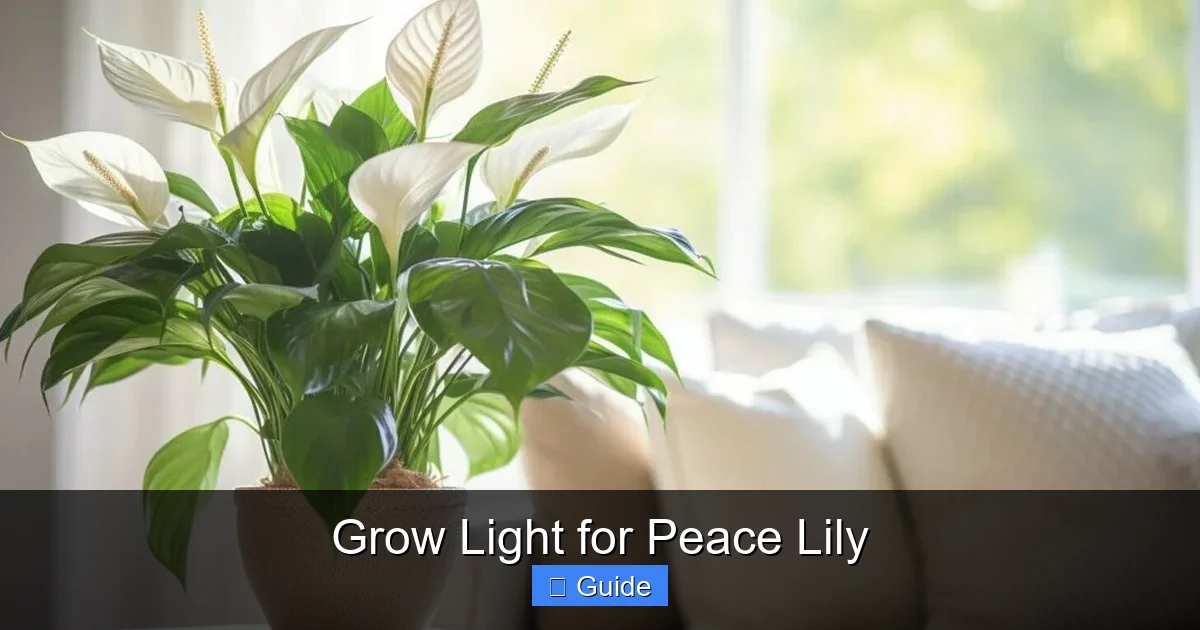
Peace lilies (Spathiphyllum species) originate in tropical Americas and Southeast Asia. They grow on forest floors beneath dense canopy. The light there is bright but filtered. Direct sun rarely touches the leaves. Yet the ambient light is strong and consistent year-round.
Visual guide about Grow Light for Peace Lily
Image source: bonsaimary.com
This tells us two things. First, peace lilies want bright light. Second, they hate direct sun. The dappled forest light is the sweet spot. Recreating this indoors means bright indirect light or well-designed artificial light.
In their native range, day length varies little. Twelve hours of light, twelve hours of dark, every day of the year. This consistency drives their growth and flowering cycles. Our temperate seasons disrupt this rhythm.
Measuring Light for Plants
Plant light is measured in several ways. Foot-candles and lux measure human-visible light. But plants use different wavelengths. Photosynthetically Active Radiation (PAR) measures light plants actually use (400-700 nanometers).
Photosynthetic Photon Flux Density (PPFD) goes further. It measures PAR photons hitting a square meter per second. Units are micromoles per square meter per second (µmol/m²/s). This is the gold standard for grow lighting.
For peace lilies, target PPFD of 100-300 µmol/m²/s. This equals roughly 1,000-3,000 foot-candles. Lower levels sustain the plant. Higher levels drive flowering. A simple lux meter helps if you lack a PAR meter. Multiply lux by 0.0185 to estimate PPFD for white LEDs.
Daily Light Integral Matters
Instant intensity is only half the story. Daily Light Integral (DLI) measures total photons delivered in a day. Units are moles per square meter per day (mol/m²/day). Peace lilies need DLI of 6-12 for good growth.
DLI equals PPFD times hours of light times 0.0036. Example: 200 µmol/m²/s for 12 hours gives 8.6 mol/m²/day. That sits in the sweet spot. Fourteen hours at 150 µmol/m²/s gives 7.6. Both work.
This means you can trade intensity for duration. Lower light for longer hours. Higher light for shorter hours. But do not exceed 16 hours. Plants need dark periods for respiration and flowering signals.
Light Quality and Spectrum
Plants respond to specific wavelengths. Blue light (400-500 nm) drives compact growth and leaf development. Red light (600-700 nm) triggers flowering and stem elongation. Green light (500-600 nm) penetrates deeper into leaf tissue.
Peace lilies need both blue and red. Full spectrum white LEDs provide this balance. They mimic sunlight with peaks in blue and red regions. The result is natural-looking light that grows great plants.
Avoid pure red or pure blue lights. These create imbalanced growth. Pure blue makes leaves thick and dark but stunts the plant. Pure red causes excessive stretching and weak stems. Balance is key.
Types of Grow Lights That Work Best
LED Grow Lights: The Modern Standard
LED technology dominates the grow light market for good reason. Efficiency is unmatched. LEDs convert 40-50 percent of electricity into usable light. The rest becomes heat, but far less than older technologies.
Heat management is crucial for peace lilies. These plants dislike hot, dry air. LED fixtures run cool. You can place them closer without cooking leaves. This means higher intensity at the canopy without heat stress.
Lifespan exceeds 50,000 hours for quality LEDs. That is 11+ years at 12 hours daily. No bulb changes. No fading output. Consistent light for the life of the fixture.
Spectrum control is precise. Manufacturers tune diode mixes for specific plant needs. Full spectrum white LEDs with added 660nm red diodes are ideal for peace lilies. Some fixtures offer dimming and spectrum switching.
Fluorescent Lights: Budget Friendly Option
T5 high-output fluorescents remain popular. They cost less upfront than LEDs. Spectrum options include 6500K (cool white) for growth and 3000K (warm white) for flowering. Mixing tubes gives balanced light.
Heat output is moderate. Fixtures warm up but rarely burn leaves at proper distance. They work well for shelf setups with multiple plants. The long tubes cover wide areas evenly.
Downsides include shorter lifespan (20,000 hours), mercury content, and lower efficiency. Bulbs dim over time. You replace them every 1-2 years. Electricity costs run higher than LED equivalents.
Compact fluorescent lamps (CFLs) work for single plants. Screw into standard sockets. Look for 6500K “daylight” bulbs rated 23-42 watts actual draw. Keep very close (6-12 inches) for adequate intensity.
Why Avoid Incandescent and Halogen
Old-school bulbs fail as grow lights. They convert 90+ percent of energy to heat. The spectrum is heavy on red and infrared, weak on blue. Peace lilies under these lights stretch badly and burn easily.
Halogens are slightly better but still terrible. High heat. Poor spectrum. Short life. High operating cost. They belong in track lighting, not plant lighting.
HID Lights: Overkill for Peace Lilies
High Intensity Discharge (Metal Halide, High Pressure Sodium) lights serve commercial grows. They pump out massive light but also massive heat. They require ballasts, special fixtures, and ventilation. Completely unnecessary for a peace lily or two.
How to Choose the Right Grow Light for Peace Lily
Match Light to Your Space
Start with your setup. A single plant on a desk needs a small fixture. A shelf of plants needs a linear bar. A floor specimen needs a panel or pendant. Measure your coverage area before shopping.
Consider aesthetics. Some grow lights look industrial. Others blend with home decor. White-housing LEDs with diffuse lenses look like regular lamps. Purple “blurple” lights scream grow op. Choose what fits your space.
Mounting options matter. Clamp lights attach to shelves. Pendant lights hang from ceilings. Floor stands offer flexibility. Under-cabinet bars tuck away neatly. Pick a form factor that works for your location.
Key Specifications to Compare
PPFD at your mounting height is the number that matters. Manufacturers should provide PPFD maps at various distances. If they only give watts or lumens, be skeptical. Watts measure electricity, not plant light. Lumens measure human brightness.
Look for actual draw watts, not “equivalent” watts. A “1000W equivalent” LED may draw 100 actual watts. The actual draw determines your electricity cost and heat output.
Spectrum specification should list color temperature (Kelvin) or provide a spectral graph. 4000K-5000K white light with added 660nm red is ideal. Avoid fixtures listing only blue and red diodes without white fill.
Coverage area should match your plant footprint. A 2×2 foot light covers one large peace lily or several small ones. Measure the light footprint at your working distance.
Budget vs Performance Tiers
Entry level ($20-50): Clip-on LED bars, small panels, CFL bulbs. Good for 1-2 small plants. Limited intensity. May lack full spectrum. Fine for maintenance, weak for flowering.
Mid range ($50-150): Quality LED panels, T5 fixtures, COB lights. Strong output. Full spectrum. Dimmable options. Covers 2×2 to 3×3 feet. Best value for serious hobbyists.
Premium ($150+): High-end quantum boards, programmable spectra, app control, commercial build quality. Overkill for most peace lily growers. Great if you expand to larger collections.
Top Features Worth Paying For
Dimming capability lets you adjust intensity without moving the light. Critical for acclimating plants. Also useful as plants grow taller.
Timer built-in or smart plug compatible. Automation prevents human error. Your plant gets consistent photoperiods even when you travel.
Passive cooling (heatsinks) beats fans. Fans fail. They make noise. They collect dust. Solid aluminum heatsinks last forever silently.
Water resistance (IP65+) protects against humidity and splashes. Peace lilies like humidity. You will mist them. Water-resistant fixtures survive.
Setting Up Your Grow Light System
Finding the Perfect Distance
Distance controls intensity. The inverse square law applies. Double the distance, quarter the intensity. Start with manufacturer recommendations. Typically 12-18 inches for mid-range LEDs. 6-12 inches for fluorescents and small LEDs.
Test with your hand. Hold your hand at plant level under the light. Count to ten. If it feels warm, the light is too close. Peace lily leaves are thinner than your hand. They burn faster.
Watch the plant for two weeks. New growth should be compact spacing. Leaves horizontal, not cupping up or down. Color deep green. No brown tips or bleached patches. Adjust distance based on response.
Raise the light as the plant grows. Maintain consistent PPFD at canopy level. A light that was perfect at 12 inches may be too strong at 6 inches when the plant gains height.
Photoperiod Programming
Peace lilies want 12-14 hours of light daily. Twelve hours mimics their native day length. Fourteen hours pushes faster growth and more blooms. Do not exceed 16 hours. The dark period is biologically necessary.
Use a timer. Mechanical timers cost $5. Digital timers offer more precision. Smart plugs let you control from your phone. Set it and forget it. Consistency beats perfection.
Consider a dawn/dusk ramp if your light supports it. Gradual on/off reduces shock. Mimics natural transitions. Not essential but nice for sensitive plants.
Seasonal adjustments are optional. Some growers reduce to 10-11 hours in winter to mimic nature. Others keep 12-14 year-round for constant growth. Both work. Consistency matters more than the exact number.
Supplemental vs Sole Source Lighting
Supplemental lighting adds to window light. Place the plant near a window. Run the grow light 8-10 hours to extend the day. This works well for east or west windows.
Sole source lighting replaces sunlight entirely. The plant lives in a dark corner. The grow light provides 100 percent of photons. Run 12-14 hours. This gives you total control but requires adequate intensity.
Most home growers use a hybrid. Bright window spot plus 6-8 hours of supplemental light in winter. Full artificial light in windowless rooms. Match your approach to your space.
Creating the Right Environment
Light drives photosynthesis. But photosynthesis needs water, CO2, and nutrients. A grow light for peace lily increases water demand. Check soil more frequently. The top inch should dry between waterings, not the whole pot.
Humidity becomes more important under lights. Transpiration increases. Aim for 50-60 percent humidity. Group plants. Use pebble trays. Run a humidifier. Misting helps briefly but evaporates fast.
Air circulation prevents fungal issues. A small clip fan on low keeps air moving. Strengthens stems too. Do not blow directly on leaves. Indirect breeze is perfect.
Fertilize more often with more light. More photosynthesis means more nutrient demand. Half-strength balanced fertilizer every 2-3 weeks during active growth. Flush monthly to prevent salt buildup.
Common Mistakes to Avoid
Too Much Light Too Fast
Enthusiastic growers often blast new lights at full power. The peace lily, accustomed to dim corners, gets scorched. Leaves bleach white or develop brown crispy patches. Tips die back. The plant goes into shock.
Always acclimate. Start at 50 percent power or double the recommended distance. Run 8 hours daily. Increase intensity 10 percent every 3-4 days. Extend photoperiod by 30 minutes weekly. Full adaptation takes 2-3 weeks.
If you see stress signs, back off immediately. Reduce intensity. Shorten duration. Increase distance. The plant will recover if caught early. Severe burns mean lost leaves and months of recovery.
Wrong Spectrum Choices
Purple “blurple” lights (heavy red/blue) were early LED standard. They grow plants but make them hard to inspect. Pests, diseases, and nutrient issues hide under purple light. White full spectrum reveals true leaf color.
Some cheap LEDs have poor color rendering (CRI < 80). Colors look washed out. You miss early yellowing or spotting. Choose CRI 90+ for accurate plant monitoring.
Single-color lights fail peace lilies. Red-only causes weak, stretchy growth. Blue-only creates compact but stunted plants. The white spathe flowers need red light to initiate but blue light to develop properly.
Inconsistent Schedules
Plants are circadian organisms. They track day length precisely. Random on/off times confuse flowering signals. The plant cannot prepare for dark period metabolic shifts.
Manual switching fails. You forget. You sleep in. You stay out late. A $10 timer eliminates this entirely. Smart plugs add convenience. There is no excuse for irregular photoperiods.
Power outages happen. Short gaps (under 2 hours) rarely hurt. Long outages reset the clock. If power returns mid-dark-period, the plant gets unexpected light. Not catastrophic but not ideal. Battery backup timers exist for critical grows.
Neglecting the Dark Period
Some think more light equals more growth. They run lights 18, 20, even 24 hours. This backfires. Peace lilies need darkness for respiration, root growth, and flowering hormone production.
Continuous light causes oxidative stress. Chlorophyll breaks down faster than it rebuilds. Leaves yellow. Growth slows. The plant becomes susceptible to pests and disease.
Respect the night. Total darkness means total darkness. No night lights. No streetlight bleed. No phone screen glow. Cover the plant or use a grow tent if ambient light leaks in.
Ignoring Heat Buildup
Even LEDs produce heat. In enclosed spaces (grow tents, cabinets, shelves), heat accumulates. Temperature rises. Humidity drops. Vapor pressure deficit spikes. The plant transpires excessively.
Monitor temperature at canopy level. Ideal range 65-80°F (18-27°C). Above 85°F, peace lilies stress. Use a min/max thermometer. Check morning and evening.
Ventilation solves heat. A small fan exhausting warm air. Passive vents drawing cool air. Space between light and shelf. Do not trap heat above the canopy.
Advanced Tips for Spectacular Results
Light Movers for Even Coverage
Stationary lights create hot spots and shadows. Light movers slowly sweep the fixture across the canopy. Every leaf gets equal time at peak intensity. Stems grow straight instead of leaning.
Rail movers suit linear fixtures. Circular movers work for panels. Both increase effective coverage 30-50 percent. A 2×2 light on a mover covers 3×3 evenly. Great for multiple plants.
Side Lighting for Bushier Growth
Top lighting shades lower leaves. The plant grows tall and bare at the base. Adding vertical side bars illuminates lower foliage. This maintains full, bushy growth from soil to tip.
Simple clip-on LEDs on either side work. Run same schedule as top light. Lower intensity (50-100 µmol/m²/s) is fine. The goal is maintaining lower leaves, not driving top growth.
Far-Red for Flower Induction
Far-red light (700-750 nm) triggers shade avoidance and flowering responses. Some advanced fixtures include 730nm diodes. A 15-minute far-red burst at end of day can accelerate blooming.
This mimics sunset. The plant senses day ending. Phytochrome ratios shift. Flowering genes activate. Use sparingly. Too much far-red causes excessive stretching.
Measuring and Monitoring
Invest in a PAR meter if you get serious. The Apogee MQ-500 is the hobbyist standard. Takes guesswork out of placement. Lets you compare fixtures objectively. Costs $300+ but pays off in optimized growth.
Cheaper option: lux meter plus conversion. UNI-T UT383 or similar runs $30. Multiply lux by 0.0185 for white LED PPFD estimate. Good enough for relative adjustments.
Track DLI weekly. Adjust duration or intensity to maintain target. Log settings and plant response. You will learn your plant’s preferences faster than any guide can teach.
Troubleshooting Light-Related Issues
Diagnosing Light Stress
Too much light: Bleached patches on upper leaves. Brown crispy tips and margins. Leaves cup upward (taco) to reduce exposure. Stunted new growth. Flowers fade fast or develop green tint.
Too little light: Dark green but thin leaves. Long petioles (leaf stems). Wide internodal spacing. No flowers. Leaves flatten horizontally to catch photons. Plant leans dramatically toward light source.
Wrong spectrum: Purple lights hide problems. Red-heavy light causes stretch. Blue-heavy light causes compact but small leaves. White light with poor CRI masks chlorosis.
Photoperiod issues: Short days (under 10 hours) prevent flowering. Long days (over 16 hours) cause stress. Irregular schedules confuse the plant. Light leaks at night disrupt flowering signals.
Fixing Common Problems
For light burn: Raise light immediately. Reduce intensity if dimmable. Shorten photoperiod by 2 hours. Increase humidity. Do not fertilize until recovery. Damaged leaves will not heal but new growth will be normal.
For insufficient light: Lower light. Increase intensity. Extend photoperiod to 14 hours. Add side lighting. Clean light lenses (dust cuts 10-20 percent output). Reflect light with white boards or mylar.
For stretching: Increase blue light proportion. Reduce distance. Add side light. Ensure dark period is truly dark. Check nitrogen levels (excess N + low light = stretch).
For no flowers: Verify 12+ hour photoperiod. Ensure PPFD over 200 µmol/m²/s. Add far-red end-of-day pulse. Check plant maturity (young plants don’t bloom). Ensure proper fertilization (phosphorus for blooms).
When to Seek Expert Help
If adjustments don’t improve things in 3-4 weeks, consider other factors. Root health. Pest infestation. Nutrient imbalance. Water quality. Disease. Light is powerful but not magic.
Post photos in plant forums with your light specs, schedule, and care routine. Experienced growers spot issues fast. Include PAR readings if you have them.
Remember: peace lilies are resilient. They survive abuse that kills fussier plants. Given correct light, they usually bounce back beautifully. Patience pays.
Conclusion
A grow light for peace lily plants is one of the best investments you can make for your indoor garden. It transforms a struggling survivor into a thriving, blooming centerpiece. The technology is accessible. The science is straightforward. The results speak for themselves.
Start with a quality full-spectrum LED. Position it 12-18 inches above your plant. Run it 12-14 hours daily on a timer. Watch your peace lily respond. New leaves will emerge larger, darker, closer together. Those coveted white spathes will appear more often and last longer.
Adjust based on what you see. Every plant is slightly different. Every home environment varies. The guidelines here give you a starting point. Your observations guide the fine-tuning.
Do not overcomplicate it. Light, water, humidity, nutrients. Get the light right and the rest becomes easier. The plant has energy to fight pests. To process fertilizer. To push roots. To make flowers.
Your peace lily wants to be spectacular. It evolved to carpet rainforest floors in lush green abundance. Give it the light it expects, and it will reward you with growth that makes visitors ask your secret. The secret is simple: photons on target, day after day.
Ready to begin? Pick a light from the mid-range tier. Set it up this weekend. Start the timer. In a month, you will see the difference. In three months, you will wonder how you ever grew without it. Your peace lily is waiting.
Frequently Asked Questions
Can peace lilies grow under artificial light only?
Yes, peace lilies can thrive under artificial light alone if the intensity, spectrum, and duration are correct. A quality full-spectrum LED providing 100-300 µmol/m²/s for 12-14 hours daily works well as sole-source lighting.
Why is my peace lily not flowering under grow lights?
Common reasons include insufficient light intensity (below 200 µmol/m²/s), too-short photoperiod (under 12 hours), immature plant age, or excess nitrogen fertilizer. Ensure proper PPFD, 12-14 hour days, and bloom-boosting fertilizer.
Do peace lilies need UV light from grow lights?
Peace lilies do not require UV light for normal growth. Standard full-spectrum horticultural LEDs provide all necessary wavelengths. UV can stress thin peace lily leaves and is unnecessary.
How do I know if my grow light is too strong for my peace lily?
Signs of excessive light include bleached or white patches on upper leaves, brown crispy leaf tips, leaves cupping upward, and stunted new growth. Raise the light or reduce intensity immediately if these appear.
Can I use a grow light for peace lily in a bathroom with no windows?
Absolutely. Bathrooms often have higher humidity which peace lilies love. A grow light makes a windowless bathroom an excellent location. Just ensure good air circulation to prevent fungal issues.
Should I adjust my grow light schedule seasonally for peace lily?
Seasonal adjustment is optional. Many growers maintain 12-14 hours year-round for consistent growth. Others reduce to 10-11 hours in winter to mimic natural cycles. Consistency matters more than the specific schedule chosen.